
News
Plywood Turnover Machines for Modern Factories: Maximizing Efficiency, Safety, and Precision
Welcome to My Blog!
I’m so glad you’re here. Before we dive into the content, I’d love to connect with you beyond this page. On my social media, I regularly share industry insights, product updates, and behind-the-scenes moments — plus, it’s a great place for us to interact!
Follow us on Facebook: Shandong Chuangxin Automation Equipment Co., Ltd
Let’s grow together and stay connected. Now, let’s jump into the blog — I hope you find the content informative, engaging, and truly valuable.
Table of Contents
Key Takeaways in This Article
- Benefits and necessity of Plywood Turnover Machines in modern plywood factories
- Differences between 180° and 90° turnover machines, including applications and specifications
- Technical parameters, customization, and automation integration
- Safety standards and compliance with ISO and CE regulations
- Industry case studies and real-world performance metrics
- Cost-benefit analysis and ROI for manufacturers
- Maintenance, durability, and lifecycle optimization tips
- Trends in smart automation and AI integration
- Frequently asked questions reflecting Google search behaviors
Modern plywood factories face increasing demands for efficiency, precision, and safety. Manual panel handling is slow, inconsistent, and potentially hazardous. Plywood turnover machines have become a critical component of industrial lines, automating panel rotation to improve throughput, reduce labor, and ensure consistent product quality.
The Role of Plywood Turnover Machines in Industrial Production
Why Manual Flipping is No Longer Viable
Manually flipping plywood panels in large-scale production leads to:
- Worker fatigue and repetitive strain injuries
- Production bottlenecks due to inconsistent panel handling
- Increased defect rates and rework costs
Automated turnover machines eliminate these problems, offering faster cycle times and consistent orientation.
Enhancing Productivity and Quality
With the integration of Plywood Turnover Machines, factories can:
- Maintain precise panel alignment for sanding, trimming, and inspection
- Reduce production interruptions caused by human error
- Enable continuous automated workflow, essential for high-volume production
Types of Plywood Turnover Machines
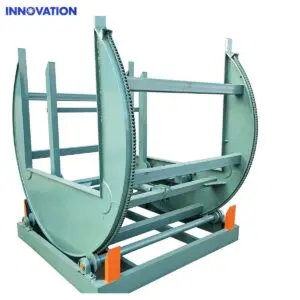
180° Plywood Turnover Machine
Concept: Rotates panels fully to flip them over, allowing double-sided processing.
Applications:
- Flipping panels for sanding on the opposite side
- Reversing panels for inspection
- Adjusting orientation before gluing or pressing
Advantages:
- Fully automatic operation
- Smooth, stable rotation
- Handles large and heavy plywood panels
- Reduces labor and improves safety
Specifications Table:
| Feature | 180° Turnover Machine |
|---|---|
| Panel Size | Up to 4 × 8 ft (1220 × 2440 mm) |
| Load Capacity | 1–3 tons |
| Rotation Angle | 180° |
| Drive System | Hydraulic or Motor-driven |
| Control System | Push button or PLC automatic |
| Rotation Speed | 10–30 seconds per flip |
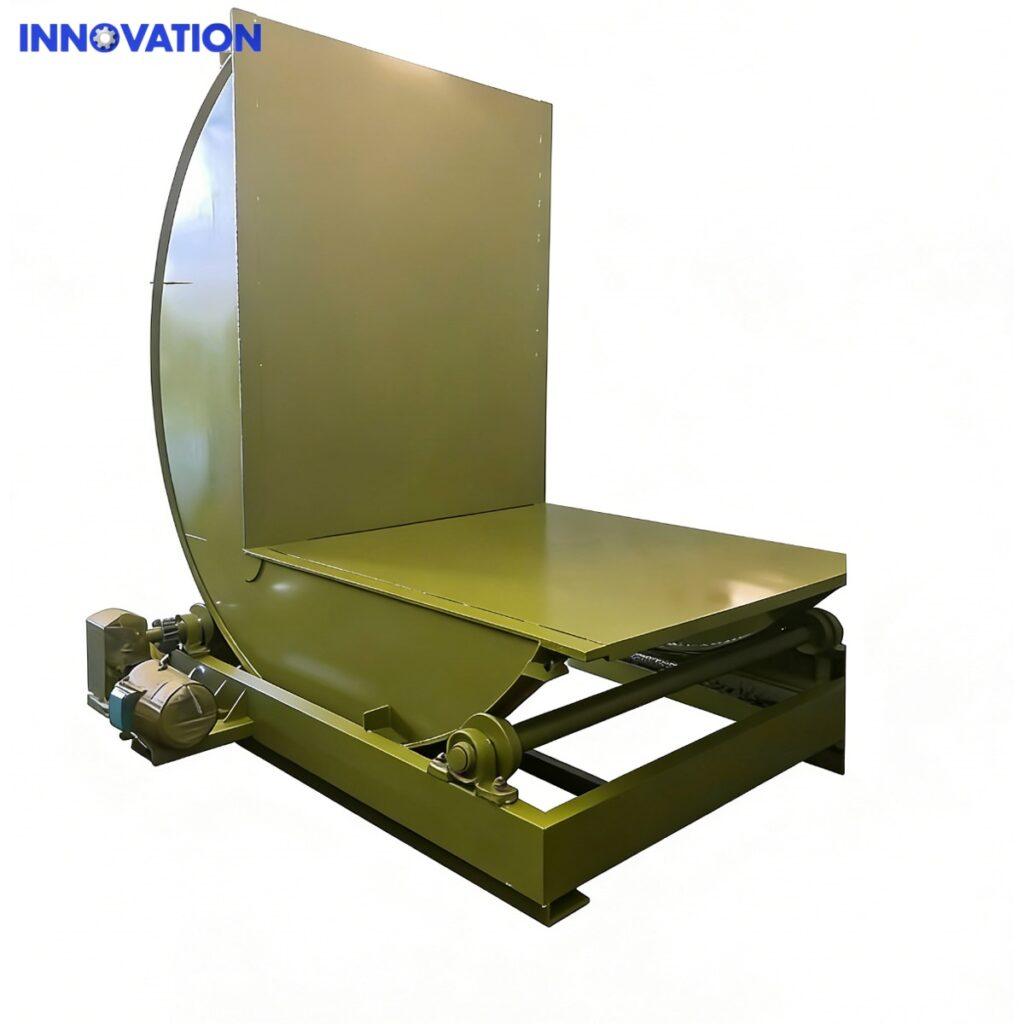
90° Plywood Turnover Machine
Concept: Rotates panels 90° to change orientation for stacking or process transfer.
Applications:
- Vertical stacking for storage
- Transfer between conveyor systems
- Orientation adjustment before trimming or packaging
Advantages:
- Compact and space-saving design
- Efficient panel rotation
- Reliable and easy to integrate with automated lines
Specifications Table:
| Feature | 90° Turnover Machine |
|---|---|
| Panel Size | 1220 × 2440 mm or customized |
| Load Capacity | 1–2 tons |
| Rotation Angle | 90° |
| Drive System | Hydraulic rotation system |
| Control Mode | Manual or PLC automatic |
| Cycle Time | 8–15 seconds per rotation |
Technical Parameters, Customization, and Automation Integration
Customization Options for Modern Factories
Modern production lines require Plywood Turnover Machines tailored to:
- Panel size variations
- Load capacities according to production volume
- Adjustable rotation speed for synchronized workflow
Custom Technical Parameters Example:
| Parameter | Standard | Optional Customization |
|---|---|---|
| Panel Size | 1220 × 2440 mm | 1250 × 2500 mm, or fully custom |
| Maximum Load | 1–3 tons | 4 tons for heavy industrial panels |
| Rotation Angle | 90° / 180° | Variable intermediate angles |
| Power Supply | 380V / 50Hz | 220V or 415V multi-phase |
| Control Mode | Push button | PLC automation, touch screen, IoT integration |
Safety Features and Standards Compliance
Safety is critical in industrial plywood production. Turnover machines comply with ISO 12100 (safety of machinery) and CE regulations. Key features include:
- Emergency stop buttons for immediate halt
- Safety limit switches to prevent over-rotation
- Guard rails and protective covers
- Stable frame structures to prevent tipping
These features ensure operators are protected while maintaining high production efficiency.
Real-World Applications and Case Studies
Case Study 1: Shandong Plywood Factory
Implementation: Integrated 180° turnover machines in double-sided sanding lines.
Results:
- 35% faster production cycles
- Labor reduction of 2 operators per shift
- Panel rework decreased by 20% due to precise flipping
Case Study 2: MDF Production Facility
Implementation: 90° turnover machines used for orientation adjustment between pressing and trimming lines.
Results:
- Smooth conveyor integration
- Reduced manual handling
- Enhanced stack alignment for automated packaging
Comparative Analysis: Manual Handling vs. Turnover Machines
| Factor | Manual Handling | Plywood Turnover Machine |
|---|---|---|
| Labor Requirement | High | Low |
| Production Speed | Medium | High |
| Safety | Medium | High |
| Initial Investment | Low | Medium-High |
| ROI | Slow | Fast |
| Error Rate | 15–20% | <5% |
Maintenance and Durability Best Practices
- Lubricate rotation mechanisms regularly
- Inspect hydraulic systems every 500 operational hours
- Check load-bearing and alignment components periodically
- Clean safety guards and replace worn parts promptly
Proper maintenance prolongs machine life and ensures uninterrupted production.
Trends in Plywood Turnover Technology
- AI-assisted panel alignment: Sensors detect misalignment in real-time
- Energy-efficient hydraulics: Reduces power consumption by up to 20%
- IoT integration: Remote monitoring of machine performance and predictive maintenance
- Multi-line automation: Machines can serve several production lines simultaneously
FAQ
Q1: How do I select the right load capacity?
A1: Evaluate the weight of the heaviest panels in your line. Standard machines support 1–3 tons, with custom options for heavier boards.
Q2: Can these machines integrate with existing production lines?
A2: Yes, most machines are designed for smooth integration with both manual and automated systems.
Q3: Which machine should I choose, 90° or 180°?
A3: 180° for full panel flipping and double-sided work; 90° for orientation adjustments and vertical stacking.
Q4: Are these machines safe for operators?
A4: Yes, equipped with emergency stops, limit switches, and protective guards, significantly reducing manual handling risks.
Q5: How much maintenance is required?
A5: Routine inspection, lubrication, and part replacement every 500–1000 operational hours.
Industry Standards and References
- ISO 12100: Safety of machinery – General principles
- CE compliance directives: Machinery Directive 2006/42/EC
- Case studies: Shandong Chuangxin Automation Equipment Co., Ltd., 2023 production line report
- Whitepaper: “Optimizing Plywood Production Efficiency with Automation,” Wood Industry Research, 2022
Conclusion
Plywood Turnover Machines are no longer optional—they are essential for modern plywood factories aiming for efficiency, precision, and safety. By selecting the right type (90° or 180°) and integrating machines with automated production lines, manufacturers can achieve higher throughput, reduced labor costs, and consistent product quality. Investing in durable, customizable turnover machines ensures a rapid ROI and keeps factories competitive in an evolving market.
 English
  Vietnamese
  Arabic