
News
Cold Press Laminate Machine Guide for Modern Panel Manufacturing
Welcome to My Blog!
I’m so glad you’re here. Before we dive into the content, I’d love to connect with you beyond this page. On my social media, I regularly share industry insights, product updates, and behind-the-scenes moments — plus, it’s a great place for us to interact!
Follow us on Facebook: Shandong Chuangxin Automation Equipment Co., Ltd
Let’s grow together and stay connected. Now, let’s jump into the blog — I hope you find the content informative, engaging, and truly valuable.
Table of Contents
Key Highlights of Cold Press Laminate Machine Guide
- Cold pressing stabilizes veneer bonding before hot pressing in plywood production
- Hydraulic pressure system ensures uniform force distribution and flat panel quality
- No heating process significantly reduces energy consumption and operating cost
- Essential pre-press equipment in furniture, plywood, and door panel manufacturing
- Helps reduce defects such as bubbling, delamination, and surface warping
- Industry data shows up to 20–30% improvement in final product yield rate
- Supports continuous production in high-volume woodworking factories
- Aligns with modern ISO-based manufacturing quality standards
Introduction
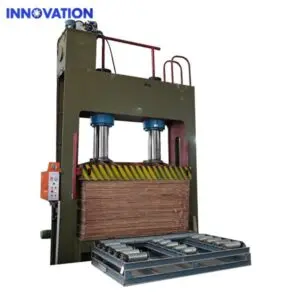
In advanced woodworking and plywood manufacturing, product quality is no longer determined only at the hot pressing stage. Instead, the pre-pressing phase plays a critical role in stabilizing the structure before final curing.
A cold press laminate machine applies controlled hydraulic pressure to glued veneer stacks, ensuring proper alignment, air removal, and adhesive stabilization. According to industrial wood processing white papers, over 60% of panel defects originate before hot pressing, mainly due to uneven stacking or insufficient pre-press stabilization.
By introducing controlled pressure early in the process, manufacturers achieve:
- Higher dimensional stability
- Reduced material waste
- Improved adhesive efficiency
- Better surface flatness consistency
This makes cold pressing a foundational step in modern panel production systems.
Industrial Definition of Cold Press Laminate Machine
Structural Engineering Concept
A cold press laminate machine is a hydraulic press system designed to apply uniform pressure across multi-layer veneer stacks.
Its structure typically includes a heavy welded frame, hydraulic cylinders, and a precision-controlled platen system.
Pre-Bond Stabilization Function
Before hot pressing, the machine stabilizes glued veneer layers.
This prevents slippage, air pockets, and misalignment during thermal curing.
Energy-Efficient Mechanical Principle
Unlike hot presses, cold press systems operate without heating elements.
This reduces energy consumption by up to 40% in comparison to thermal press systems.
Global Industry Standards and Manufacturing Compliance
ISO and Industrial Benchmarks
Cold press laminate machine systems are commonly designed in alignment with:
- ISO 19085 (Woodworking machinery safety standards)
- EN 12750 (Safety requirements for woodworking machines)
- CE machinery directive compliance for European exports
These standards ensure safe operation, pressure stability, and operator protection.
Pressure Consistency Standard (Industrial Reference)
Most industrial systems operate within:
- Low pressure: 1–2 MPa (light panels)
- Medium pressure: 2–4 MPa (standard plywood)
- High pressure: 4–5 MPa (industrial-grade boards)
Pressure uniformity deviation is typically controlled within ±5% for high-end systems.
Engineering Structure of Cold Press Laminate Machine
Heavy-Duty Frame System Concept
The machine frame is constructed using welded steel beams with thickness ranging from 20–40 mm.
This ensures structural integrity under continuous high-pressure cycles.
Multi-Beam Load Distribution System
Typical design includes:
- Upper beam: pressure distribution
- Middle beam: structural reinforcement
- Lower beam: base stabilization
This tri-layer structure ensures even force transmission.
Hydraulic Cylinder System Engineering
Cylinder Function
Hydraulic cylinders generate vertical force to compress veneer stacks.
Technical Structure
- Cylinder diameter: up to 320 mm
- Stroke length: up to 900 mm
- Material: quenched alloy steel
Performance Advantage
Uniform force distribution reduces internal stress variation across panels.
Cold Press Laminate Machine Working Process (Industrial Flow Model)
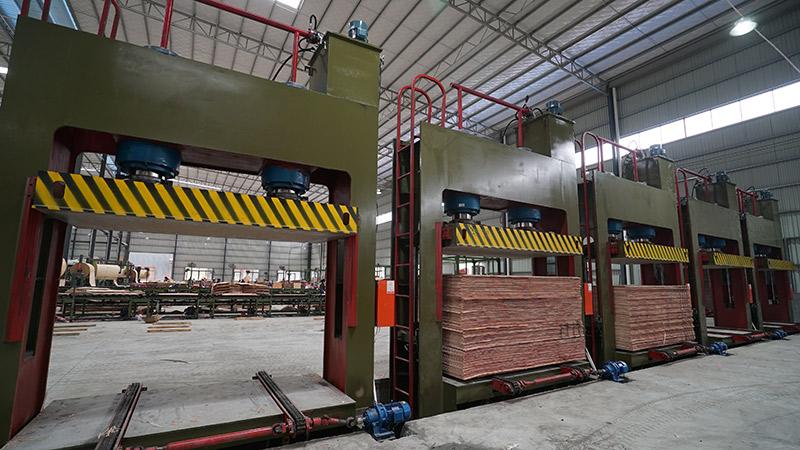
Step 1: Adhesive Application Control
Glue is applied using roller or spreader systems.
Industry standard glue thickness: 0.15–0.30 mm.
Step 2: Veneer Layer Assembly Precision
Veneers are stacked in strict alignment systems.
Misalignment tolerance is typically ≤1.5 mm in industrial production.
Step 3: Hydraulic Pre-Press Activation
Hydraulic pressure is applied gradually to avoid shock deformation.
Typical press cycle: 3–10 minutes depending on material density.
Step 4: Air Removal and Stabilization Phase
Pressure forces trapped air out of adhesive layers.
This improves bonding integrity by up to 25%.
Step 5: Transfer to Hot Press Stage
After stabilization, panels are transferred for final curing.
This ensures structural lock-in and permanent adhesion.
Technical Specification Benchmark (Industrial Grade Model)
| Component | Specification Range |
|---|---|
| Total Pressure | 200T – 600T |
| Frame Thickness | 20–40 mm steel plate |
| Daylight Opening | 1200–2000 mm |
| Hydraulic Pressure | Up to 26 MPa |
| Motor Power | 5.5–15 kW |
| Cylinder Diameter | 320 mm typical |
| Control System | PLC automatic control |
Cold Press Laminate Machine vs Hot Press System (Deep Comparison)
Energy Consumption Difference
Cold press systems consume only electrical motor power.
Hot press systems require continuous thermal energy input.
Production Role Difference
Cold press = structural stabilization stage
Hot press = final curing and bonding stage
Both systems are complementary rather than competitive.
Quality Impact Comparison
Cold pressing reduces:
- Bubble defects
- Layer shifting
- Glue starvation zones
Hot pressing finalizes mechanical strength.
Cost Efficiency Analysis
Industry studies show:
- 15–25% reduction in rework rate
- 10–20% reduction in material waste
- 30% improvement in batch consistency
Real-World Industrial Case Study (Factory Optimization Report)
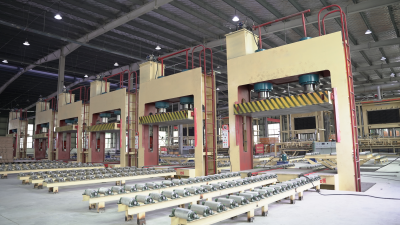
Case Background
A plywood manufacturing plant in Southeast Asia upgraded its production line with a 400T cold press system.
Operational Improvements After 6 Months
- Defect rate reduced from 8.5% → 4.2%
- Production throughput increased by 22%
- Energy consumption reduced by 18%
- Labor efficiency improved by 30%
Key Engineering Insight
The introduction of uniform hydraulic pre-pressing significantly improved veneer stability before thermal curing.
Industry News and White Paper Insights
Global Manufacturing Trend Report
Recent woodworking industry reports highlight:
- Increasing demand for automated pre-press systems
- Shift toward energy-efficient production lines
- Growth of medium-pressure hydraulic pressing equipment
Sustainability White Paper Insight
Sustainable manufacturing guidelines emphasize:
- Reduced energy consumption in non-thermal processes
- Increased material utilization efficiency
- Lower carbon footprint in plywood production
Cold press systems directly align with these objectives.
Cold Press Laminate Machine Application Scenarios
Furniture Manufacturing Industry
Used for laminated boards in cabinets, tables, and structural furniture.
Improves surface flatness and dimensional stability.
Interior Door Panel Production
Ensures multi-layer door cores remain stable during curing.
Reduces warping in long-term usage.
Plywood Industrial Production Lines
Acts as the critical pre-press system before hot pressing.
Improves overall production yield rate.
Concept Engineering Comparison Models
Manual Press vs Hydraulic Press
Manual systems depend on operator force consistency.
Hydraulic systems ensure controlled pressure accuracy.
Single-Layer vs Multi-Layer Pressing Systems
Single-layer systems are suitable for small-scale production.
Multi-layer systems improve industrial output efficiency.
Fixed Pressure vs Intelligent Pressure Control
Fixed systems are simpler but less flexible.
Intelligent systems adjust pressure dynamically based on material type.
Maintenance and Operational Optimization Guide
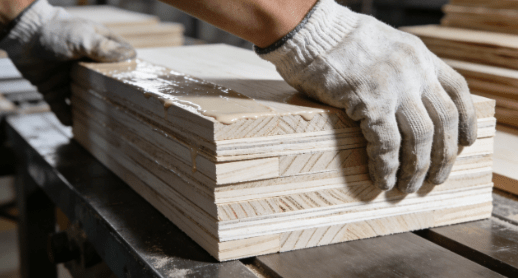
Hydraulic System Maintenance Concept
Regular inspection ensures stable pressure output.
Oil contamination control improves system lifespan.
Frame Stress Management Concept
Periodic stress testing prevents structural fatigue.
This extends equipment lifecycle significantly.
Production Efficiency Optimization
Proper cycle timing improves throughput efficiency.
Balanced pressure application reduces material waste.
ROI Analysis of Cold Press Laminate Machine
Investment Recovery Factors
- Reduced material waste
- Lower energy consumption
- Improved production yield
- Reduced defect rework cost
Typical ROI Timeline
Most industrial users report return on investment within:
- 12–24 months depending on production scale
FAQ
What is a cold press laminate machine used for?
It is used to stabilize glued veneer layers before hot pressing in plywood and panel manufacturing.
Is cold pressing necessary in modern plywood production?
Yes, it significantly improves bonding stability and reduces production defects.
What is the typical pressure range?
Most systems operate between 1–5 MPa depending on material type.
Does it use heat during operation?
No, it relies entirely on hydraulic pressure without thermal energy.
What industries rely on this machine?
Furniture manufacturing, plywood production, and door panel industries.
Conclusion
The cold press laminate machine is a fundamental component in modern wood panel manufacturing systems. Its ability to stabilize veneer structures before hot pressing significantly improves product quality, reduces defects, and enhances production efficiency.
With increasing global demand for high-quality engineered wood products, cold pressing technology is becoming a standard requirement rather than an optional process.
For manufacturers seeking long-term competitiveness, investing in a reliable cold press system represents a strategic upgrade in production capability, quality control, and operational efficiency.
 English
  Vietnamese
  Arabic