
News
Why Your Production Line Needs a Short Cycle Press
Welcome to My Blog!
I’m so glad you’re here. Before we dive into the content, I’d love to connect with you beyond this page. On my social media, I regularly share industry insights, product updates, and behind-the-scenes moments — plus, it’s a great place for us to interact!
Follow us on Facebook: Shandong Chuangxin Automation Equipment Co., Ltd
Let’s grow together and stay connected. Now, let’s jump into the blog — I hope you find the content informative, engaging, and truly valuable.
Table of Contents
Key Takeaways for This Article
- Understanding the short cycle press and its industrial significance
- How short cycle presses improve production efficiency and quality
- Detailed workflow and essential components of a short cycle press
- Benefits, maintenance, and operational best practices
- Industry standards, certifications, and technical benchmarks
- Comparative analysis with standard presses and alternative technologies
- Case studies, practical applications, and ROI considerations
- FAQ for common questions about short cycle presses
Introduction
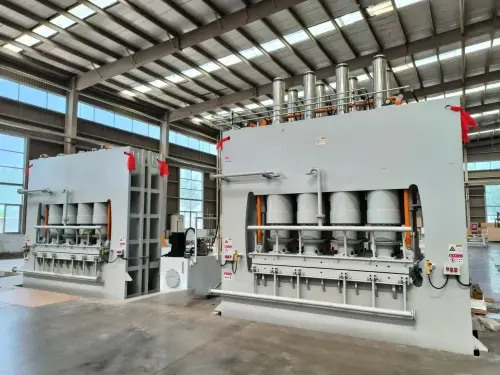
In today’s highly competitive manufacturing environment, efficiency and quality are no longer optional—they are critical for survival. Whether producing furniture panels, decorative boards, or laminated components, manufacturers face increasing demands for faster cycle times, consistent surface quality, and reduced labor costs.
The short cycle press has emerged as a game-changing solution. By integrating rapid heating, precise hydraulic control, and automation, these presses allow factories to dramatically increase throughput while maintaining exceptional product consistency. According to a 2023 industry whitepaper from the International Woodworking Machinery Association (IWMA), factories using short cycle lamination presses reported an average production increase of 35–50% with a simultaneous reduction in labor hours by 20–30%.
In this article, we explore the full potential of short cycle presses, including technical standards, workflow analysis, real-world case studies, and actionable guidance for manufacturers considering adoption.
What is a Short Cycle Press?
Definition of Short Cycle Press
A short cycle press is a high-efficiency hot press designed to laminate decorative or functional layers onto substrates such as MDF, particleboard, or plywood. Its distinguishing feature is a rapid pressing cycle, typically between 8–30 seconds, which is significantly faster than conventional hot presses.
Core Concept and Working Principle
- Rapid Heating: Advanced ceramic or aluminum plates ensure fast heat transfer.
- Precision Pressure: Hydraulic systems deliver uniform pressure across the panel surface, preventing warping or bubbles.
- Automation Integration: PLC-controlled systems synchronize loading, pressing, and unloading for consistent quality and reduced manual intervention.
Industrial Significance of Short Cycle Press
High-Volume Production Capability
Short cycle presses are ideal for mass production lines, where reducing pressing time directly translates into higher output. For example, a mid-size furniture panel factory in Germany reported that switching from standard presses (180–300 seconds per cycle) to short cycle presses reduced production time by 65%, allowing them to fulfill larger orders with the same workforce.
Meeting Quality Standards
Short cycle presses help manufacturers comply with international quality benchmarks such as:
- EN 312 – Particleboards and MDF specifications for surface durability
- ANSI A208.1 – Particleboard performance and bonding standards
- ISO 9001:2015 – Quality management compliance
Environmental and Sustainability Benefits
- Reduced energy consumption per panel due to shorter heating cycles
- Lower scrap rates as uniform adhesion reduces defective products
- Supports green manufacturing initiatives in line with ISO 14001:2015
Essential Components of a Short Cycle Press
Loading System
Automatic feeders reduce manual handling and ensure precise alignment of raw boards. Key specifications:
- Load capacity: 50–200 kg per panel
- Feed rate: up to 100 panels/hour for standard 18mm MDF
Hot Press Plates & Hydraulic System
- Temperature range: 150–220°C
- Pressure: 50–100 kg/cm² adjustable via PLC
- Plate material: high-strength steel or aluminum alloy for rapid heat transfer
PLC Control & Touchscreen Interface
- Full automation with touchscreen control for cycle time, temperature, and pressure
- Real-time monitoring for fault detection
- Data logging for production reports
Unloading & Stacking System
- Automatic panel removal and stacking reduces labor
- Supports integration with downstream trimming or inspection systems
Short Cycle Press Workflow: Step-by-Step
| Step | Description | Typical Cycle Time (Seconds) |
|---|---|---|
| Raw Board Feeding | Automated loading of MDF, particleboard, or plywood | 2–3 |
| Decorative Paper Alignment | Align melamine or vinyl paper | 1–2 |
| Layer Positioning | Ensure precise placement | 1 |
| Press Loading | Transfer material into press | 1 |
| Heating & Pressing | Apply hydraulic pressure and heat | 8–20 |
| Cooling Phase | Slight cooling inside press | 2–3 |
| Unloading | Automatic removal from press | 1–2 |
| Stacking / Inspection | Prepare for packaging or next processing step | 2 |
Advantages of a Short Cycle Press
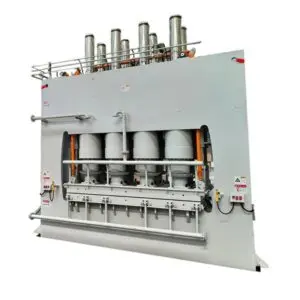
Enhanced Efficiency
- Cycle time reduction of up to 80% compared to traditional presses
- Enables higher output without increasing factory footprint
Consistent Product Quality
- Uniform heat and pressure prevent common defects such as delamination or surface bubbles
- Suitable for premium panel production
Labor Optimization
- Automated feeding, pressing, and stacking reduces operator dependence
- Lowers training requirements and operational errors
Flexible Production Line Integration
- Short cycle presses can be customized to match specific line layouts
- Supports mixed panel sizes and materials
Short Cycle Press vs Standard Press: Comparative Analysis
| Feature | Short Cycle Press | Standard Press |
|---|---|---|
| Cycle Time | 8–30 seconds | 180–300 seconds |
| Output | 2–3x higher | Standard |
| Automation | Full PLC integration | Partial / Manual |
| Energy Efficiency | High (shorter heat duration) | Lower (longer cycles) |
| Quality Consistency | Uniform adhesion | Moderate (manual variations possible) |
Observation: For factories with high-volume production and strict quality requirements, short cycle presses provide measurable ROI within the first 12–18 months.
Real-World Case Studies
Case Study – European Furniture Manufacturer
- Implemented 3 short cycle lamination presses on a 50,000 m² factory floor
- Output increased by 45% within 6 months
- Reduced scrap panels by 25%
Case Study – Chinese Decorative Board Producer
- Upgraded from manual hot presses to PLC-controlled short cycle presses
- Labor reduced from 15 operators per line to 7
- Energy savings estimated at 18% per month
Industry Trends and Innovations
- AI-Assisted Pressing: Predictive algorithms adjust pressure and temperature dynamically
- IoT Integration: Real-time monitoring and remote diagnostics
- Sustainable Materials: Compatibility with recycled MDF and eco-friendly melamine sheets
White Paper Reference: “Advances in Short Cycle Press Technology for High-Volume Panel Production”, IWMA, 2023. Key findings: automation reduces human error by 35%, and ROI for medium-scale factories averages 14–18 months.
Maintenance and Best Practices
Hydraulic System Monitoring
- Check oil levels and pressure monthly
- Replace seals and hoses according to manufacturer schedule
Plate Cleaning and Maintenance
- Remove adhesive residues daily
- Inspect plates for wear and cracks
PLC and Sensor Calibration
- Update software and firmware quarterly
- Verify temperature and pressure sensors to maintain cycle accuracy
Conclusion
For modern manufacturing facilities focused on efficiency, quality, and sustainability, a short cycle press is no longer optional—it is essential. By combining rapid cycle times, automated operations, and precise hydraulic control, factories can achieve higher throughput, consistent product quality, and measurable cost savings. From small decorative board producers to large-scale furniture manufacturers, the adoption of short cycle press technology represents a strategic investment for competitive advantage.
FAQ
What materials are compatible with short cycle presses?
MDF, particleboard, plywood, and coated decorative sheets such as melamine and vinyl.
How does cycle time impact energy consumption?
Shorter cycles reduce heat duration, lowering electricity consumption by 15–25% per 1000 panels.
Are short cycle presses suitable for small factories?
Yes, modular designs allow smaller-scale integration with customizable line configurations.
How do I calculate ROI for installing a short cycle press?
Consider factors such as output increase, labor reduction, energy savings, and decreased scrap rates. For example, a 20% output boost and 30% labor saving often cover machine costs in under two years.
 English
  Vietnamese
  Arabic