
News
High Efficiency Short Cycle Hot Press Line for Mass Production Systems
Table of Contents
Introduction

In modern industrial manufacturing, production efficiency, consistency, and automation capability are key factors that determine competitiveness. As demand for decorative panels, laminated boards, and engineered wood products continues to rise, manufacturers are increasingly adopting advanced pressing systems to meet large-scale production requirements.
Among these technologies, the short cycle hot press line stands out as one of the most efficient solutions for mass production systems. It integrates heat, pressure, and automated material handling into a continuous workflow designed to maximize output while maintaining stable product quality.
Industrial production analysis shows that automated hot press systems can significantly reduce cycle time, improve surface consistency, and lower defect rates compared to traditional pressing methods.
This article explores how a high efficiency short cycle hot press line works, its core components, industrial applications, and why it is essential for modern mass production systems.
What Is a Short Cycle Hot Press Line?
A short cycle hot press line is an automated production system used for laminating decorative surfaces onto wood-based panels such as MDF, HDF, particle board, and plywood.
The system applies controlled heat and hydraulic pressure in a short pressing cycle to bond decorative materials such as melamine paper or laminate films onto panel substrates.
Unlike traditional press systems, short cycle hot press lines are designed for:
- High-speed continuous production
- Automated workflow integration
- Stable surface quality control
- Large-scale industrial output
These systems are widely used in furniture manufacturing, decorative panel production, and engineered wood processing industries.
How a Short Cycle Hot Press Line Works
The working process of a short cycle hot press line is based on automation and synchronized production stages.
First, raw panels are loaded into the production line using automated feeding systems. Decorative materials such as resin-impregnated paper are positioned on the panel surface.
Next, the panels enter the hot pressing section. The hydraulic system applies uniform pressure while heated platens activate the adhesive layer, creating a strong and stable bond between the surface material and the substrate.
After pressing, the finished panels are automatically transferred to cooling and stacking systems.
Because the entire process is highly automated, the production line can operate continuously with minimal manual intervention, significantly improving output efficiency.
Core Components of a Short Cycle Hot Press Line
A high-efficiency short cycle hot press line consists of several integrated systems that work together to ensure stable performance.
Hydraulic Press System
This system provides the necessary pressure for lamination. Stable hydraulic force ensures consistent bonding quality across all panels.
Heating System
Heated platens ensure even temperature distribution, which is essential for adhesive activation and surface quality consistency.
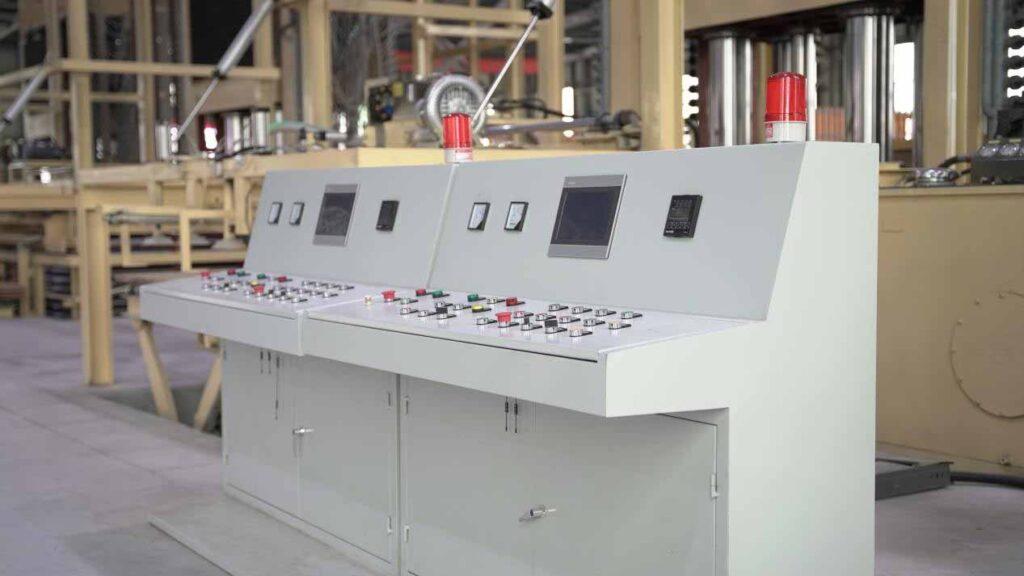
Automation Control System
Modern systems use PLC or CNC-based controllers to manage temperature, pressure, and cycle timing with high precision.
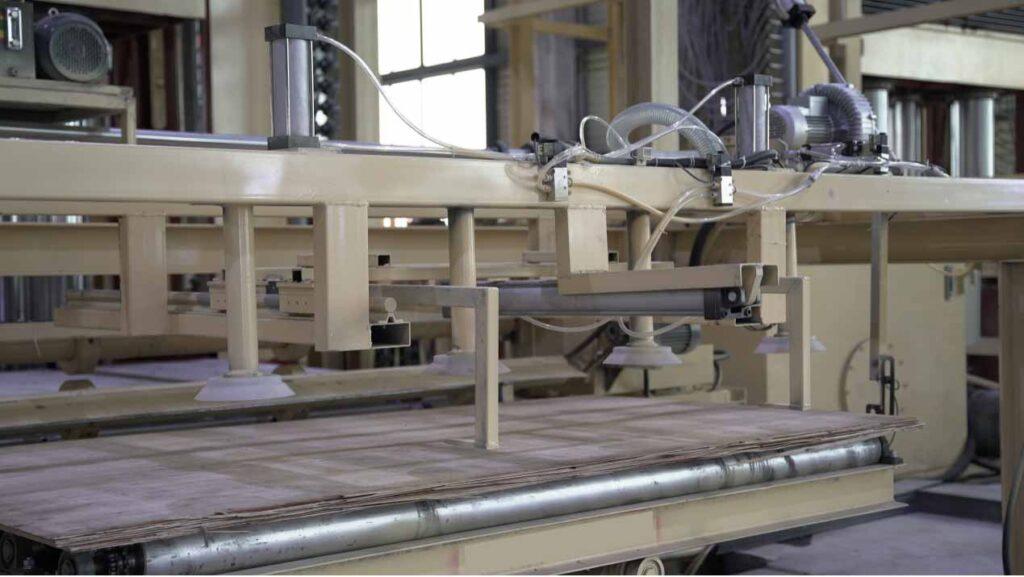
Conveyor and Transfer System
Automated conveyors ensure continuous material flow between different production stages, reducing downtime.
Loading and Unloading Units
These systems reduce manual labor and improve production speed by automating panel handling processes.
How Short Cycle Hot Press Lines Improve Mass Production Efficiency
Faster Production Cycles
Short pressing times allow manufacturers to produce a higher number of panels in a shorter time frame, significantly increasing output capacity.
Continuous Automated Workflow
Automation enables uninterrupted production flow, reducing delays caused by manual handling or material repositioning.
Reduced Labor Dependency
Operators primarily monitor the system rather than perform repetitive manual tasks, lowering labor costs.
Improved Product Consistency
Stable pressure and temperature control ensure uniform surface quality and reduce product defects.
Lower Production Waste
Precise process control reduces adhesive waste, material rejection, and rework requirements.
Comparison Table: Short Cycle Hot Press Line vs Traditional Systems
| Feature | Short Cycle Hot Press Line | Traditional Press System |
|---|---|---|
| Production Speed | High | Moderate |
| Automation Level | High | Low to Medium |
| Labor Requirement | Low | High |
| Surface Quality Consistency | Excellent | Variable |
| Production Capacity | Suitable for mass production | Limited scalability |
| Energy Efficiency | Optimized | Higher consumption |
| Workflow Continuity | Fully continuous | Intermittent |
This comparison clearly shows why modern manufacturers prefer short cycle hot press lines for large-scale production environments.
Industrial Applications
Short cycle hot press lines are widely used in industries requiring high-volume panel production.
Furniture Manufacturing
Used for producing decorative cabinet boards, tabletops, and interior furniture panels with consistent surface quality.
Decorative Panel Production
Ideal for melamine boards and laminated decorative panels used in interior design applications.
Engineered Wood Industry
Improves efficiency in MDF, HDF, and plywood surface processing.
Flooring Manufacturing
Used for producing laminated flooring panels with high durability and wear resistance.
Key Factors Affecting Production Efficiency
Several technical and operational factors influence system performance:
Temperature Stability
Uneven heating can lead to bonding defects and inconsistent surface finish.
Pressure Accuracy
Stable hydraulic pressure ensures uniform adhesion across the entire panel surface.
Cycle Time Optimization
Incorrect timing can reduce production efficiency or affect bonding quality.
Material Quality
Panel flatness, moisture content, and surface preparation directly impact final results.
Maintenance Level
Regular maintenance ensures stable performance and reduces downtime risks.
Common Production Issues and Solutions
Surface Bubbles
Often caused by moisture imbalance or uneven pressure distribution.
Weak Bonding
May result from insufficient temperature or incorrect pressing time.
Surface Defects
Can occur due to worn platens or poor material preparation.
Hydraulic Instability
Usually linked to system wear or lack of proper maintenance.
Preventive maintenance and process optimization are essential for avoiding these issues.
Maintenance Best Practices
To ensure long-term efficiency, manufacturers should follow structured maintenance routines:
- Regular hydraulic system inspection
- Cleaning of heating platens
- Calibration of temperature and pressure systems
- Lubrication of mechanical components
- Monitoring of automation system performance
Proper maintenance significantly improves machine lifespan and production stability.
Future Development Trends
Short cycle hot press line technology continues to evolve toward intelligent and fully automated systems.
Smart Monitoring Systems
Real-time data tracking improves production control and predictive maintenance.
Energy-Efficient Heating
Advanced heating technologies reduce energy consumption while maintaining performance.
Fully Automated Production Lines
Integration with robotic loading and stacking systems enhances efficiency.
Industry 4.0 Integration
Data-driven manufacturing enables better production planning and optimization.
Conclusion
A high efficiency short cycle hot press line is a critical solution for modern mass production systems in the panel manufacturing industry. By combining automation, precise pressure control, and rapid cycle processing, it significantly improves production output while maintaining consistent quality.
Its advantages in speed, stability, and scalability make it an essential investment for manufacturers aiming to enhance productivity and reduce operational costs in competitive industrial environments.
FAQ
What is a short cycle hot press line used for?
A short cycle hot press line is used for high-speed lamination of decorative surfaces onto MDF, HDF, plywood, and particle boards. It enables efficient mass production with stable bonding quality and automated workflow integration.
How does a short cycle hot press line work?
It works by applying controlled heat and hydraulic pressure in a short cycle to bond decorative materials onto panels. The process is fully or semi-automated, ensuring continuous production and consistent surface quality.
What are the advantages of a short cycle hot press line?
It offers high production speed, reduced labor costs, stable surface quality, lower defect rates, and improved energy efficiency. It is ideal for large-scale industrial panel manufacturing operations.
What materials can be processed in a short cycle hot press line?
It is commonly used for MDF, HDF, particle board, plywood, melamine paper, and decorative laminates in furniture, flooring, and interior decoration industries.
How to maintain a short cycle hot press line?
Regular maintenance includes checking hydraulic systems, cleaning heating platens, calibrating temperature and pressure controls, and inspecting automation components to ensure long-term stable performance.
Need Help Choosing the Right Short Cycle Hot Press Line?
If you’re unsure which short cycle hot press line is best for your production capacity, panel materials, or automation requirements, our experts are here to help. Contact us today for a personalized consultation and get a tailored solution that improves production efficiency, surface quality, and long-term operational stability. Don’t wait until production bottlenecks affect your output—get in touch now to optimize your manufacturing system and strengthen your competitive advantage!
 English
  Vietnamese
  Arabic