
News
Why Every Workshop Needs a Plywood Putty Spreader Machine
Welcome to My Blog!
I’m so glad you’re here. Before we dive into the content, I’d love to connect with you beyond this page. On my social media, I regularly share industry insights, product updates, and behind-the-scenes moments — plus, it’s a great place for us to interact!
Follow us on Facebook: Shandong Chuangxin Automation Equipment Co., Ltd
Let’s grow together and stay connected. Now, let’s jump into the blog — I hope you find the content informative, engaging, and truly valuable.
Table of Contents
Introduction
In modern plywood manufacturing, competition is no longer defined only by raw material quality or pressing technology. The real differentiator is surface finishing consistency. Whether a factory produces furniture-grade plywood, construction panels, or decorative boards, even minor surface defects can lead to rejection, price reduction, or rework.
Industry reports from woodworking equipment surveys in Asia and Europe consistently show that surface finishing accounts for up to 18%–25% of total labor cost in plywood production lines. More importantly, inconsistent putty application is one of the top three causes of surface rejection in downstream lamination processes.
This is where the Plywood Putty Spreader Machine becomes a strategic production asset rather than just auxiliary equipment. It is designed to standardize surface filling, reduce dependency on manual labor, and ensure stable output quality across large-scale production environments.
Industrial Role of Surface Filling in Plywood Manufacturing
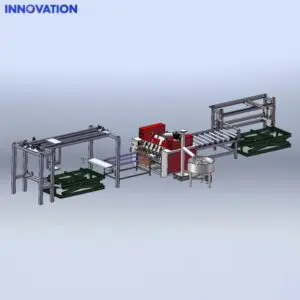
Surface Defect Compensation in Modern Panels
Plywood sheets naturally contain micro-voids, resin gaps, and veneer irregularities. Without proper filling, these defects become visible after sanding or coating.
The putty spreading stage is responsible for:
- Filling surface micro-cracks and pores
- Leveling veneer inconsistencies
- Preparing substrate for coating adhesion
- Improving final aesthetic uniformity
A Plywood Putty Spreader Machine ensures these processes are controlled and repeatable rather than operator-dependent.
Quality Standards Driving Automation
Global plywood quality is commonly evaluated under standards such as:
- EN 13986 (European wood-based panels standard)
- ISO 12460 (formaldehyde emission classification)
- CARB Phase II (California Air Resources Board compliance)
- JAS structural plywood grading system (Japan Agricultural Standards)
While these standards primarily define emissions and structural performance, surface quality grading in OEM and furniture markets increasingly depends on coating uniformity, which directly relates to putty application consistency.
Engineering Structure Behind a Plywood Putty Spreader Machine
High-Precision Roller System Design
The core of the machine is its roller assembly. Industrial-grade models typically use:
- Chrome-plated steel rollers
- Diameter range: 150–250 mm
- Hardness tolerance: HRC 55–60
These rollers ensure even distribution of putty under controlled pressure, preventing both over-application and surface starvation.
Intelligent Thickness Control System
Modern systems integrate PLC-based control logic that regulates:
- Feeding speed (10–30 m/min)
- Spreading pressure
- Putty film thickness (0.1–2.0 mm range)
This allows manufacturers to fine-tune output depending on board grade and downstream finishing requirements.
Structural Frame Stability
Industrial machines are built using reinforced welded steel frames designed to minimize vibration. This is critical because even small oscillations can cause uneven coating thickness across wide panels such as 4ft × 8ft sheets.
Process Flow Optimization in Automated Putty Spreading
Continuous Feeding System
Panels are transported via synchronized conveyor belts. Optical or mechanical alignment systems ensure the board enters the machine without deviation.
Surface Detection and Calibration
Advanced models include leveling sensors that detect:
- Board thickness variation
- Edge alignment deviation
- Surface tilt or curvature
This ensures consistent coating pressure across irregular surfaces.
Dual-Surface Processing Capability
High-capacity configurations support simultaneous top and bottom coating. This reduces production cycles by nearly 40% in large-scale operations.
Leveling and Excess Removal
After application, scraper units remove excess material, ensuring:
- Uniform coating thickness
- Reduced sanding workload
- Lower material waste ratio (typically reduced by 12%–18%)
Performance Comparison: Manual vs Automated Systems
| Performance Indicator | Manual Application | Automated Machine |
|---|---|---|
| Labor requirement | High (3–5 workers per line) | Low (1 operator) |
| Output consistency | Operator dependent | Industrial grade uniformity |
| Production speed | 5–10 m/min equivalent | 10–30 m/min continuous |
| Material waste | High variability | Controlled and reduced |
| Defect rate | 6%–12% typical | <3% in optimized lines |
| Scalability | Limited | High-volume industrial scaling |
This comparison shows why many medium and large plywood manufacturers are transitioning toward automation.
Technical Specification Benchmark (Industrial Reference)
Typical industrial-grade configuration:
- Working width: 1220 mm / 2440 mm
- Panel thickness: 3–30 mm
- Power range: 7–15 kW
- Air pressure: 0.6–0.8 MPa
- Machine weight: 2500–4500 kg
- Frame lifetime: 8–12 years under standard maintenance
These parameters align with mid-to-high-end woodworking production standards in Asia and Europe.
Industry Case Study: Production Upgrade in Southeast Asia
A medium-scale plywood factory in Vietnam upgraded from manual putty application to an automated spreading system in 2024.
Before Upgrade:
- 6 workers per shift
- High variation in surface finishing quality
- Rework rate around 9.2%
- Limited output: ~800 panels/day
After Installation of Plywood Putty Spreader Machine:
- Labor reduced to 2 operators
- Rework rate dropped to 2.8%
- Output increased to ~1300 panels/day
- Material waste reduced by approximately 15%
The payback period reported by the factory was approximately 14 months, mainly due to labor savings and reduced rejection rates.
Industry Research and Market Trends
According to woodworking machinery industry reports published between 2023–2025:
- Global plywood production continues to grow at ~4.1% CAGR
- Automation adoption in finishing processes is increasing faster than in pressing or cutting stages
- Surface treatment machinery demand has grown by approximately 18% year-over-year in Asia-Pacific regions
The report highlights that surface finishing automation, including systems like the Plywood Putty Spreader Machine, is becoming a priority investment area for manufacturers targeting export-grade compliance.
Conceptual Breakdown: Why Consistency Matters More Than Speed
Surface Uniformity as a Value Driver
Consistent surface finishing directly affects:
- Paint adhesion quality
- Lamination bonding strength
- Customer rejection rates
- Final product pricing tiers
Even minor inconsistencies can downgrade panels from furniture grade to construction grade.
Automation vs Operator Skill Dependency
Manual processes rely heavily on operator experience. Automated systems remove variability by enforcing:
- Fixed pressure parameters
- Standardized speed settings
- Controlled material flow
This reduces production risk significantly.
Maintenance Strategy for Long-Term Stability
Daily Maintenance Practices
- Cleaning roller surfaces after each shift
- Checking scraper alignment
- Inspecting putty flow channels
Weekly Maintenance Tasks
- Lubrication of transmission components
- PLC system calibration check
- Conveyor belt tension adjustment
Annual Overhaul Recommendations
- Roller resurfacing if wear exceeds tolerance
- Electrical system inspection
- Bearing replacement cycles
Proper maintenance can extend machine life beyond 10 years in industrial environments.
Common Operational Challenges and Solutions
Uneven Putty Distribution
Usually caused by roller wear or improper pressure calibration. Solution: recalibrate pressure system and inspect roller surface integrity.
Material Clogging
Occurs when putty viscosity is too high. Solution: adjust formulation or heating system if available.
Conveyor Misalignment
Can lead to edge defects. Solution: realign feeding guide rails and recalibrate sensors.
ROI Analysis for Manufacturing Investment
A simplified return model for a medium production line:
- Equipment investment: baseline industrial cost range
- Labor savings: 40%–60% reduction
- Material savings: 10%–18% reduction
- Defect reduction: up to 70% improvement
Average ROI cycle: 12–24 months depending on production volume.
Conclusion
The shift toward automation in woodworking is not optional anymore—it is a structural industry transformation. The Plywood Putty Spreader Machine plays a critical role in bridging production efficiency and surface quality requirements.
Factories that adopt this technology gain measurable advantages in cost control, product consistency, and scalability. As global demand for high-grade plywood continues to rise, surface finishing automation will remain one of the most important competitive factors in the industry.
In this context, investing in advanced finishing systems is not just an equipment upgrade—it is a long-term manufacturing strategy.
FAQ
Is this machine suitable for small workshops?
Yes, compact models are available, but ROI is higher in medium to large-scale production environments.
Can it handle different types of putty materials?
Most industrial machines support standard wood putty, resin-based fillers, and modified polymer compounds.
What is the typical lifespan of the machine?
With proper maintenance, 8–12 years is common in continuous production environments.
Does it require highly skilled operators?
No. Basic PLC training is sufficient for daily operation.
How does it improve final plywood quality?
It ensures uniform surface leveling, reduces sanding defects, and improves coating adhesion consistency.
 English
  Vietnamese
  Arabic