
News
High Speed Disperser Mixer for Plywood: Key to Consistent Plywood Quality
Welcome to My Blog!
I’m so glad you’re here. Before we dive into the content, I’d love to connect with you beyond this page. On my social media, I regularly share industry insights, product updates, and behind-the-scenes moments — plus, it’s a great place for us to interact!
Follow us on Facebook: Shandong Chuangxin Automation Equipment Co., Ltd
Let’s grow together and stay connected. Now, let’s jump into the blog — I hope you find the content informative, engaging, and truly valuable.
Table of Contents
- Understand how adhesive quality directly affects plywood strength and durability
- Learn why a High Speed Disperser Mixer for Plywood improves glue consistency
- Explore key working principles and industrial components of the system
- Compare traditional mixing methods vs high-speed dispersion technology
- Discover technical parameters used in modern plywood factories
- Review real production benefits and ROI-driven improvements
- Explore FAQs based on real buyer and engineer search behavior
Introduction
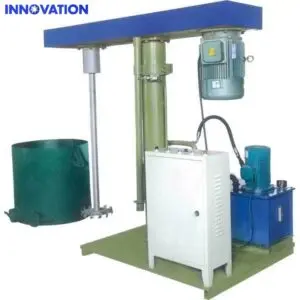
In plywood manufacturing, the final product quality is not determined only by pressing or veneer selection. The real foundation lies in adhesive preparation. Poor mixing leads to weak bonding, delamination, and inconsistent panel strength.
A High Speed Disperser Mixer for Plywood is designed to solve this issue by ensuring uniform dispersion of adhesive components at industrial scale. It significantly improves glue stability, reduces production inconsistency, and enhances final board performance.
Industry observations show that adhesive-related defects can account for up to 20% of plywood quality complaints in mid-scale production environments. This makes mixing technology a core investment area for modern factories.
High Speed Disperser Mixer for Plywood: Core Working Concept
High-Speed Dispersion Principle
The system operates using a high-speed rotating disc that generates strong shear force. This breaks down adhesive particles and distributes them evenly throughout the mixing tank.
The result is a stable, homogeneous glue mixture that maintains consistent viscosity during production.
Mechanical Stability in Industrial Mixing
Unlike conventional mixers, this system ensures:
- Controlled turbulence
- Stable rotational force
- Uniform particle distribution
This minimizes clumping and separation during storage or application.
Continuous Industrial Operation
A High Speed Disperser Mixer for Plywood is designed for continuous or batch production lines, supporting large-scale adhesive preparation without interruption.
Key System Structure of High Speed Disperser Mixer for Plywood
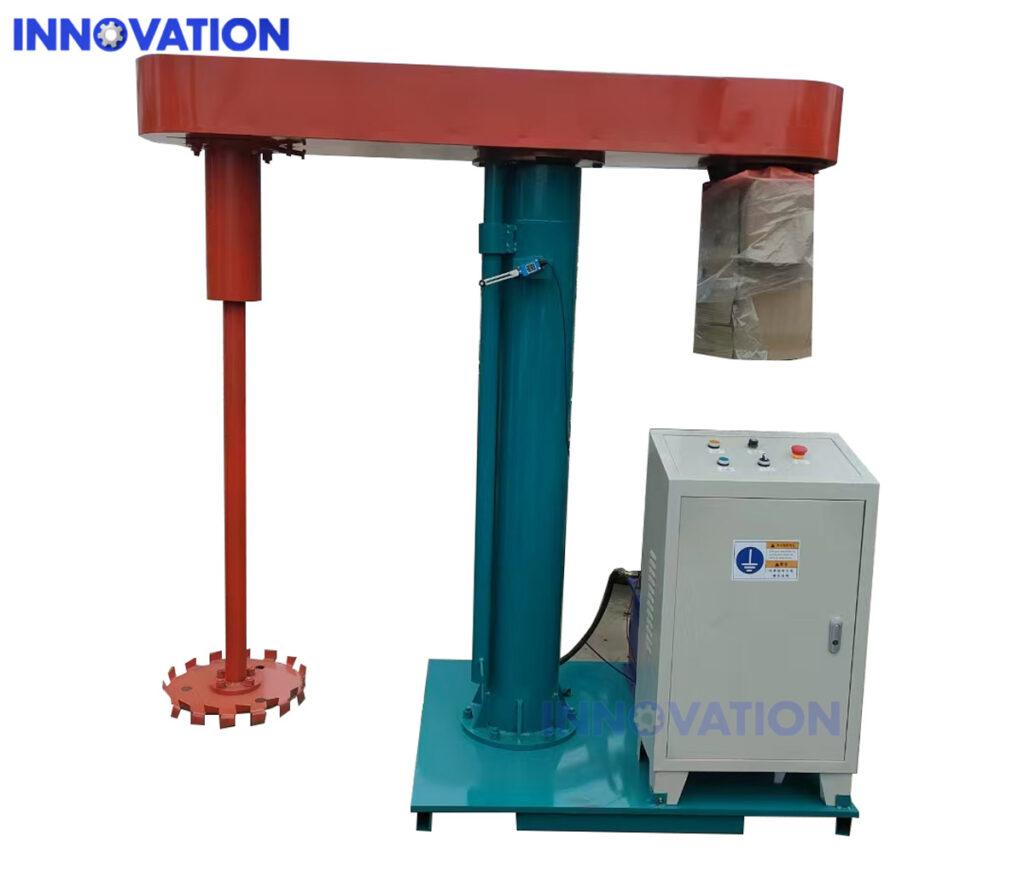
High-Speed Dispersing Unit
This is the core component responsible for breaking down adhesive particles. It operates at high RPM to ensure rapid dispersion.
Hydraulic Lifting System
The hydraulic system allows vertical adjustment of the mixing head, improving safety and operational flexibility.
Heavy-Duty Mixing Tank
Designed for industrial adhesives such as:
- Phenolic resin (PF glue)
- Urea-formaldehyde (UF glue)
- Melamine-modified adhesives
- Specialty industrial bonding agents
Intelligent Control Panel
Operators can manage:
- Speed adjustment
- Mixing duration
- Temperature control (optional)
- Automatic or manual modes
Technical Performance Overview of High Speed Disperser Mixer for Plywood
| Parameter | Specification Range | Industrial Impact |
|---|---|---|
| Motor Power | 7.5 kW – 18.5 kW | Determines mixing intensity |
| Rotation Speed | 0–1440 RPM | Controls dispersion quality |
| Tank Capacity | 200–2000 liters | Production scalability |
| Voltage | 380V / customizable | Global adaptability |
| Mixing Time | 20–60 minutes | Production efficiency |
| Hydraulic Power | 1.1–2.2 kW | Lifting stability |
These parameters vary depending on production scale and adhesive type requirements.
High Speed Disperser Mixer for Plywood in Industrial Applications
Veneer Adhesive Preparation
Ensures uniform glue distribution before veneer coating, improving bonding strength.
Film-Faced Plywood Production
Critical for high-strength adhesive layers required in construction-grade panels.
LVL and Structural Boards
Supports high-performance adhesives required for load-bearing engineered wood products.
Large-Scale Manufacturing Lines
Integrated into automated production systems for continuous output.
Traditional Mixer vs High Speed Disperser Mixer for Plywood
Operational Differences
| Feature | Traditional Mixer | High Speed Disperser Mixer |
|---|---|---|
| Mixing Method | Mechanical stirring | High-speed dispersion disc |
| Uniformity | Medium | High consistency |
| Mixing Time | Long | Significantly reduced |
| Energy Efficiency | Lower | Optimized power use |
| Industrial Suitability | Small scale | Large-scale production |
Quality Impact Comparison
Traditional mixing often leaves micro-clumps in adhesives, while high-speed dispersion ensures complete particle breakdown, improving bonding reliability.
Conceptual Understanding: Why Dispersion Matters in Adhesive Science
Particle Breakdown Efficiency
Effective dispersion reduces molecular clustering in adhesives, ensuring smoother application.
Viscosity Stability
Stable viscosity ensures predictable spreading behavior during production.
Bonding Strength Improvement
Uniform adhesive distribution improves penetration into wood fibers, increasing structural integrity.
Production Efficiency Benefits of High Speed Disperser Mixer for Plywood
Reduced Mixing Cycle Time
Factories report up to 30%–50% reduction in adhesive preparation time.
Lower Material Waste
More consistent mixing reduces overuse of adhesive compounds.
Improved Line Synchronization
Stable glue supply improves coordination with spreading and pressing systems.
Enhanced Final Product Quality
Better bonding reduces delamination rates and improves export-grade compliance.
Industry Insight: Adhesive Technology Trends in Plywood Manufacturing
Recent industry trends highlight:
- Increasing adoption of automated adhesive systems in Asia-Pacific plywood factories
- Growing demand for low-formaldehyde and eco-friendly adhesives
- Rising importance of consistency in export-oriented production lines
Modern buyers increasingly prioritize equipment that improves quality stability over raw production speed, making disperser mixers a strategic investment.
Case Example: Production Upgrade Impact
A plywood manufacturer upgrading from conventional mixing to a High Speed Disperser Mixer for Plywood observed:
- 35% reduction in adhesive preparation time
- 22% improvement in bonding consistency
- 15% reduction in adhesive consumption
- Noticeable decrease in product delamination issues
The return on investment was achieved within approximately 12–18 months depending on production scale.
Maintenance and Operational Guidelines
Daily Maintenance
- Clean mixing tank after each batch
- Inspect dispersing disc condition
- Check hydraulic system pressure
Weekly Maintenance
- Lubricate moving parts
- Inspect electrical control system
- Verify speed calibration accuracy
Long-Term Maintenance
- Replace worn dispersing discs
- Check motor efficiency
- Recalibrate PLC system
Proper maintenance ensures stable performance for 8–12 years of industrial operation.
FAQ
What is the main function of a High Speed Disperser Mixer for Plywood?
It ensures uniform adhesive mixing to improve bonding strength and plywood surface stability.
Can it handle different adhesive types?
Yes, it supports PF, UF, melamine-based, and customized industrial adhesives.
Is it suitable for small factories?
It is scalable, but most cost-effective in medium to large production environments.
How does it improve plywood quality?
It ensures consistent glue distribution, reducing defects like delamination and weak bonding.
What is the typical mixing time?
Depending on formulation, usually between 20 and 60 minutes.
Conclusion
The High Speed Disperser Mixer for Plywood is more than a mixing device—it is a critical quality control system in modern plywood manufacturing. By ensuring adhesive uniformity, it directly influences structural strength, durability, and surface quality.
As plywood production moves toward automation and stricter quality standards, factories that invest in advanced dispersion technology gain a long-term competitive advantage in both domestic and export markets.
Choosing the right mixing system is no longer optional—it is a strategic decision that defines production stability and product reputation.
 English
  Vietnamese
  Arabic