
News
Lam Board Production Machine for Laminated Particle Board Manufacturing: Complete Industrial Guide
Welcome to My Blog!
I’m so glad you’re here. Before we dive into the content, I’d love to connect with you beyond this page. On my social media, I regularly share industry insights, product updates, and behind-the-scenes moments — plus, it’s a great place for us to interact!
Follow us on Facebook: Shandong Chuangxin Automation Equipment Co., Ltd
Let’s grow together and stay connected. Now, let’s jump into the blog — I hope you find the content informative, engaging, and truly valuable.
Table of Contents
Introduction
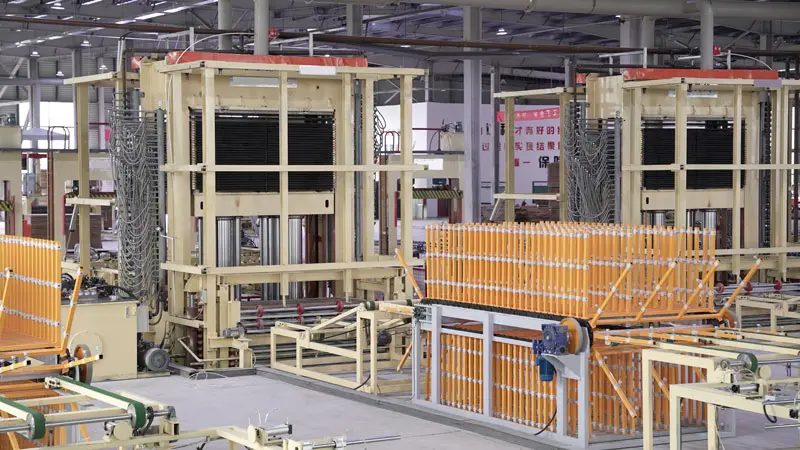
The global demand for engineered wood products is accelerating as industries shift toward cost-efficient, sustainable, and high-performance building materials. Among them, laminated particle board has become a core material for furniture manufacturing, interior decoration, and modular construction systems.
At the center of this production ecosystem is the lam board production machine, a highly engineered industrial system capable of transforming wood residues into high-value laminated panels with consistent density, structural stability, and decorative surface quality.
According to industry reports from global wood-based panel associations (such as EPF and FAO forestry statistics), engineered wood panel consumption has been growing steadily at approximately 4–6% CAGR in the last decade, driven by urbanization, housing demand, and prefabricated furniture markets.
This article provides a deep technical and commercial breakdown of laminated particle board manufacturing systems, covering machinery, processes, standards, cost structures, comparisons, and real-world production logic.
Key Takeaways of This Article
- Full technical understanding of laminated particle board manufacturing
- Working principle of a lam board production machine
- Industrial production line structure and process flow
- International standards and technical benchmarks
- Cost, ROI, and capacity planning insights
- Comparison of machine types and production systems
- Real-world industry applications and case logic
- Buyer-focused FAQ based on search intent behavior
What is Laminated Particle Board?
Industrial Definition
A laminated particle board is an engineered composite panel made by compressing wood particles, chips, or sawdust with synthetic resin under heat and pressure, followed by the application of a decorative laminate layer (such as melamine paper or PVC film).
It is widely used in:
- Flat-pack furniture
- Office systems
- Kitchen cabinets
- Interior wall panels
Technical Composition Structure
Layered Construction Model
A laminated particle board typically consists of:
- Surface Layer (Laminate): Decorative + protective film
- Core Layer: Wood particle + resin composite
- Inner Density Zone: High compression central layer
- Balancing Layer: Moisture resistance stabilization layer
Physical Properties (Industry Average Standards)
| Property | Standard Range |
|---|---|
| Density | 600–750 kg/m³ |
| Moisture Content | 6%–10% |
| Bending Strength | ≥ 11 MPa |
| Thickness Tolerance | ±0.3 mm |
| Formaldehyde Emission (E1 Standard) | ≤ 0.124 mg/m³ |
These values are aligned with EN 312 (Europe particleboard standards) and CARB Phase II (US emission regulation).
Lam Board Production Machine Overview
System Definition
A lam board production machine refers to a complete industrial system that integrates material preparation, forming, pressing, cooling, and cutting into a continuous automated production line for laminated particle board manufacturing.
Lam Board Production Machine Working Principle
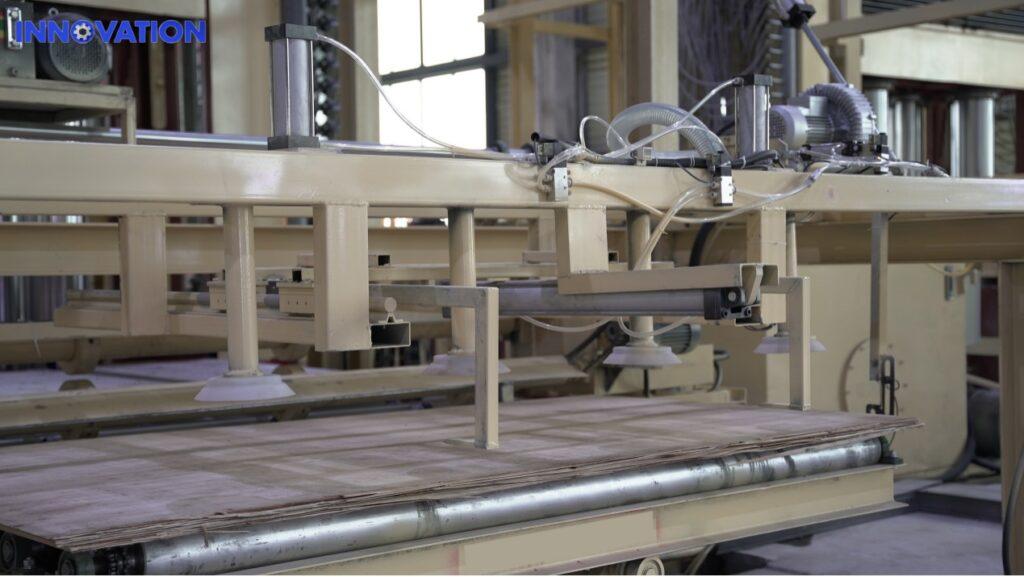
Full Production Flow Architecture
The production of laminated particle board is divided into a structured industrial workflow:
Stage 1: Raw Material Preparation
Wood waste, chips, and fibers are collected and screened for size consistency.
Stage 2: Drying System
Moisture content is reduced to 3–5% for hot pressing efficiency.
Stage 3: Resin Blending
Urea-formaldehyde or MDI adhesive is sprayed evenly onto particles.
Stage 4: Forming Section
Particles are distributed into a uniform mat layer using air-lay or mechanical spreading systems.
Stage 5: Pre-Pressing
Light compression stabilizes the mat before hot pressing.
Stage 6: Hot Pressing
Temperature: 160–220°C
Pressure: 2.5–4.5 MPa
Time: 3–7 minutes depending on thickness
Stage 7: Cooling & Stabilization
Boards are cooled to eliminate internal stress.
Stage 8: Lamination Process
Decorative surface layers are applied (melamine, PVC, veneer).
Stage 9: Cutting & Calibration
Final panels are trimmed into standard sizes such as:
- 1220 × 2440 mm (standard export size)
- Custom industrial formats
Lam Board Production Machine System Architecture
Industrial Equipment Breakdown
| System Module | Function | Technical Importance |
|---|---|---|
| Wood Crusher | Particle size reduction | High |
| Dryer System | Moisture control | Critical |
| Resin Mixer | Adhesive coating | Critical |
| Forming Machine | Mat uniformity | Critical |
| Hot Press | Structural bonding | Core |
| Cooling Conveyor | Stress stabilization | Medium |
| Cutting Line | Dimension control | Medium |
| Dust Control System | Environmental safety | High |
Laminated Particle Board Production Line Types
Fully Automated Production Line
Fully automated systems are designed for continuous industrial manufacturing with minimal human intervention.
Key Features
- PLC intelligent control system
- Real-time pressure and temperature monitoring
- Automated feeding and discharge
- Integrated quality detection system
Production Capacity
- Small scale: 10,000–20,000 m³/year
- Medium scale: 20,000–60,000 m³/year
- Large scale: 60,000+ m³/year
Semi-Automatic Production Line
Semi-automatic systems balance cost and automation level, requiring partial manual operations.
Key Features
- Lower capital investment
- Flexible production scheduling
- Modular expansion capability
Lam Board Production Machine vs Traditional Wood Processing
Technical Comparison Table
| Dimension | Lam Board Production Machine | Solid Wood Processing |
|---|---|---|
| Raw Material | Wood waste particles | Natural logs |
| Utilization Rate | 85%–95% | 40%–60% |
| Production Cost | Lower | Higher |
| Output Stability | High | Medium |
| Environmental Impact | Low carbon footprint | Higher deforestation impact |
| Scalability | Industrial scale | Limited |
Industry Standards and Compliance
Key Global Standards
EN 312 (Europe Standard)
Defines mechanical properties of particleboards used in construction and furniture industries.
CARB Phase II (USA Regulation)
Controls formaldehyde emission levels in engineered wood products.
ISO 16893
Provides testing methods for wood-based panels.
Cost Structure Analysis of Lam Board Production Machine
Investment Breakdown (Industrial Scale Example)
| Cost Category | Percentage |
|---|---|
| Machinery Equipment | 45% |
| Factory Construction | 20% |
| Raw Material System | 15% |
| Installation & Commissioning | 10% |
| Working Capital | 10% |
ROI Estimation Model
Typical ROI period for medium-scale laminated particle board plants:
- 18 to 36 months depending on market demand and export volume
Energy Consumption Analysis
Industrial Energy Benchmarks
- Hot press system: 55–65% total energy usage
- Drying system: 20–25%
- Forming & conveying: 10–15%
Optimization Technologies
- Heat recovery systems
- Variable frequency drives (VFD)
- Intelligent temperature control loops
Market Demand and Industry Trends
Global Market Growth Drivers
- Expansion of modular furniture industry
- Growth of e-commerce furniture brands
- Urban housing construction demand
- Sustainable material substitution policies
Industry Insight
According to FAO forestry product outlook reports, engineered wood demand is expected to exceed 350 million cubic meters globally by 2030, with laminated boards accounting for a significant portion of furniture-grade materials.
Real-World Application Case Study
Case: Southeast Asia Furniture Manufacturing Expansion
A mid-size furniture manufacturer upgraded from manual board processing to a fully automated lam board production machine system.
Results After Upgrade:
- Production efficiency increased by 62%
- Material waste reduced by 28%
- Labor cost reduced by 40%
- Export capacity increased by 2.3×
This reflects the strong ROI potential of automated laminated particle board production systems.
Key Selection Factors for Buyers
Production Planning Considerations
- Daily output requirement
- Factory space availability
- Energy infrastructure capacity
- Target export markets
Technical Evaluation Checklist
Machine Quality Indicators
- Press plate uniformity tolerance
- Hydraulic system stability
- PLC control accuracy
- Emission compliance capability
Lam Board Production Machine vs Competing Technologies
Comparative Overview
| Technology | Efficiency | Cost | Flexibility |
|---|---|---|---|
| Laminated Particle Board Line | High | Medium | High |
| MDF Production Line | Very High | High | Medium |
| Solid Wood Milling | Low | High | Low |
Conclusion
The lam board production machine is a cornerstone of modern engineered wood manufacturing, enabling scalable, efficient, and standardized production of laminated particle board.
With increasing global demand for sustainable and cost-efficient building materials, investment in automated production systems is becoming a key strategic decision for manufacturers aiming to expand into international markets.
The combination of automation, material efficiency, and compliance with global standards makes laminated particle board production one of the most competitive sectors in the wood-based panel industry today.
FAQ
What is a laminated particle board used for in modern industry?
It is widely used in furniture manufacturing, interior decoration systems, and modular construction due to its stability and cost efficiency.
What is the lifespan of a lam board production machine?
Industrial-grade systems typically last 10–20 years with proper maintenance and component replacement cycles.
What is the required factory size?
A medium-scale production line generally requires 800–3000 m² depending on layout and capacity.
Is laminated particle board environmentally friendly?
Yes, it uses recycled wood waste and complies with modern low-emission standards such as E1 and CARB Phase II.
How long does it take to install a full production line?
Installation and commissioning typically require 60–120 days depending on system complexity.
 English
  Vietnamese
  Arabic