
أخبار
شرح عملية تصنيع لوحة الضغط البارد
مرحباً بكم في مدونتي!
يسعدني جدًا وجودك هنا. قبل أن نتعمق في المحتوى، يسعدني التواصل معك عبر هذه الصفحة. أشارك بانتظام رؤىً حول الصناعة، وتحديثاتٍ حول المنتجات، ولحظاتٍ من وراء الكواليس على حساباتي على مواقع التواصل الاجتماعي، كما أنها منصةٌ رائعةٌ للتواصل!
تابعونا على الفيسبوك: شركة شاندونغ تشوانغشين لمعدات الأتمتة المحدودة
لننمو معًا ونبقى على تواصل. والآن، لننتقل إلى المدونة - آمل أن تجدوا محتواها غنيًا بالمعلومات، وجذابًا، وقيّمًا حقًا.
جدول المحتويات
Ultimate Guide to Cold Press Board Production, Technology, and Best Practices
Cold press board is rapidly transforming the engineered wood panel industry due to its energy-efficient bonding process, improved surface quality, and lower defect rates. Manufacturers worldwide are turning to cold press technology to optimize plywood, veneer, and laminated panel production.
Today’s advanced machinery and refined workflows allow cold press board production to be highly repeatable and quality-controlled. In this article, we cover every step of the manufacturing process, key equipment specifications, operational best practices, economic benefits, and real-world examples. Whether you’re a plywood manufacturer, furniture maker, or industrial panel producer, this guide will help you unlock the full potential of cold press board technology.
Key Points You’ll Learn
- What cold press board is and why it matters
- Complete step-by-step manufacturing workflow
- Core equipment: cold press machines explained
- Pressing pressures, cycle times, and quality targets
- Cold press vs hot press: pros, cons & when to choose which
- Detailed specifications of industry-standard machines
- Real case studies and production data
- Troubleshooting common production issues
- FAQ with practical answers for manufacturers
What Is Cold Press Board?
Definition and Core Concept
Cold press board refers to a wood-based panel manufactured by applying uniform hydraulic pressure on glued veneers or laminates without heat. Unlike traditional hot press methods, cold pressing uses pressure alone to partially set the adhesive, stabilize layers, and prepare the panel before final curing.
- Ensures flat panels with minimal distortion
- Reduces energy use by eliminating heat in the initial stage
- Improves dimensional stability and reduces exterior defects
Why Cold Press Board Matters Today
According to industry data from the Wood Products Manufacturers Association Annual Report 2024, cold press processes can reduce energy consumption by up to 35% compared to hot press alone, while increasing pre-press throughput by nearly 20–30%.
Cold press boards are widely used in:
- Furniture frames and cabinets
- Interior wall paneling
- Flooring substrates
- Door skins and decorative laminates
- Industrial packaging and composites
The Cold Press Board Manufacturing Workflow
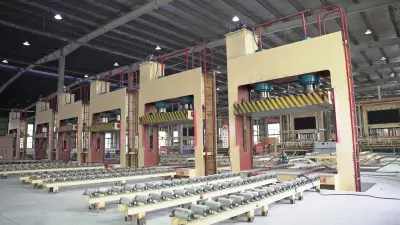
The cold press production process is highly structured. Each step is critical for final panel quality.
Step 1: Glue Application
Cold press board quality begins with adhesive application:
- A glue spreader applies a uniform layer of adhesive to each veneer sheet
- Coverage rate is critical: too little glue leads to weak bonding; too much causes squeeze-out
- Common adhesives include phenol-formaldehyde and urea-formaldehyde resins
Best Practice Tips:
- Measure glue pick-up at 150–200 g/m² for most plywood grades
- Ensure viscosity is optimized for ambient temperature
Step 2: Veneer Stacking and Orientation
Veneers are stacked in a precise order to ensure strength and stability:
- Alternating grain directions increase panel rigidity
- Panels may be 3–7+ layers depending on thickness requirements
- Automated stacking systems improve consistency and reduce labor costs
Statistical Insight: Automated stacking reduces misalignment defects by >25% vs manual stacking.
Step 3: Panel Loading
The assembled veneer stack is loaded onto the cold press platen:
- Hydraulic lift tables or conveyors handle large panels
- Manual loading is possible for smaller drip-feed systems
Proper loading ensures safety and reduces handling damage.
Step 4: Cold Pressing Operation
During pressing, hydraulic cylinders apply uniform pressure:
- Typical pressures range from 1 MPa to 5 MPa
- Pressing times vary based on panel thickness (3–10+ minutes)
- Fully automatic systems control speed, pressure, and timing
Why Uniform Pressure Matters:
Uniform pressure eliminates voids and air pockets, which are primary causes of delamination during later hot pressing.
Step 5: Platen Release and Panel Unloading
After pressing:
- The cold press platen rises automatically
- Panels are removed and staged for hot pressing
- Remaining adhesive is partially set, minimizing movement
This staging improves surface flatness and prevents warping in the final curing stage.
Cold Press Machine: Technology and Context
ما هي آلة الضغط البارد؟
أ آلة الضغط البارد applies consistent hydraulic pressure to veneer stacks without heat. It’s used in the pre-press stage of plywood, laminated boards, and composite panels.
مزايا آلات الضغط البارد:
- Energy savings by eliminating heat
- Strong, stable bonding quality
- Better handling of large panel volumes
- Low maintenance and easy operation
المكونات الأساسية لـ آلة الضغط البارد
النظام الهيدروليكي
The hydraulic system provides press force using pumps, valves, and cylinders:
- Pollution-free hydraulic station
- High-pressure pumps (e.g., 10MC plunger pumps)
- Rated working pressures up to 26 ميجا باسكال
Platen Structure
Platen size and configuration determine panel size capacity:
- Lower beam opening often exceeds 1800 ملم
- Upper and lower platens precision machined
Control Systems
Modern cold press machines feature:
- Fully automatic PLC control
- Pressure, time, and cycle optimization
- Safety interlocks
Cold Press Machine Specifications (Industry Standard)
| مواصفة | Value/Range |
|---|---|
| Total Press Force | 150T – 400T |
| الضغط الهيدروليكي | 1–5 MPa operating range |
| Platen Width | 900–1800 mm |
| Press Time | 3–10 minutes per cycle |
| Hydraulic Power | 5.5–10 kW motors |
| Control Type | Automatic PLC |
| Typical Panel Thickness | 3–50 mm |
This table represents typical parameters for plywood cold press systems used in medium to large-scale production.
Cold Press vs Hot Press: What’s the Difference?
Pressing Mechanism
الضغط البارد:
- Uses hydraulic pressure only
- No heat
- Ideal for preliminary bonding
الصحافة الساخنة:
- Uses both heat and pressure
- Final curing stage
- Provides stronger adhesive activation
استهلاك الطاقة
Cold press operations consume 25–40% less energy than equivalent hot press cycles, according to industry energy audits.
Product Quality and Applications
| ملكية | الضغط البارد | مكبس ساخن |
|---|---|---|
| Surface Flatness | عالي | مرتفع جداً |
| Adhesion Strength | Moderate (pre-stage) | High (final cure) |
| استخدام الطاقة | Lower | Higher |
| وقت الدورة | Shorter | Longer |
| Production Cost | Lower | Higher |
Summary: Cold press prepares panels for final curing, saving energy and improving workflow efficiency. Hot press ensures final bonding and product performance.
Real-World Production Data and Case Studies
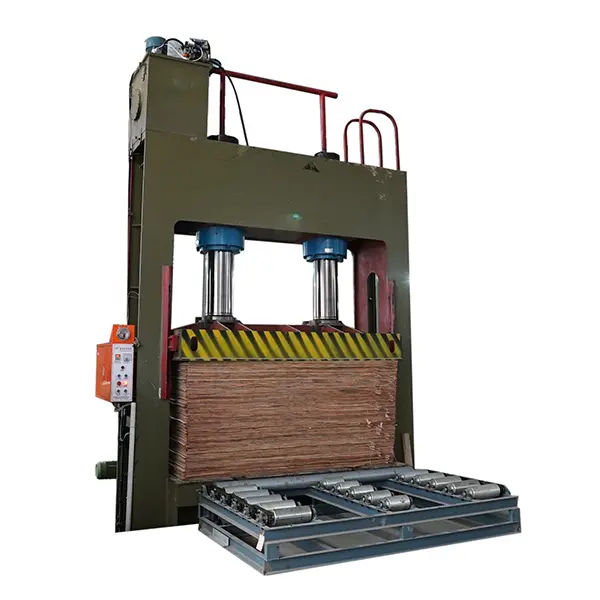
Case Study 1: Plywood Manufacturer – China
A mid-sized plywood manufacturer upgraded to a 400T cold press system in 2023. Key results after 12 months:
- Production output increased by 28%
- Energy cost savings: >30% per panel
- Defect rates dropped from 6.2% to 2.1%
- Flatness score (industry standard metric) improved by 19%
Operational improvements were attributed to uniform pressure and automated PLC control.
Case Study 2: Furniture Panel Line – Europe
An OEM used cold press board pre-pressing in cabinet panel production:
- Average cycle time: 8 minutes per panel
- Quality consistency improved by 22%
- Labor reliance reduced due to automated loading/unloading
Manufacturers reported faster hot press throughput due to better pre-stabilized boards.
Academic Insight
A 2022 wood science study published in the Journal of Wood Processing and Technology concluded that cold press stabilization significantly enhances composite panel adhesion and reduces heat-related distortion when followed by hot pressing — a finding that supports modern hybrid workflows.
Common Production Issues and Troubleshooting
Uneven Adhesion
Cause: Inconsistent glue application
Solution: Calibrate glue spreader and monitor coverage rates
Air Pockets in Panels
Cause: Insufficient pressure or short press time
Solution: Increase holding time or verify hydraulic pressure
Surface Waves or Warping
Cause: Misaligned veneer orientation during stacking
Solution: Use alignment guides or automated stacking system
Maintenance Best Practices for آلات الضغط البارد
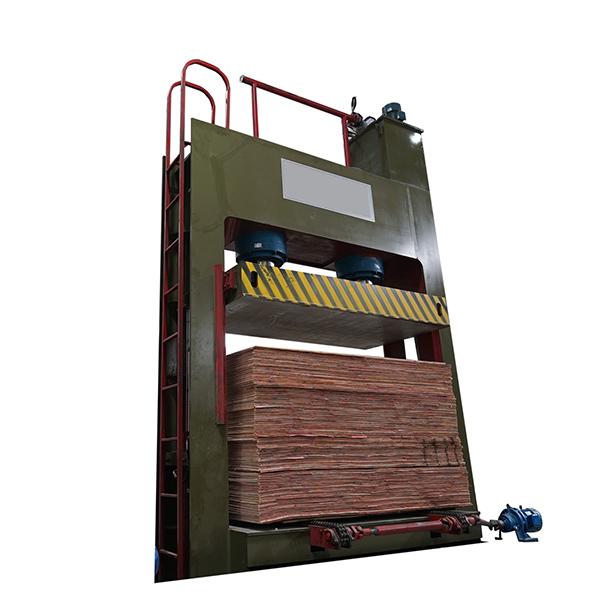
Daily Checks
- Inspect hydraulic oil levels
- Clean platen surfaces
- Test pressure sensors
Weekly Tasks
- Check cylinder seals
- Lubricate moving parts
Monthly Inspection
- Validate PLC calibration
- Review safety interlocks and alarms
Regular maintenance improves reliability and extends machine life by 20–30%.
خاتمة
Cold press board manufacturing combines engineering precision, material science, and modern automation. By controlling glue application, veneer stacking, hydraulic pressure, and cycle timing, manufacturers can significantly improve quality while lowering costs and energy usage.
As global demand for engineered wood products grows, cold press technology continues to play a vital role in efficient, sustainable production. Understanding this process enables manufacturers to innovate, scale, and compete in a dynamic market.
التعليمات
Q1: What is the ideal press time for cold press board?
A1: Typically 3-10 دقائق, depending on panel thickness and adhesive type.
Q2: Can cold press board be used without hot pressing?
A2: Generally no — cold press is a pre-stage. Final curing is recommended via hot press.
Q3: How does cold press improve final product quality?
A3: By stabilizing veneers, reducing air pockets, and improving flatness before hot pressing.
Q4: Is cold press board environmentally friendly?
A4: Yes — it consumes less energy and can use lower-emission adhesives.
Q5: What are typical production volumes with cold press systems?
A5: Medium manufacturers may produce 500–1500 panels/day, scaling higher with automation.
 Arabic
  English
  Vietnamese