
أخبار
عملية إنتاج الأخشاب الهندسية
مرحباً بكم في مدونتي!
يسعدني جدًا وجودك هنا. قبل أن نتعمق في المحتوى، يسعدني التواصل معك عبر هذه الصفحة. أشارك بانتظام رؤىً حول الصناعة، وتحديثاتٍ حول المنتجات، ولحظاتٍ من وراء الكواليس على حساباتي على مواقع التواصل الاجتماعي، كما أنها منصةٌ رائعةٌ للتواصل!
تابعونا على الفيسبوك: شركة شاندونغ تشوانغشين لمعدات الأتمتة المحدودة
لننمو معًا ونبقى على تواصل. والآن، لننتقل إلى المدونة - آمل أن تجدوا محتواها غنيًا بالمعلومات، وجذابًا، وقيّمًا حقًا.
جدول المحتويات
أهم النقاط في هذه المدونة
- A complete breakdown of the engineered wood production process from raw logs to finished panels
- Core materials including fibers, particles, and veneers and how they impact performance
- Detailed explanation of each manufacturing stage: preparation, blending, forming, pressing, and finishing
- Key machinery such as hot presses, laminating lines, and automated production systems
- Technical concepts like density, moisture resistance, and bonding strength
- Comparison of MDF, particle board, plywood, and OSB for different applications
- Industry standards, certifications, and quality benchmarks
- Real-world case studies and production efficiency data
- Cost structure, sustainability trends, and future innovations
- FAQ addressing practical buyer and engineering concerns
مقدمة
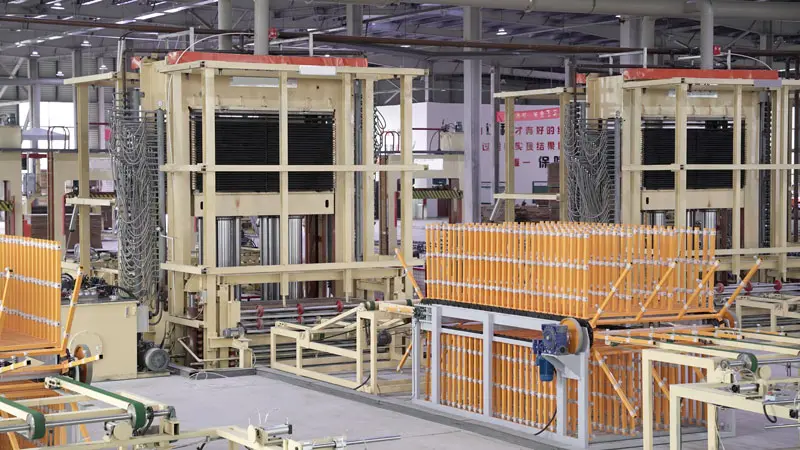
In modern construction and furniture manufacturing, engineered wood is no longer just an alternative to solid timber—it is a strategically engineered material designed for performance, efficiency, and scalability. Behind every smooth MDF board, durable plywood sheet, or structural OSB panel lies a complex and highly optimized engineered wood production process.
What makes this process particularly important is its ability to convert low-value wood residues—chips, fibers, and veneers—into high-value products with predictable strength, durability, and surface quality. In fact, studies from global wood industry reports show that engineered wood manufacturing can improve raw material utilization by up to 85–95%, compared to less than 60% in traditional lumber processing.
As demand grows for sustainable building materials and cost-effective furniture solutions, understanding how engineered wood is produced becomes critical for manufacturers, importers, and project developers. This guide provides a deep, structured look into every stage of the process, supported by technical insights, real data, and industry practices.
Raw Materials in Engineered Wood Production Process
Wood Input Types
Wood Fibers
Fibers are the primary material for MDF (Medium Density Fiberboard). They are produced by refining wood chips into fine strands. These fibers allow for a smooth, uniform surface, making them ideal for painting and laminating.
Wood Particles
Particles are small wood chips or flakes used in particle board. They are cost-efficient and widely used in mass-produced furniture. Their size distribution plays a key role in board strength and density.
Wood Veneers
Veneers are thin sheets of wood peeled from logs. They are used in plywood and LVL (Laminated Veneer Lumber), providing excellent structural strength due to cross-layer bonding.
Adhesives and Chemical Additives
راتنج اليوريا فورمالدهايد (UF)
Used in interior panels due to fast curing and low cost. However, it has limited moisture resistance.
راتنج الفينول فورمالدهايد (PF)
Offers superior water resistance and durability. Commonly used in structural and exterior panels.
Melamine-Urea-Formaldehyde (MUF)
Combines durability and surface quality, often used in decorative panels.
Additives
Wax emulsions improve water resistance, while fire retardants enhance safety performance in specialized applications.
Step-by-Step Engineered Wood Production Process
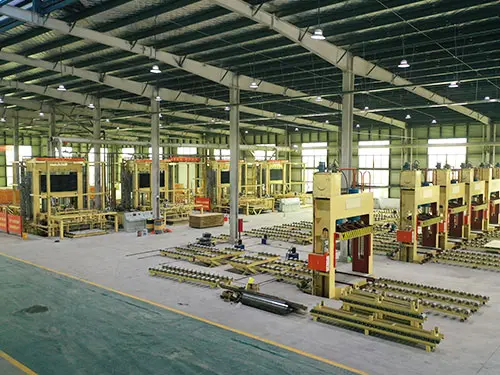
Raw Material Preparation
Debarking and Chipping
Logs are first debarked to remove impurities. They are then chipped into uniform sizes, typically 20–30 mm length, ensuring consistent downstream processing.
Drying
Moisture content is reduced to 2–5% using rotary dryers. Proper drying is essential to ensure strong adhesive bonding and prevent panel defects.
Fiber and Particle Processing
Fiber Refining
Wood chips are softened using steam and then mechanically refined into fibers. This step is crucial for MDF quality.
Particle Classification
Particles are screened into different sizes. Fine particles are used for surface layers, while coarse particles form the core.
Blending and Resin Application
Resin Mixing
Fibers or particles are blended with adhesives in controlled environments. Resin content typically ranges from 6% to 12% depending on board type.
Uniform Coating
Advanced spray systems ensure even resin distribution, which directly impacts bonding strength and durability.
Mat Formation
Layer Structuring
Different board types require different structures:
- MDF: Homogeneous fiber mat
- Particle Board: Three-layer structure
- Plywood: Cross-laminated veneers
Pre-Pressing
The loose mat is compressed to improve density uniformity and facilitate handling before hot pressing.
Hot Pressing Stage
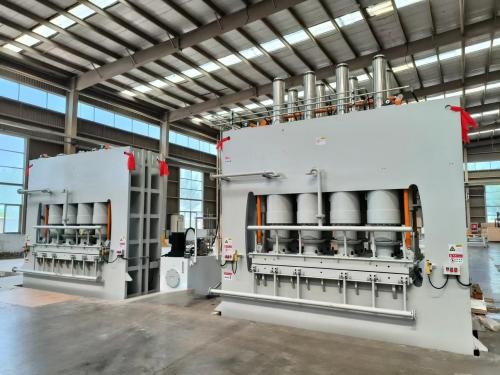
Temperature and Pressure
Boards are pressed at 160–220°C and pressures up to 3–5 MPa. Press cycles typically range from 3 to 10 minutes, depending on thickness.
Equipment Systems
Modern facilities use:
- Multi-layer hot presses (15–30 layers)
- Hydraulic presses (800T–4000T capacity)
- Continuous press lines for high-volume production
Concept: Bonding Mechanism
Heat activates resin curing, while pressure consolidates the material. This creates a strong internal bond that defines board strength.
Cooling and Stabilization
After pressing, boards are cooled in star coolers or stacking systems. Gradual cooling prevents internal stress, which can lead to warping or cracking.
Cutting, Sanding, and Finishing
القطع الدقيق
Edge trimming machines achieve tolerances of ±0.5 mm, ensuring dimensional accuracy.
الصنفرة
Multi-head sanding machines improve surface smoothness to Ra < 10 μm, suitable for coating and laminating.
Surface Finishing
Boards may be laminated with melamine paper, veneer, or PVC films using short-cycle presses.
Key Equipment in Engineered Wood Manufacturing
Hot Press Technology
High-layer presses (15–30 layers) allow batch production, while continuous presses enable large-scale, uninterrupted output.
Laminating Lines
Short-cycle laminating machines (3–11 layers) enhance productivity and surface quality.
Integrated Production Systems
Advanced production lines include:
- Plywood and LVL lines
- Wood-plastic composite panel systems
- Automated edge trimming and stacking systems
Automation reduces labor requirements by up to 40% and increases production consistency.
Comparison of الخشب الهندسي Types
| يكتب | Density (kg/m³) | Strength | مقاومة الرطوبة | يكلف | طلب |
|---|---|---|---|---|---|
| MDF | 600–800 | واسطة | قليل | قليل | Furniture |
| Particle Board | 500–700 | منخفض متوسط | قليل | Very Low | Cabinets |
| الخشب الرقائقي | 500–750 | عالي | متوسط الارتفاع | واسطة | بناء |
| OSB | 600–700 | عالي | واسطة | واسطة | Structural panels |
Concept Sections for Better Understanding
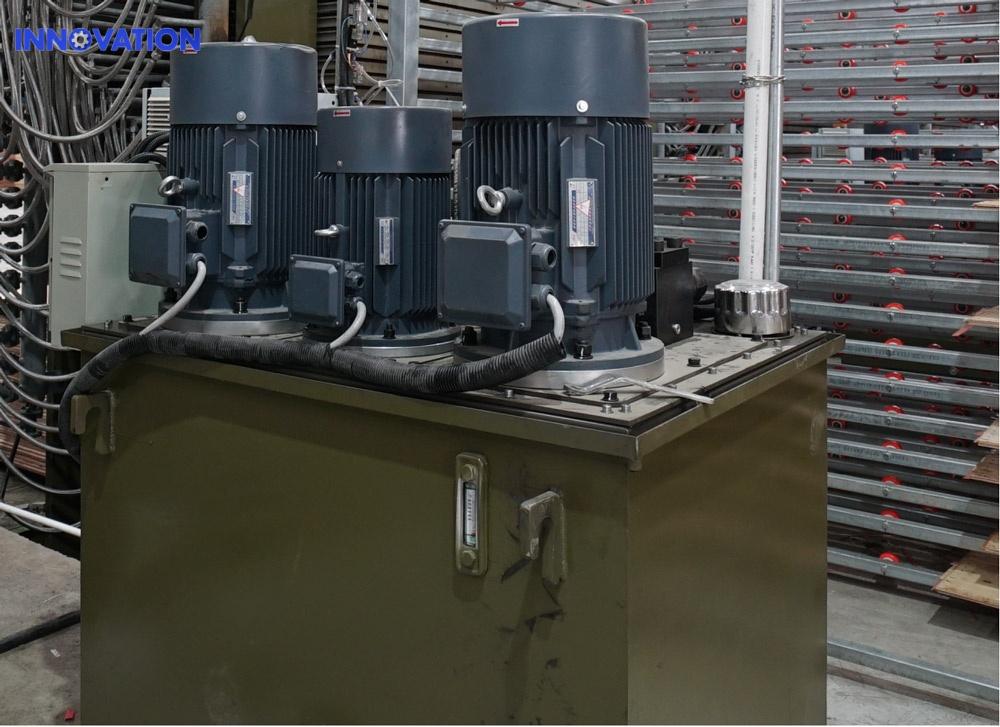
Concept: Density Control
Density is controlled during pressing. Higher density increases strength but also weight and cost.
Concept: Moisture Resistance
Boards using PF resin can withstand humidity levels above 85%, making them suitable for exterior use.
Concept: Emission Standards
Formaldehyde emissions are regulated under standards like:
- E0/E1 (Europe)
- CARB Phase 2 (USA)
Lower emissions improve indoor air quality and product safety.
Quality Standards and Certifications
International Standards
- EN 13986 (Europe): Structural wood-based panels
- ANSI A208 (USA): Particleboard and MDF standards
- ISO 16893: General performance requirements
Performance Benchmarks
- Internal bond strength: ≥0.35 MPa (MDF standard)
- Thickness swelling: ≤10% after 24h water immersion
- Bending strength: ≥20 MPa for structural panels
Cost Structure in الخشب الهندسي Production Process
Raw Material Costs
Typically account for 40–60% of total production cost.
استهلاك الطاقة
Drying and pressing consume significant energy, often representing 20 تش30% of costs.
Labor and Automation
Automation reduces labor costs while improving efficiency and consistency.
Case Studies and Industry Insights
Case Study: High-Efficiency MDF Line
A modern MDF plant in Southeast Asia upgraded to a continuous press system, increasing output by 35% while reducing defects by 20%.
Case Study: Plywood Export Growth
Export-oriented plywood manufacturers adopting PF resin achieved higher durability ratings, enabling access to premium international markets.
Industry Trends and Innovations
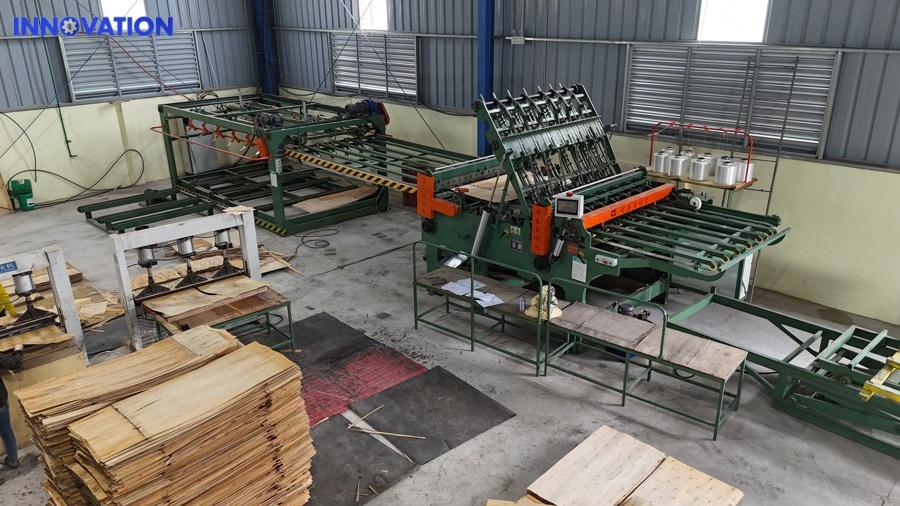
Smart Manufacturing
AI-based monitoring systems analyze pressure, temperature, and density in real time, improving quality control.
Sustainable Materials
Use of recycled wood and bio-based adhesives is growing, reducing environmental impact.
High-Performance Panels
Demand for fire-resistant, waterproof, and lightweight panels is increasing in construction and furniture industries.
Best Practices for Buyers and Manufacturers
Choose Based on Application
Use MDF for smooth finishes, plywood for strength, and OSB for structural needs.
Evaluate Supplier Capability
Check production lines, certifications, and quality consistency.
Consider Total Cost
Balance initial price with durability, maintenance, and lifecycle cost.
التعليمات
What is the engineered wood production process?
It is a multi-stage process that converts wood fibers, particles, or veneers into panels using adhesives, heat, and pressure.
How long does production take?
Depending on the product, the full process from raw material to finished board can take several hours to a full day.
Which type is best for moisture resistance?
Plywood with PF resin offers the best moisture resistance.
Is engineered wood sustainable?
Yes, it uses wood residues and improves material efficiency, making it more sustainable than solid wood.
What affects product quality most?
Key factors include raw material quality, resin type, pressing conditions, and finishing accuracy.
خاتمة
ال engineered wood production process is a highly advanced and efficient system that transforms raw wood into versatile, high-performance materials. By combining precise engineering, advanced machinery, and optimized workflows, manufacturers can produce panels that meet diverse application needs—from furniture to structural construction.
As the industry continues to evolve with automation, sustainability, and smart technologies, engineered wood will remain a cornerstone material in modern manufacturing. Understanding its production process not only improves purchasing decisions but also ensures better performance, cost efficiency, and long-term value.
 Arabic
  English
  Vietnamese