
News
Edge Banding Trimmers Buying Guide: Best Edge Banding Trimmers for Wood Panel Finishing Applications
Welcome to My Blog!
I’m so glad you’re here. Before we dive into the content, I’d love to connect with you beyond this page. On my social media, I regularly share industry insights, product updates, and behind-the-scenes moments — plus, it’s a great place for us to interact!
Follow us on Facebook: Shandong Chuangxin Automation Equipment Co., Ltd
Let’s grow together and stay connected. Now, let’s jump into the blog — I hope you find the content informative, engaging, and truly valuable.
Table of Contents
Key Takeaways
- Edge banding trimmers are essential for high-precision finishing in wood-based panel production
- They directly affect furniture appearance, durability, and dimensional accuracy
- Automated systems significantly improve efficiency and reduce defect rates
- Integration with cutting and lamination lines is critical for modern factories
- Proper selection can improve output consistency by 30–60%
- ROI depends heavily on automation level and production scale
Introduction
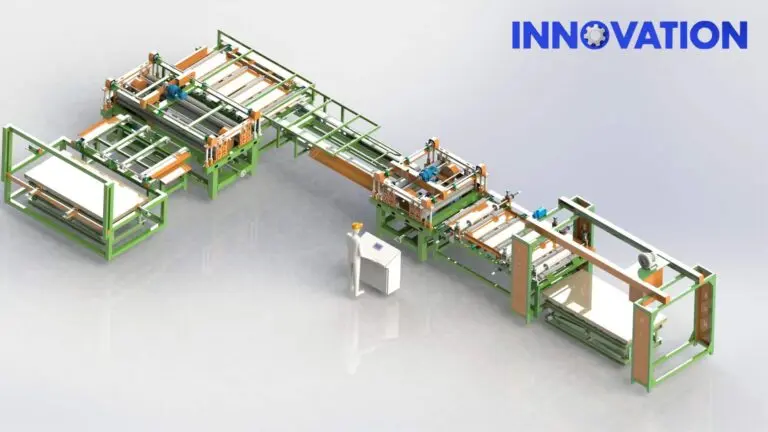
In modern wood-based panel manufacturing, product quality is no longer determined only by raw materials or pressing technology. The final appearance of furniture is strongly influenced by edge finishing accuracy. This is where edge banding trimmers play a decisive role.
Industry quality reports show that nearly 40% of visible defects in furniture panels come from poor edge finishing, including uneven trimming, glue overflow, and misaligned edge bands. As global buyers demand higher aesthetic standards, trimming systems have become a core part of production competitiveness.
Today, manufacturers producing MDF, plywood, and laminated boards increasingly rely on automated trimming systems integrated into smart production lines. These systems are no longer auxiliary equipment—they are central to quality control.
What Are Edge Banding Trimmers in Industrial Production
Edge banding trimmers are precision woodworking machines used to remove excess material after the edge banding process, ensuring clean, smooth, and accurate panel edges.
Core Function of Edge Banding Trimmers
They are designed to:
- Remove excess PVC, ABS, veneer, or melamine strips
- Correct edge alignment issues
- Improve surface uniformity
- Prepare panels for final finishing
Why Edge Finishing Matters
Poor edge finishing affects:
- Moisture resistance
- Structural durability
- Furniture assembly accuracy
- Overall product appearance
Even minor defects can significantly reduce product value in export markets.
Edge Banding Trimmers in Industrial Production Systems
Role in Wood Panel Manufacturing Lines
Edge banding trimmers are usually installed after:
- Panel cutting systems
- Laminating press machines
- Edge banding machines
They function as the final finishing stage before packaging.
Production Line Integration Concept
Modern factories use continuous flow systems where trimming is synchronized with upstream processes. This reduces manual handling and improves production efficiency.
Why Integration Improves Efficiency
Integrated systems help reduce:
- Rework rates
- Labor dependency
- Material handling errors
- Production delays
Best Edge Banding Trimmers: Industrial Classification System
Manual Edge Banding Trimmers
Used in small workshops and custom production environments.
Key characteristics:
- Operator-controlled trimming
- Low investment cost
- Flexible usage
Limitations:
- Low consistency
- High labor requirement
- Limited production capacity
Semi-Automatic Edge Banding Trimmers
A balance between manual control and mechanical automation.
Advantages:
- Better precision than manual systems
- Moderate production speed
- Reduced human error
Common applications:
- Small furniture factories
- Custom woodworking shops
Fully Automatic Edge Banding Trimmers
Designed for industrial mass production.
Key features:
- CNC-controlled trimming
- Automatic feeding systems
- Continuous operation capability
Advantages:
- High output efficiency
- Stable quality consistency
- Labor cost reduction of 40–60%
Edge Banding Trimmers vs Edge Trimming Saw Systems
| Feature | Edge Banding Trimmers | Trimming Saw System |
|---|---|---|
| Function | Fine finishing | Rough cutting |
| Precision | High | Medium |
| Production stage | Final processing | Pre-processing |
| Material focus | Decorative edges | Raw board edges |
| Automation | Medium–High | High |
Trimming saws are used for structural shaping, while edge banding trimmers focus on aesthetic refinement and surface quality.
Industrial Example: Automatic Roller Edge Trimming System
In large-scale production, roller-based trimming systems are widely used for continuous processing.
Automatic Feeding Concept
Boards are transported via roller conveyors into the cutting zone, ensuring stable and uninterrupted production flow.
High-Speed Cutting System
These systems typically use:
- Dual high-speed blades
- Precision roller alignment
- Stable feeding pressure control
Why Roller Systems Improve Quality
They reduce vibration and improve:
- Cutting accuracy
- Surface smoothness
- Production continuity
Technical Specifications of Industrial Trimming Systems
| Parameter | Industrial Range |
|---|---|
| Feeding speed | 0–55 m/min |
| Output capacity | 200–350 panels/hour |
| Blade speed | Up to 7000 rpm |
| Cutting thickness | 3–35 mm |
| Total power | 35–45 kW |
| Machine weight | 7–9 tons |
Higher blade speed improves cutting smoothness, while heavier structure enhances operational stability.
Edge Banding Trimmers Selection Strategy
Production Scale Matching
- Small workshop → manual system
- Medium factory → semi-automatic system
- Industrial plant → fully automatic system
Material-Based Selection
Different materials require different finishing precision:
- MDF → smooth edge finishing
- Plywood → structural stability trimming
- PVC panels → anti-peeling precision cutting
Automation Level Impact
Higher automation provides:
- Better consistency
- Lower defect rate
- Reduced operator dependency
Energy Efficiency Consideration
Modern systems reduce energy consumption by 15–25% through optimized motors and inverter control.
Cost Structure and Investment Analysis
Key Cost Factors
- Automation level
- Cutting system design
- Conveyor integration
- Electrical control system
Operating Cost Breakdown
| Cost Category | Share |
|---|---|
| Labor | 25–40% |
| Energy | 20–30% |
| Maintenance | 10–15% |
| Spare parts | 5–10% |
ROI Performance
Typical industrial performance:
- ROI period: 18–30 months
- Productivity increase: 30–60%
- Defect reduction: up to 70%
Industry Case Study: Factory Automation Upgrade
A furniture manufacturer upgraded from manual trimming to automated edge banding trimmers.
Before upgrade:
- Defect rate: 7.2%
- Output: 900 panels/day
- High labor dependency
After upgrade:
- Defect rate: 2.3%
- Output: 1,400 panels/day
- Labor reduced by 38%
Key improvements came from:
- Roller feeding system
- CNC precision control
- Continuous processing integration
Industry Standards and Quality Requirements
Relevant standards include:
- ISO 9001 quality management system
- EN 14322 decorative laminate standards
- ISO 2426 dimensional stability testing
- CE machinery safety directive
Compliance ensures:
- Export eligibility
- Product consistency
- Operational safety
Industry Trends and Technology Development
Smart Manufacturing Integration
Modern systems include:
- IoT monitoring
- Remote diagnostics
- AI-based defect prediction
Automation Expansion
Market trends show strong growth in:
- Fully automated trimming systems
- Integrated production lines
- Smart factory solutions
Energy Optimization
New technologies focus on:
- Low-energy motors
- Smart load balancing
- Reduced idle consumption
Energy savings can reach up to 30% in advanced systems.
Common Buying Mistakes
Price-Only Decision Making
Low-cost machines often suffer from:
- Poor precision
- Short lifespan
- High maintenance costs
Ignoring Production Scale
Mismatch leads to:
- Bottlenecks
- Overloading
- Inefficient operation
Weak After-Sales Support Evaluation
Critical factors include:
- Spare parts availability
- Technical support capability
- Software upgrade service
FAQ
What are edge banding trimmers used for?
They are used to remove excess edge material after banding to achieve smooth and precise finishing.
Are edge banding trimmers necessary for furniture production?
Yes, they are essential for high-quality surface finishing and durability.
What is the difference between trimming saw and edge banding trimmers?
Trimming saw performs rough cutting, while trimmers handle fine finishing.
Can edge banding trimmers be automated?
Yes, modern systems support full automation with CNC and conveyor integration.
Which industries use edge banding trimmers?
Furniture manufacturing, MDF production, plywood processing, and panel industries.
Conclusion
Edge banding trimmers have become a core component of modern wood-based panel production systems. They ensure precise finishing, improve product aesthetics, and significantly enhance production efficiency.
As manufacturing shifts toward automation and intelligent production systems, trimming technology is evolving into a key quality control process rather than a simple finishing step. For manufacturers competing in global markets, investing in advanced edge banding trimmer systems is a strategic necessity for long-term success.
 English
  Vietnamese
  Arabic