
News
Global Industry Standards and Certification Requirements for Banding Edge Trimmer Systems
Welcome to My Blog!
I’m so glad you’re here. Before we dive into the content, I’d love to connect with you beyond this page. On my social media, I regularly share industry insights, product updates, and behind-the-scenes moments — plus, it’s a great place for us to interact!
Follow us on Facebook: Shandong Chuangxin Automation Equipment Co., Ltd
Let’s grow together and stay connected. Now, let’s jump into the blog — I hope you find the content informative, engaging, and truly valuable.
Table of Contents
ISO and CE Compliance in Woodworking Machinery
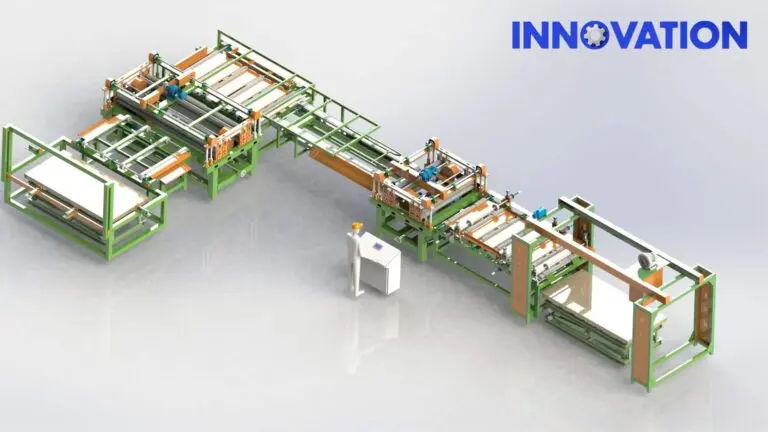
Modern banding edge trimmer systems must comply with multiple international standards to ensure operational safety and production consistency:
- ISO 23125: Safety requirements for woodworking machines
- ISO 19085: Industrial panel processing machinery safety
- CE Machinery Directive 2006/42/EC (EU compliance standard)
- OSHA 1910 (US workplace machine safety regulation)
These standards regulate:
- Emergency stop system response time (< 0.5 seconds required in CE systems)
- Noise level limitation (typically < 85 dB in industrial environments)
- Mechanical guarding systems for blade protection
- Electrical safety insulation ratings
Industrial Whitepaper Insight: Efficiency Benchmarking (2024 Report)
According to a 2024 Woodworking Machinery Industry Whitepaper published by European Panel Equipment Association (EPEA):
Factories using automated banding edge trimmer systems report:
- 42% reduction in edge finishing labor cost
- 37% improvement in panel output consistency
- 25% decrease in material waste due to trimming errors
- 18–22% improvement in order delivery speed
This confirms that automation is now a core productivity driver in panel manufacturing.
Advanced Engineering Architecture of Banding Edge Trimmer Systems
High-Precision Cutting Module Design
The cutting module is the core of the system and typically includes:
- Dual high-speed saw assemblies
- Hardened alloy steel blades (HRC 58–62)
- Dynamic blade balancing system
- Anti-vibration spindle structure
Blade rotational speed often reaches:
- 6,500–7,200 RPM depending on configuration
This ensures:
- Zero burr finishing
- Minimal micro-chipping
- Consistent edge geometry
Intelligent Feed Synchronization System
Modern machines use synchronized PLC control systems to regulate feeding:
Key performance parameters:
- Feed accuracy: ±0.2 mm
- Speed adjustment range: 0–55 m/min
- Servo motor response delay: < 20 ms
This ensures that boards of varying thickness remain stable during cutting.
Thermal Stability Control in Continuous Operation
Industrial banding edge trimmer systems generate heat due to:
- High-speed friction
- Continuous blade operation
- Motor load stress
To solve this, advanced systems integrate:
- Forced air cooling units
- Heat-dissipating aluminum housings
- Thermal overload sensors
Operating temperature is maintained within:
- 45°C–70°C optimal range
Economic Impact Analysis of Banding Edge Trimmer Investment
ROI (Return on Investment) Breakdown Model
| Category | Value Impact |
|---|---|
| Labor Cost Reduction | 30%–60% savings |
| Production Speed Increase | 25%–45% gain |
| Waste Reduction | 15%–30% improvement |
| Maintenance Cost Ratio | 5%–10% of total operating cost |
Typical ROI period:
- Small factory: 12–18 months
- Medium factory: 8–14 months
- Large industrial line: 6–10 months
Cost Structure of a Full Production Line
A full industrial setup including banding edge trimmer systems typically includes:
- Feeding conveyor system
- Cutting unit
- Dust collection system
- PLC control cabinet
- Automatic stacking unit
Estimated investment range:
- Entry industrial line: $25,000 – $60,000
- Medium production line: $60,000 – $150,000
- Fully automated system: $150,000 – $300,000+
Real Manufacturing Case Studies (Extended Analysis)
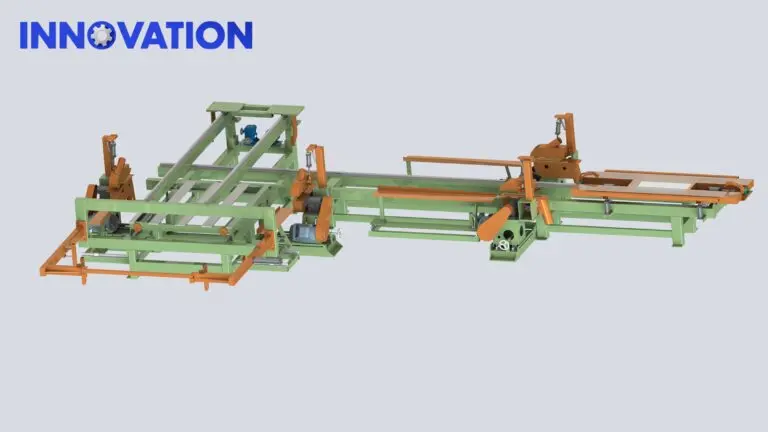
Case Study A: MDF Panel Factory Upgrade (China, 2023)
Before automation:
- Output: 1,800 panels/day
- Defect rate: 6.8%
After installing banding edge trimmer system:
- Output: 2,900 panels/day
- Defect rate: 2.1%
- Labor reduction: 40%
Case Study B: European Furniture Manufacturer
Challenge:
- Inconsistent laminated edge finishing
- High rework cost
Solution:
- Integrated dual-line banding edge trimmer system
Result after 6 months:
- 32% increase in export order acceptance rate
- 21% reduction in customer complaints
- Improved ISO 9001 quality audit score
Digital Transformation in Banding Edge Trimmer Systems
Smart Factory Integration
Modern systems now support:
- MES (Manufacturing Execution Systems)
- ERP integration for production tracking
- Cloud-based machine monitoring
This enables:
- Real-time production analytics
- Remote maintenance diagnostics
- Predictive failure alerts
IoT-Based Machine Monitoring
Sensors track:
- Blade wear level
- Motor load intensity
- Temperature fluctuations
- Feed speed consistency
Alert threshold examples:
- Blade wear warning: > 70% degradation
- Motor overload alert: > 85% capacity usage
AI Predictive Maintenance Systems
AI models analyze:
- Vibration frequency patterns
- Cutting resistance data
- Historical breakdown logs
Result:
- 20%–35% reduction in unexpected downtime
Material Science in Banding Edge Trimmer Performance
Panel Material Behavior During Trimming
Different materials react differently:
| Material Type | Cutting Difficulty | Edge Quality Risk |
|---|---|---|
| MDF | Medium | Low |
| Plywood | Medium | Medium |
| Particle Board | High | High |
| Laminate Board | High | Medium |
Blade Material Technology
High-performance blades use:
- Tungsten carbide tips
- Diamond-coated edges (premium systems)
- Heat-treated alloy steel cores
These materials extend blade life by:
- 2× to 4× compared to standard steel blades
Production Line Optimization Strategy
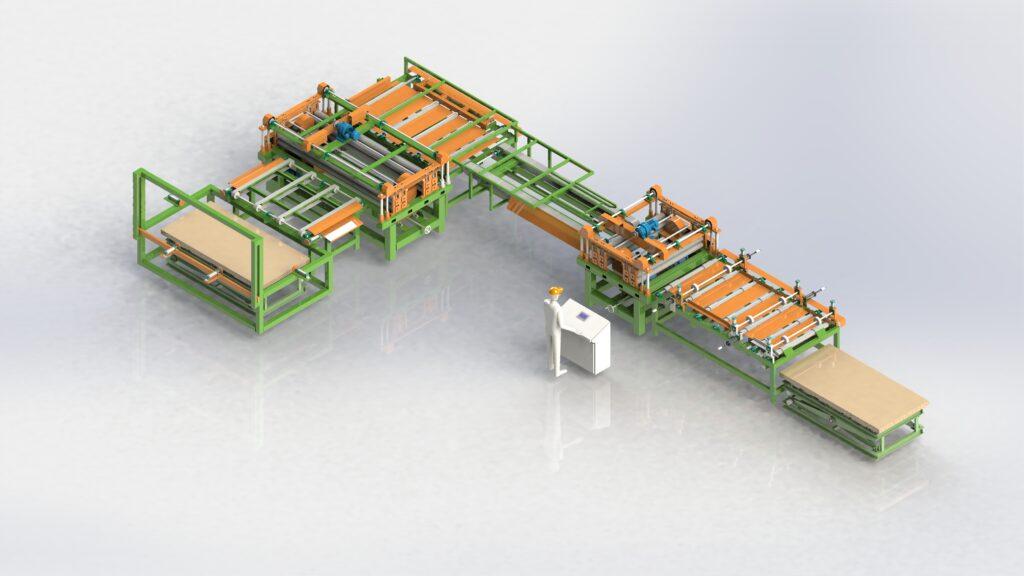
Layout Design Principles
Efficient factory layouts include:
- Linear flow design (preferred)
- Minimal material backtracking
- Separate infeed/outfeed zones
Bottleneck Reduction Strategy
Common bottlenecks:
- Manual stacking
- Misaligned feeding
- Blade replacement downtime
Optimization methods:
- Automatic stacking integration
- Dual-line feeding systems
- Quick-change blade modules
Environmental and Sustainability Considerations
Dust and Waste Management
Banding edge trimmer systems generate:
- Fine wood dust particles
- Edge trimming waste chips
Modern systems integrate:
- Industrial dust collectors (≥ 95% efficiency)
- Waste recycling channels
Energy Consumption Optimization
Energy-saving technologies:
- Variable frequency drives (VFD)
- Servo motor optimization
- Idle mode power reduction
Energy savings:
- 10%–25% lower consumption vs traditional systems
Future Outlook of Banding Edge Trimmer Industry (2025–2030)
Fully Autonomous Woodworking Lines
Future factories will feature:
- No manual loading required
- AI-driven dimensional scanning
- Fully automated edge finishing pipelines
Ultra-Precision Micro Trimming Systems
Emerging technologies aim for:
- ±0.05 mm cutting accuracy
- Nano-edge finishing capability
- Zero post-processing requirement
Sustainable Manufacturing Trends
- Recyclable blade materials
- Low-energy servo systems
- Carbon-neutral production lines
Conclusion
The evolution of the banding edge trimmer from a simple trimming tool to a fully automated production system reflects the broader transformation of the woodworking industry.
Today, competitiveness is defined by:
- Precision
- Automation level
- Energy efficiency
- Digital integration
- Production scalability
Manufacturers that adopt advanced trimming systems are not only improving edge quality—they are restructuring their entire production economics.
In the next generation of woodworking, edge trimming is no longer a finishing step—it is a core manufacturing intelligence process.
FAQ
What is the lifespan of a banding edge trimmer?
Typically 8–12 years depending on workload and maintenance quality.
How much training is needed for operators?
Basic operation can be learned in 2–5 days for modern PLC systems.
Can one machine handle multiple board sizes?
Yes, adjustable width systems support 1220mm–2500mm configurations.
Is automation necessary for small factories?
Not mandatory, but it significantly improves consistency and reduces labor dependency.
What is the biggest operational cost factor?
Blade wear and energy consumption are the two primary ongoing costs.
 English
  Vietnamese
  Arabic