
News
Hot Press Machine for Laminates and Best Laminate Hot Press Solutions Explained
Welcome to My Blog!
I’m so glad you’re here. Before we dive into the content, I’d love to connect with you beyond this page. On my social media, I regularly share industry insights, product updates, and behind-the-scenes moments — plus, it’s a great place for us to interact!
Follow us on Facebook: Shandong Chuangxin Automation Equipment Co., Ltd
Let’s grow together and stay connected. Now, let’s jump into the blog — I hope you find the content informative, engaging, and truly valuable.
Table of Contents
Key Takeaways of This Guide
- Understanding how laminate pressing systems improve bonding strength and surface quality
- How a hot press machine for laminates works in industrial manufacturing
- Key thermal, hydraulic, and structural technologies behind hot pressing
- Clear comparison between hot press and cold press processes
- Real industrial specification example with production-level parameters
- Selection guide, applications, and operational best practices
- FAQ section aligned with real search intent and buyer questions
Introduction
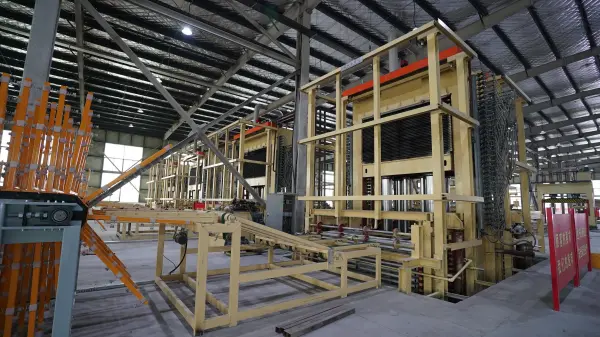
In engineered wood and decorative panel industries, product quality is defined during the pressing stage. Even premium raw materials cannot deliver strong performance without controlled heat and pressure application.
A hot press machine for laminates is designed to permanently bond surface layers such as decorative paper, veneer, or resin-impregnated films onto substrates like plywood, MDF, or particleboard. By combining heat activation and hydraulic pressure, it ensures strong adhesion, smooth finishing, and long-term durability.
As global demand for high-quality furniture panels and flooring materials continues to rise, hot pressing has become a core industrial process rather than an optional production step.
Hot Press Machine for Laminates in Modern Production Systems
What is a Laminate Pressing System?
A laminate pressing system refers to industrial equipment used to bond decorative or functional layers onto wood-based panels under controlled heat and pressure conditions.
Core functions include:
- Activating thermosetting adhesives
- Bonding decorative surfaces to substrates
- Improving surface smoothness and flatness
- Increasing structural density and durability
Role of Hot Press Machine for Laminates
The hot press machine for laminates ensures that adhesive materials fully cure under controlled thermal conditions.
It transforms layered materials into stable engineered boards suitable for furniture, flooring, and construction applications.
Why Hot Pressing Is Critical
Without heat activation, adhesives remain partially uncured.
This leads to weak bonding, surface bubbling, and reduced service life of the final product.
Hot Press Machine for Laminates Working Principle
Heat-Pressure Synergy Concept
Hot pressing works by combining thermal energy and mechanical force.
Heat softens resin-based adhesives while pressure ensures deep penetration into wood fibers.
Thermal Oil Heating System Concept
Thermal oil circulates inside platen channels to maintain stable and uniform temperature distribution.
This prevents uneven curing and surface defects across large panels.
Hydraulic Compression Mechanism
Hydraulic cylinders generate consistent vertical pressure across multiple platens.
This ensures uniform thickness and stable bonding across the entire board surface.
Hot Press Machine for Laminates Core Structure
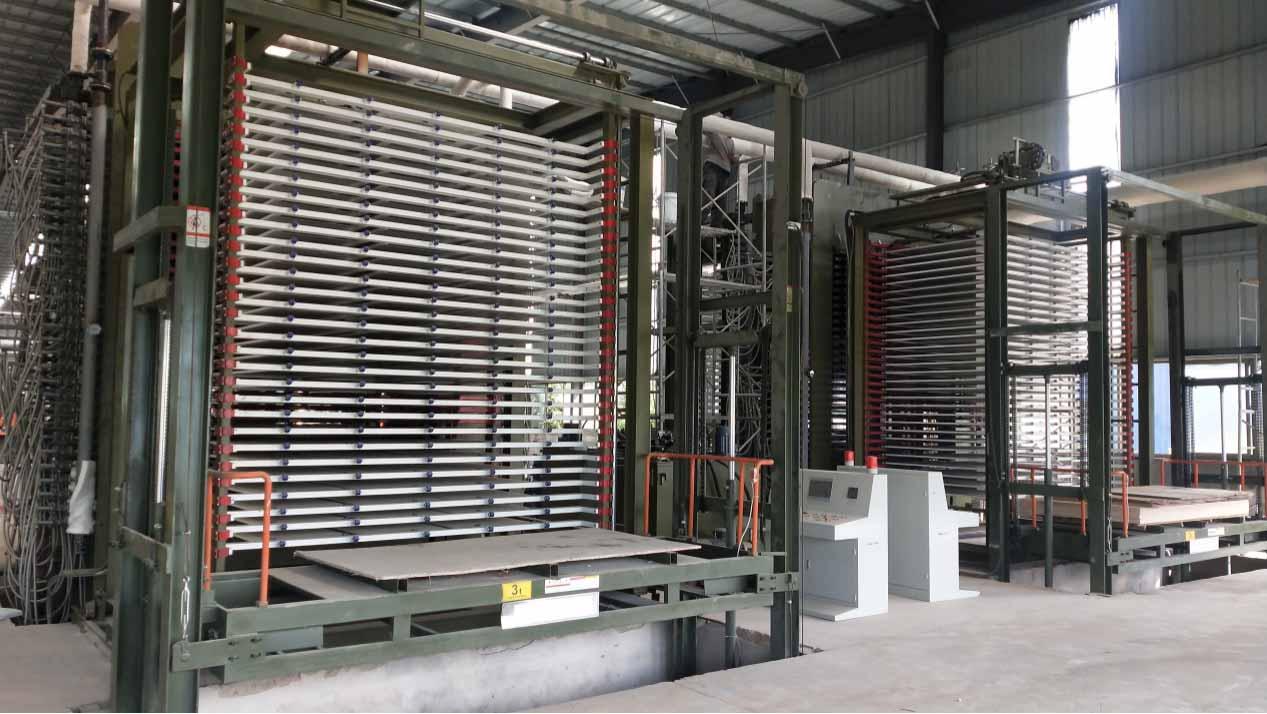
Heavy-Duty Frame System
Industrial hot press machines are built using reinforced steel frames designed for continuous operation.
High rigidity prevents deformation under long-term high-pressure cycles.
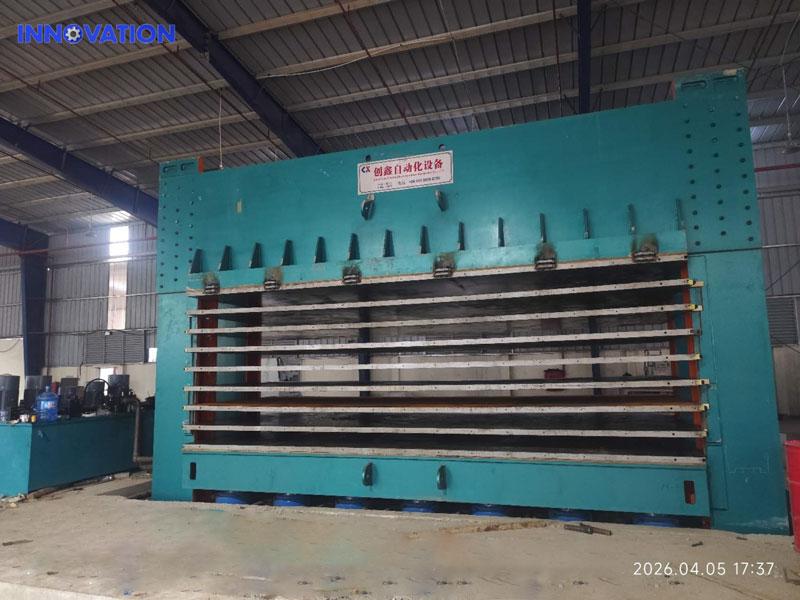
Multi-Layer Platen Configuration
Multi-layer systems allow batch processing of laminate boards.
Key structural features:
- 11-layer pressing capacity for high output efficiency
- Precision-machined platen flatness within 0.1 mm tolerance
- Dual oil circuit system for consistent heat transfer
PLC Intelligent Control System
Modern equipment uses programmable logic controllers (PLC) for automated operation.
Control functions include:
- Temperature control across multiple zones
- Pressure staging and cycle adjustment
- Automatic loading/unloading coordination
- Moisture discharge and safety control
Hot Press Machine for Laminates Workflow Explained
Adhesive Activation Stage
Thermosetting adhesives are activated under controlled heat.
This step determines final bonding strength and durability.
Laminate Layer Assembly
Decorative layers are placed onto substrate boards with precise alignment.
Any misalignment can lead to surface defects after pressing.
Hot Pressing Cycle Phase
Heat and pressure are applied simultaneously for curing.
Typical industrial parameters:
- Temperature: 120°C – 180°C
- Pressure: 10 – 20 MPa
- Cycle time: 5 – 15 minutes depending on material thickness
Cooling and Stabilization Stage
After pressing, panels are cooled under controlled conditions.
This prevents internal stress and deformation after release.
Industrial Specification Example: High-Capacity Hot Press System
| Component | Specification |
|---|---|
| Total Pressure | 600T |
| Platen Size | 1370 × 2700 mm |
| Number of Platens | 11 layers |
| Hydraulic Cylinder | 220 × 1000 mm × 6 units |
| Heating Method | Thermal oil system |
| Control System | PLC fully automatic |
| Installed Power | 29.5KW |
This configuration is widely used in industrial-scale laminate production facilities requiring high output and stable quality.
Hot Press Machine for Laminates vs Cold Press Machine
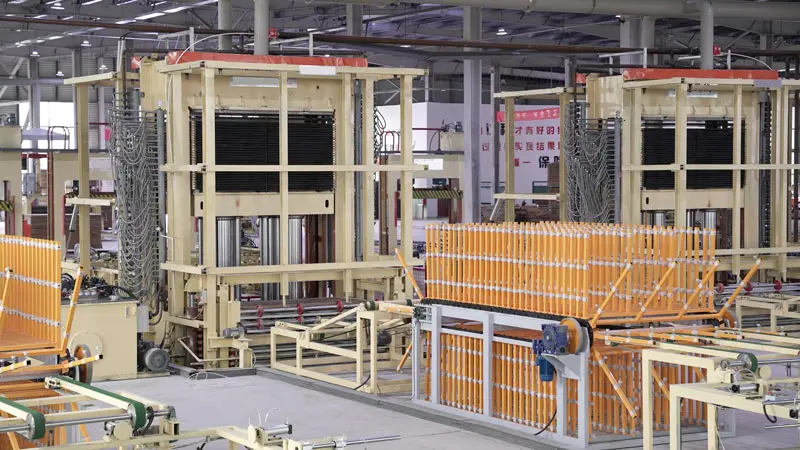
Functional Role Difference
Hot press machines finalize bonding through heat curing.
Cold press machines stabilize veneer layers before thermal processing.
Energy Consumption Difference
Hot pressing requires continuous heating energy.
Cold pressing operates without thermal systems.
Production Stage Difference
Cold press = pre-bond stabilization stage
Hot press = final curing and surface finishing stage
Output Quality Difference
Hot pressing delivers final surface smoothness and structural strength.
Cold pressing ensures alignment and reduces early-stage defects.
Comparison Table: Hot Press vs Cold Press
| Feature | Hot Press Machine | Cold Press Machine |
|---|---|---|
| Heat Requirement | Yes | No |
| Pressure Range | High (10–20 MPa) | Low–Medium (1–5 MPa) |
| Function Stage | Final curing | Pre-pressing |
| Surface Finish | Excellent | Basic |
| Energy Usage | High | Low |
| Production Role | Final product formation | Stabilization stage |
Types of Laminate Hot Press Systems
Single-Layer Hot Press System
Suitable for small-scale production with limited investment.
It offers simple operation and flexible usage.
Multi-Layer Hot Press System
Designed for industrial batch production.
It significantly improves production efficiency and output capacity.
Fully Automated Press Line
Integrates conveyors, PLC systems, and automated loading units.
It minimizes labor dependency and maximizes productivity.
Advantages of Hot Press Machine for Laminates
High Bonding Strength
Heat ensures complete curing of adhesives.
This results in durable and long-lasting panel structures.
Superior Surface Quality
Uniform pressure eliminates surface defects.
This is essential for decorative laminate applications.
High Production Efficiency
Multi-layer systems enable continuous batch processing.
This reduces production time per unit.
Material Compatibility Flexibility
Supports plywood, MDF, particleboard, and composite boards.
This makes it suitable for multiple industrial applications.
Application Scenarios of Laminate Hot Press Systems
Furniture Manufacturing Industry
Used for cabinets, tables, and decorative panels.
Ensures smooth surface finishing and strong structural integrity.
Flooring Production Industry
Used for engineered flooring surface lamination.
Improves wear resistance and aesthetic quality.
Construction Panel Industry
Used in wall panels and structural boards.
Provides stability under load-bearing conditions.
Hot Press Machine for Laminates Selection Guide
Pressure Capacity Selection
Higher tonnage is required for thick or multi-layer materials.
Small factories typically use lower-capacity systems.
Heating System Selection
Thermal oil systems provide stable temperature control.
Electric systems offer easier maintenance.
Automation Level Selection
Fully automated systems increase efficiency.
Semi-automatic systems reduce initial investment cost.
Production Scale Matching
Selection should match daily output requirements.
Large-scale production requires multi-layer systems.
Real Production Case Study
A laminate manufacturing factory upgraded its production line with a hot press machine for laminates.
Before Upgrade:
- Surface inconsistency issues
- 10–12% defect rate
- Slow production cycle
After Upgrade:
- Defect rate reduced to 3–5%
- Improved surface uniformity
- 30% increase in production efficiency
Final Outcome:
The factory significantly improved export quality consistency and reduced material waste.
Industry Standards and Quality Requirements
International Compliance Standards
- EN 14322 (Decorative laminate boards)
- ISO bonding strength testing standards
- CARB Phase II emission requirements
Key Quality Indicators
- Surface flatness ≤ 0.1 mm
- No delamination after stress testing
- Stable moisture resistance performance
Maintenance Guidelines for Hot Press Machine for Laminates
Hydraulic System Maintenance
Hydraulic oil should be replaced every 6–12 months.
Filters must be cleaned regularly to maintain pressure stability.
Heating System Maintenance
Thermal oil circulation must be checked periodically.
Platen heating channels should be inspected for uniform performance.
Operational Best Practices
Avoid overloading beyond rated capacity.
Ensure correct adhesive application and material alignment.
FAQ
What is a hot press machine for laminates used for?
It is used to bond decorative or functional layers onto wood-based panels using heat and pressure.
What temperature is used in hot pressing?
Typically between 120°C and 180°C depending on adhesive type and material.
How long is a hot pressing cycle?
Most cycles range from 5 to 15 minutes depending on thickness and production requirements.
What is the difference between hot press and cold press?
Hot press uses heat for final curing, while cold press is used for pre-stabilization.
Can hot press machines improve surface quality?
Yes, they significantly improve smoothness, flatness, and overall finish quality.
What industries use laminate hot press machines?
Furniture manufacturing, flooring production, construction materials, and decorative panel industries.
Conclusion
A hot press machine for laminates is a core component in modern laminate manufacturing systems. It ensures strong bonding, high surface quality, and stable production efficiency through precise heat and pressure control.
For manufacturers aiming to compete in global markets, investing in advanced hot pressing technology is essential for improving product consistency, reducing defects, and achieving long-term production stability.
 English
  Vietnamese
  Arabic