
News
Industrial Plywood Glue Spreader Machine Buying Guide
Welcome to My Blog!
I’m so glad you’re here. Before we dive into the content, I’d love to connect with you beyond this page. On my social media, I regularly share industry insights, product updates, and behind-the-scenes moments — plus, it’s a great place for us to interact!
Follow us on Facebook: Shandong Chuangxin Automation Equipment Co., Ltd
Let’s grow together and stay connected. Now, let’s jump into the blog — I hope you find the content informative, engaging, and truly valuable.
Table of Contents
Key Takeaways
- Understand how a plywood glue spreader machine improves bonding strength and production efficiency
- Learn key technical parameters before purchasing industrial glue spreading equipment
- Compare manual, semi-automatic, and fully automatic systems
- Explore industry standards, energy consumption, and ROI data
- Review real factory case studies and global market trends
- Identify common purchasing mistakes and how to avoid them
- FAQ section based on real buyer search behavior
Introduction
In modern plywood and engineered wood production, adhesive application is not a secondary process—it is the foundation of structural integrity. Any inconsistency in glue distribution directly leads to delamination, weak bonding, or surface defects.
A plywood glue spreader machine ensures that adhesive is applied uniformly across veneer or board surfaces, significantly improving bonding strength and reducing material waste. For industrial-scale manufacturers, it is one of the most critical machines in the production line, directly influencing product quality, output efficiency, and cost structure.
According to the 2023 Global Wood Panel Equipment Market Report (Woodworking Machinery Association):
- 78% of plywood defects originate from inconsistent glue application
- Automated glue spreading increases production efficiency by 20–35%
- Glue waste can be reduced by up to 30% using precision roller systems
These numbers highlight why selecting the right machine is a strategic investment rather than a simple equipment purchase.
Understanding Plywood Glue Spreader Machine Technology
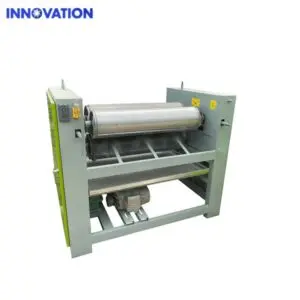
What is a Plywood Glue Spreader Machine?
A plywood glue spreader machine is an industrial device designed to apply a controlled and uniform adhesive layer on wood veneers or panels using precision roller systems.
It is widely used in:
- Plywood production lines
- MDF and particle board factories
- Furniture panel manufacturing
- Laminated wood processing industries
Core Working Principle
The machine operates through a multi-stage roller system:
- Glue roller applies adhesive evenly
- Metering roller controls glue thickness
- Squeezing roller stabilizes coating consistency
- Output conveyor transfers coated veneer for pressing
This ensures precise glue distribution, minimal waste, and stable bonding strength.
Industrial Importance of Plywood Glue Spreader Machine
Structural Bonding Performance
A uniform adhesive layer increases bonding strength by 15–25% compared to manual application methods, according to European Wood Engineering Standards EN 314-2.
Production Efficiency Impact
Factories using automated glue spreaders report:
- 20–40% faster production cycles
- Reduced manual labor dependency
- Lower rejection rates in final products
Cost Optimization Effect
Glue accounts for 18–25% of total plywood production cost. Efficient spreading systems can reduce glue consumption by up to 30%.
Key Technical Specifications of Plywood Glue Spreader Machine
Standard Industrial Configuration
| Parameter | Specification |
|---|---|
| Machine Size | 2200 × 1000 × 1400 mm |
| Roller Quantity | 4 pcs |
| Roller Length | 1400 mm |
| Max Veneer Width | 1400 mm |
| Veneer Thickness Range | 0.6–20 mm |
| Gluing Speed | 24–90 m/min |
| Motor Power | 3 kW |
| Rubber Thickness | 13 mm |
| Glue Roller Diameter | 246 mm |
Performance Parameters Explained
Gluing Speed Control System
Variable frequency drive (VFD) systems allow adjustable speed from 24 to 90 m/min, enabling flexible production across different veneer types.
Roller Pressure System
Precision-adjustable squeezing rollers ensure glue layer uniformity, reducing over-application or dry spots.
Motor Efficiency
Industrial-grade 3 kW motors provide stable torque for continuous operation in 24/7 production environments.
Types of Plywood Glue Spreader Machine
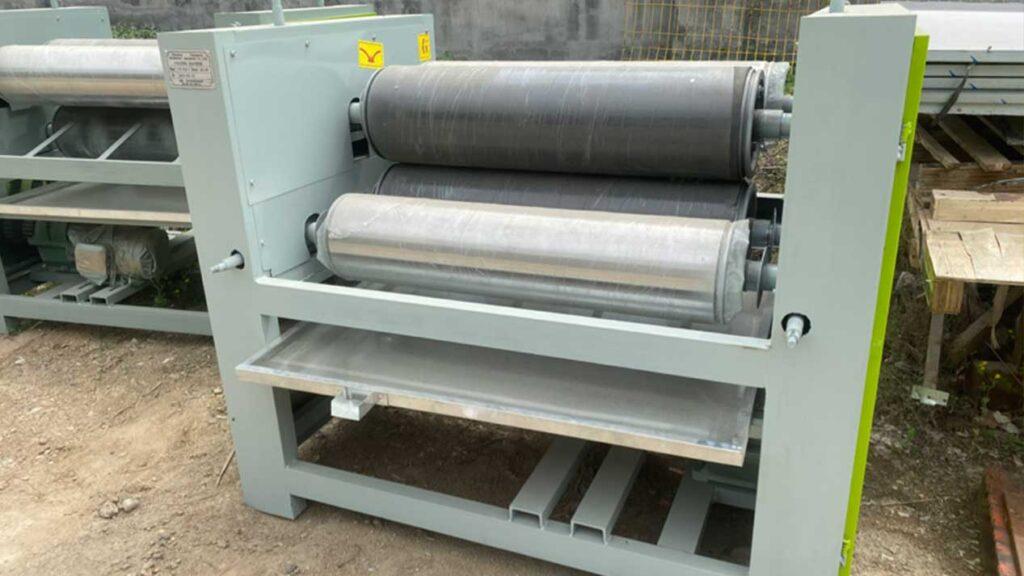
Manual Glue Spreader Machines
Manual systems require operator-controlled glue feeding and roller adjustment.
Advantages:
- Lower cost investment
- Simple mechanical structure
- Easy maintenance
Limitations:
- Inconsistent glue thickness
- High labor dependency
- Lower production efficiency
Semi-Automatic Glue Spreader Machines
These systems combine manual feeding with automatic roller pressure control.
Best for:
- Medium-scale plywood factories
- Flexible production environments
Fully Automatic Glue Spreader Machines
Fully automated systems integrate PLC control, automatic feeding, and precision roller control.
Advantages:
- High precision glue application
- Stable production quality
- Reduced labor cost by up to 40%
- Suitable for mass production lines
Comparison of Glue Spreader Systems
| Feature | Manual | Semi-Automatic | Fully Automatic |
|---|---|---|---|
| Precision | Low | Medium | High |
| Production Speed | Low | Medium | High |
| Labor Requirement | High | Medium | Low |
| Glue Waste Control | Poor | Moderate | Excellent |
| Investment Cost | Low | Medium | High |
| ROI Speed | Slow | Medium | Fast |
Industry Standards and Compliance
Key International Standards
- EN 314-2: Plywood bonding strength classification
- ISO 12460: Formaldehyde emission standards for wood-based panels
- CARB Phase 2: Emission control for adhesive-based wood products
- FSC Certification: Sustainable raw material sourcing
Compliance Importance
Machines compliant with these standards ensure:
- Global export eligibility
- Higher product reliability
- Reduced environmental impact
Case Studies: Real Factory Applications
Case Study 1: Southeast Asian Plywood Factory
- Installed: Fully automatic 4ft glue spreader machine
- Output increase: 32%
- Glue savings: 27% reduction
- Defect rate: reduced by 18%
Case Study 2: European Furniture Manufacturer
- Focus: High-quality decorative plywood panels
- Result: Improved surface bonding consistency by 22%
- Reduced labor cost by 35%
Case Study 3: MDF Production Line Upgrade
- Upgraded from manual to automatic system
- Production cycle time reduced from 12 min to 7 min
- Annual savings: approx. $48,000 in glue material costs
Industry Trends and Market Insights
Automation Growth
The global wood panel machinery market is projected to grow at 5.8% CAGR (2024–2030), driven by automation and precision equipment demand.
Smart Glue Application Systems
Modern machines now include:
- IoT monitoring systems
- Real-time glue consumption tracking
- AI-based pressure adjustment
Sustainability Focus
Manufacturers are shifting toward:
- Low-VOC adhesives
- Recyclable roller materials
- Energy-efficient motor systems
Cost Analysis and ROI Evaluation
Investment Breakdown
| Cost Factor | Impact |
|---|---|
| Machine Price | Initial capital expense |
| Glue Consumption | Major operational cost |
| Labor Cost | Reduced with automation |
| Maintenance Cost | Long-term operational factor |
ROI Example
A medium-scale factory using an automatic glue spreader achieved:
- 25% reduction in glue usage
- 30% increase in production efficiency
- ROI achieved in approximately 14–18 months
Common Purchasing Mistakes
Ignoring Production Scale
Choosing underpowered machines leads to bottlenecks and reduced efficiency.
Overlooking Glue Compatibility
Different adhesives require different roller materials and pressure systems.
Focusing Only on Price
Low-cost machines often lack precision systems, increasing long-term operational costs.
Maintenance and Operational Best Practices
Daily Maintenance
- Clean roller surfaces after production
- Remove adhesive residue immediately
Weekly Maintenance
- Check roller alignment
- Inspect motor and gearbox system
Monthly Maintenance
- Lubricate mechanical parts
- Inspect electrical and PLC systems
Conclusion
Selecting the right plywood glue spreader machine is a critical decision for any wood panel manufacturer. It directly influences:
- Product quality and bonding strength
- Production efficiency and cycle time
- Glue consumption and cost control
- Long-term factory profitability
With increasing automation and global competition, investing in a high-precision glue spreading system is no longer optional—it is a necessity for scalable, efficient, and sustainable production.
A well-selected machine ensures consistent quality, lower operational costs, and stronger market competitiveness, making it a core asset in modern plywood manufacturing.
FAQ
What does a plywood glue spreader machine do?
It evenly applies adhesive onto wood veneers to ensure strong bonding in plywood production.
Is automatic glue spreading better than manual?
Yes, it provides higher precision, faster production, and significantly lower glue waste.
How much glue can it save?
Typically between 20%–30% depending on production settings.
What industries use glue spreader machines?
Plywood, MDF, furniture manufacturing, and construction panel industries.
What is the ideal production speed?
Industrial machines operate between 24–90 m/min depending on material type.
How often does maintenance need to be done?
Basic cleaning daily, with full inspection weekly and monthly.
 English
  Vietnamese
  Arabic