
News
Inside a Modern Plywood Production Line: Complete Walkthrough
Welcome to My Blog!
I’m so glad you’re here. Before we dive into the content, I’d love to connect with you beyond this page. On my social media, I regularly share industry insights, product updates, and behind-the-scenes moments — plus, it’s a great place for us to interact!
Follow us on Facebook: Shandong Chuangxin Automation Equipment Co., Ltd
Let’s grow together and stay connected. Now, let’s jump into the blog — I hope you find the content informative, engaging, and truly valuable.
Table of Contents
Key Takeaways
- A complete, step-by-step explanation of how a modern plywood production line processes raw logs into finished panels
- In-depth technical insights on veneer peeling, moisture control, glue application, pressing technology, sanding, and QC
- Multiple concept sections covering veneer geometry, bonding chemistry, surface grading, press temperature curves, and more
- Real factory numbers, industry benchmarks, and expert commentary integrated throughout
- Comprehensive comparison of traditional vs modern plywood production setups
- Expanded analysis on sustainability, automation, energy efficiency, and smart monitoring
- Includes a natural-language FAQ section designed for today’s conversational search queries
Introduction
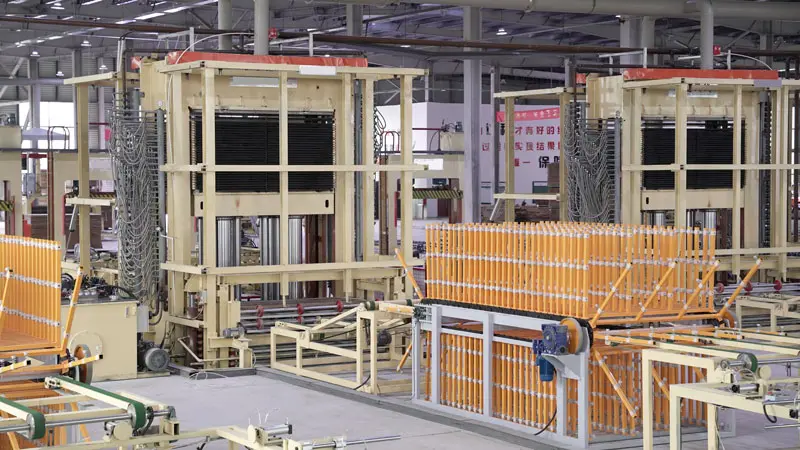
The plywood industry is transforming faster than ever before. Global construction growth, rising engineered wood usage, and the surge in modular furniture manufacturing continue to push plywood demand upward. Modern factories equipped with advanced plywood production line technology can now produce 3,000–8,000 panels per day, automated to a level unimaginable two decades ago.
Understanding how these production lines operate helps manufacturers optimize yield, equipment buyers make informed purchasing decisions, and industry professionals elevate product quality. This expanded walkthrough goes deeper than typical explanations. You’ll discover not only how plywood is made but why each stage matters, what technical parameters are used, which concepts define product quality, and how technology is reshaping manufacturing worldwide.
Raw Material Intake: Where a Plywood Production Line Begins
Log Selection and Grading
Choosing the right log species and grade determines panel strength, surface appearance, and production yield.
Concept: Log Grade Classification
Log grading divides logs by diameter, straightness, knot density, and defect patterns.
Higher-grade logs yield more face veneer with fewer repairs, while lower-grade logs are suitable for core layers.
Optimal selection reduces waste and increases total recoverable veneer by up to 15–22%.
Log Conditioning
Logs are preheated in hot water vats or steam rooms for 8–12 hours before peeling.
Concept: Thermal Softening
Heating softens lignin, decreasing the force needed for peeling.
Conditioned logs create flatter veneers with fewer microcracks.
Temperature varies by species: e.g., poplar at 52–58°C, eucalyptus at 65–72°C.
Log Debarking Stages in a Plywood Production Line
Primary Debarker Types
- Ring debarker – fast, ideal for uniform-diameter plantations
- Drum debarker – excellent for mixed species and varying log sizes
- Flail debarker – high bark removal rates for rough logs
Concept: Bark-to-Wood Friction
Debarkers remove bark through differential friction, where outer bark shears away before inner wood.
Lower bark residue reduces blade wear and avoids dark marks on veneer.
Efficient debarking can improve veneer brightness by 5–7%.
Veneer Peeling: The Heart of the Plywood Production Line
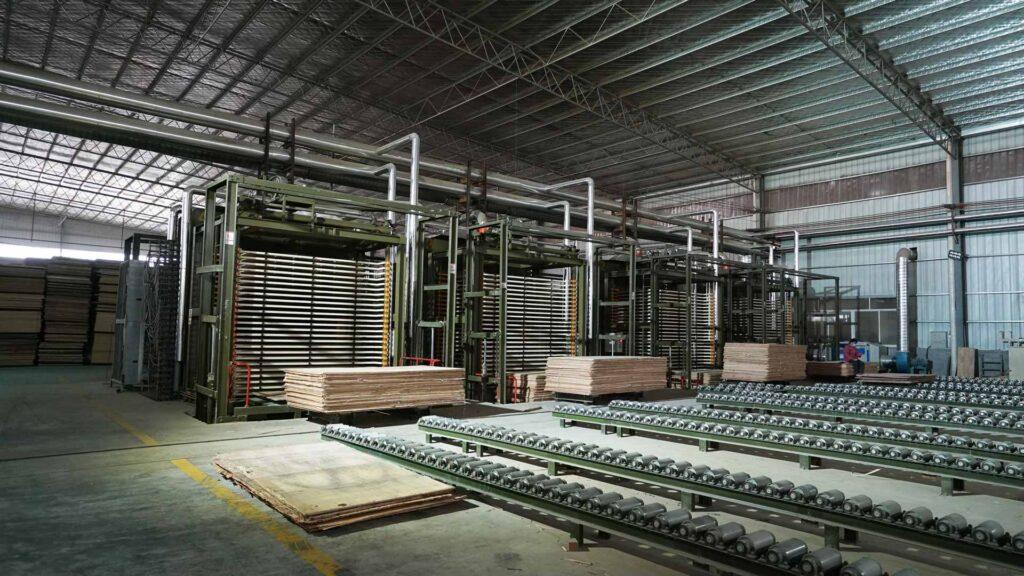
Rotary Lathe Mechanics
A CNC-controlled rotary lathe positions the log against a peeling knife, peeling veneers from 0.8 mm to 4 mm thick.
Concept: Peeling Geometry
Key parameters include:
- Knife angle (20–22° typical)
- Pressure bar force (adjusted by veneer thickness)
- Rotation speed (200–350 rpm)
Proper geometry reduces waves, splits, and thickness inconsistency.
Modern servo-driven lathes can maintain ±0.05 mm thickness accuracy.
Veneer Clipping
High-speed clippers cut wide veneer sheets into accurate-width strips.
Concept: Edge Optimization
Computer vision determines the best cutting paths to maximize usable veneer.
Optimized clipping reduces waste by 8–12% and improves stacking consistency.
Veneer Drying and Moisture Control
Roller Dryer Systems
Roller dryers use hot air circulation in 10–20 heating zones to dry veneers efficiently.
Chain Dryers
Perfect for thin veneers and delicate species.
Concept: Target Moisture Content
Ideal veneer moisture ranges from 5–8% depending on adhesive type.
Over-dried veneers crack during pressing; under-dried veneers cause steam blisters.
Inline moisture scanners maintain real-time monitoring with ±0.3% accuracy.
Energy Consumption Benchmarks
Modern veneer dryers consume 650–900 kWh per m³, while older systems may exceed 1,200 kWh.
Veneer Sorting and Grading Automation
Manual vs AI Grading
Manual grading relies on trained operators.
Automated vision systems detect defects with >95% accuracy.
Concept: Defect Recognition
AI systems analyze:
- Knots
- Holes
- Discoloration
- Splits
- Glue line shadows
- Core voids
This ensures correct face veneer selection, improving surface quality for furniture-grade plywood.
Glue Application: Bonding Layers in a Modern Plywood Production Line
Glue spreaders apply adhesive uniformly before pressing.
Common Adhesive Systems
- UF (Urea Formaldehyde) – interior use
- MUF (Melamine-Urea Formaldehyde) – moisture-resistant
- PF (Phenol Formaldehyde) – structural/exterior grade
Concept: Glue Spread Rate
Spread rate affects bond strength, press time, and cost.
Ideal rates:
- 120–160 g/m² for standard plywood
- 150–180 g/m² for moisture-resistant products
Precise control reduces glue waste by up to 25%.
Cold Pressing: Why It Improves Final Quality
Cold pressing forms a stable mat before hot pressing.
Concept: Pressure Distribution
Uniform pressure removes air pockets and aligns veneer layers.
Typical cold press force ranges from 0.6–1.2 MPa.
Better cold pressing equals fewer delamination defects in final panels.
Hot Pressing: Core Strength Formation in a Plywood Production Line
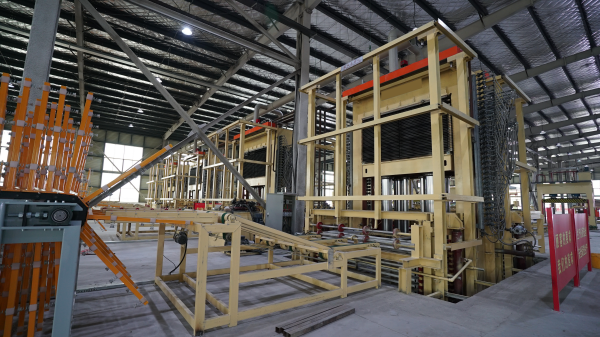
Two Major Press Types
- Multi-opening hot press – most common, produces batches
- Continuous hot press – high-speed, premium factories
Concept: Heat–Pressure–Time (HPT) Model
A perfect press cycle requires:
- Temperature: 110–150°C
- Pressure: 1–1.8 MPa
- Time: 3–8 minutes
Adhesive resin crosslinking at correct HPT produces structural-grade bonding.
Press Temperature Curves
A typical three-phase curve:
- Heating phase
- Bonding phase (peak temperature maintained)
- Cooling/pressure release phase
Trimming, Sizing, and Edge Quality
Panel saws remove excess edges and trim to standard sizes.
Concept: Dimensional Tolerance
Good factories achieve ±1 mm variation on length/width and ±0.2 mm on thickness.
Precision trimming improves performance in downstream processing such as CNC routing.
Surface Sanding and Calibration
Wide belt sanders achieve final thickness accuracy.
Concept: Surface Uniformity Index
This measures surface flatness and thickness variation.
High-quality plywood stays within 0.15–0.25 mm thickness variance.
Quality Control Standards in the Plywood Production Line
Mechanical Tests
- MOE (Modulus of Elasticity): 4,000–7,500 MPa typical
- MOR (Modulus of Rupture): 30–60 MPa
- Bond Shear Strength: 1.0–1.8 MPa minimum for structural plywood
Visual Inspections
Inspectors check for:
- Core gaps
- Delamination
- Bond shadows
- Overlaps
- Press blisters
Concept: Defect Propagation
Core voids create stress concentration points.
These points spread under load, reducing bending strength by up to 35%.
Traditional vs Modern Plywood Production Line Comparison
Traditional Lines
- Heavy manual labor
- Low veneer recovery
- Inconsistent moisture control
- Higher defect rate (up to 12–15%)
Modern Automated Lines
- AI-Vision grading
- Servo peeling
- Automated glue dosing
- Continuous hot pressing
- Real-time QC systems
Key Performance Differences
Modern lines improve:
- Yield by 20–25%
- Labor efficiency by 40–60%
- Bond consistency by 30–40%
Environmental and Sustainability Innovations
Low-Emission Adhesives
Factories use E0/E1-grade resins meeting EN 717-1 standards.
Zero-Waste Veneer Utilization
Leftovers become:
- Particleboard
- Biomass fuel
- Pallet blocks
Concept: Circular Utilization
Maximizes log value and reduces waste disposal costs.
Energy Recovery
Heat exchangers reclaim energy from dryers and presses.
Reduces total energy demand by 20–35%.
Industry 4.0 and Smart Automation in Plywood Production Lines
Modern Monitoring Technologies
- Infrared moisture scanners
- Servo-driven lathes
- AI defect graders
- Real-time glue usage meters
- Cloud-based production dashboards
Concept: Data-Driven Optimization
Continuous data feedback improves throughput and reduces machine downtime.
Factories adopting Industry 4.0 typically gain 5–12% extra yield without new machines.
Global Market Benchmarks and Trends
- Asia-Pacific leads production, accounting for over 65% of global output
- Automated plywood plants now average 3,000–5,000 sheets/day
- Furniture-grade plywood demand increasing 8–12% annually
- Sustainability-driven demand for low-formaldehyde plywood rising globally
Expert Insights
Dr. Elaine Harper, Wood Composites Researcher
“Moisture control is the single most important variable influencing hot press quality.”
Mark Ellison, Industrial Wood Technology Consultant
“Modern plywood lines are built around integration—machines must communicate, not just operate.”
Conclusion
A modern plywood production line is a sophisticated, highly optimized system blending engineering, chemistry, automation, and machine precision. Each stage—from peeling to pressing—is critical to creating plywood that meets global performance standards.
Thanks to innovations in AI grading, continuous hot pressing, energy recovery, automated glue control, and smart monitoring, plywood manufacturing is evolving rapidly. These advancements give factories higher yield, better product consistency, reduced waste, and more sustainable production—ensuring competitiveness in a demanding global market.
FAQ
How many machines are typically in a full plywood production line?
Usually 8–12 major units including debarker, lathe, dryer, glue spreader, cold press, hot press, saw, and sander.
How many workers does an automated line require?
Modern lines run with 8–12 operators per shift.
What is the normal daily production capacity?
Medium plants: 600–1,200 sheets/day
Large facilities: 3,000–5,000+ sheets/day
What veneers are used for plywood?
Thickness usually ranges from 0.8 mm to 4 mm, depending on the application.
Is automation worth the cost?
Yes—automation usually pays back in 18–30 months through higher yield and lower labor cost.
 English
  Vietnamese
  Arabic