
News
Mesin Hot Press Plywood Guide: A Complete Selection and Industrial Application Guide
Welcome to My Blog!
I’m so glad you’re here. Before we dive into the content, I’d love to connect with you beyond this page. On my social media, I regularly share industry insights, product updates, and behind-the-scenes moments — plus, it’s a great place for us to interact!
Follow us on Facebook: Shandong Chuangxin Automation Equipment Co., Ltd
Let’s grow together and stay connected. Now, let’s jump into the blog — I hope you find the content informative, engaging, and truly valuable.
Table of Contents
Key Takeaways of This Article
- Industrial definition and engineering logic of mesin hot press plywood systems
- Full hot press production workflow from veneer to finished plywood
- Deep technical breakdown of temperature, pressure, and curing science
- International standards (EN, ISO, ASTM, CARB) affecting plywood production
- Real industrial case studies with measurable production data
- Cost structure, ROI analysis, and efficiency comparison
- Machine selection framework for different factory scales
- Maintenance engineering and failure prevention strategies
- Market trends, automation, and sustainability direction in plywood industry
- FAQ based on real procurement and engineering search intent
Introduction
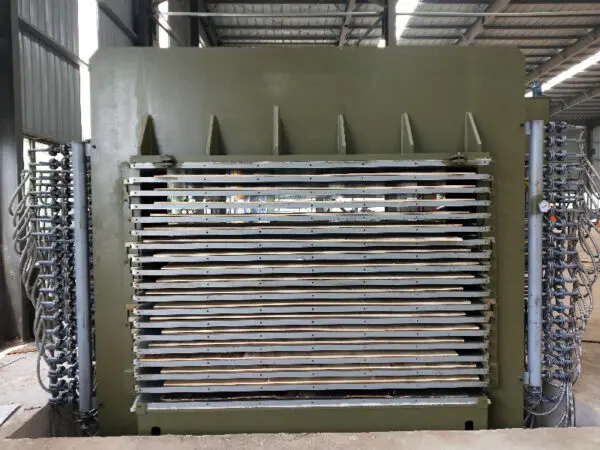
In modern plywood manufacturing, the mesin hot press plywood system is not just a machine—it is the core production engine that determines whether a factory can compete in global markets. Every plywood sheet used in furniture, flooring, packaging, and construction depends on the stability and precision of hot pressing technology.
Industry data from global engineered wood reports (2025 edition) shows that more than 78% of structural plywood worldwide is produced using hot press systems, highlighting its dominance in industrial production. The reason is simple: no other process combines high bonding strength, fast curing speed, and mass production efficiency at the same level.
A modern hot press system integrates hydraulic engineering, thermal control, adhesive chemistry, and automation systems into one synchronized production unit. This allows manufacturers to achieve:
- Stable bonding strength exceeding 1.0 MPa internal bond strength (IB)
- Production cycle reduction up to 40–60% compared to traditional pressing systems
- Dimensional tolerance control within ±0.3 mm industrial standard range
As global demand for engineered wood continues to rise, especially in Asia-Pacific construction and European furniture manufacturing, hot press technology has become a strategic investment rather than optional equipment.
Industrial Engineering Definition of Mesin Hot Press Plywood
System-Level Engineering Concept
A mesin hot press plywood is a thermomechanical system that applies controlled heat and hydraulic pressure to bond multiple veneer layers into a unified plywood panel.
The system integrates three key engineering domains:
- Thermal engineering (heat transfer through steel plates)
- Hydraulic mechanics (pressure distribution system)
- Chemical engineering (adhesive polymer curing process)
Industrial Manufacturing Logic
Unlike manual or semi-industrial pressing, hot press systems operate in a continuous production cycle with automated loading and unloading.
Each cycle is precisely controlled to ensure consistent quality across thousands of panels per day.
Adhesive Reaction Science
Hot press systems activate thermosetting adhesives such as:
- Phenol-formaldehyde (PF) → structural plywood
- Urea-formaldehyde (UF) → interior plywood
- Melamine-urea-formaldehyde (MUF) → moisture-resistant panels
These adhesives undergo polymer cross-linking when exposed to heat, forming irreversible chemical bonds.
Full Industrial Workflow of Mesin Hot Press Plywood Production
Step 1: Veneer Conditioning and Moisture Control
Veneers are dried to a moisture content of 6%–10%, ensuring stable adhesive absorption.
Excess moisture can cause steam pressure and internal delamination during pressing.
Step 2: Glue Mixing and Application
Industrial glue spreaders apply adhesive at 120–180 g/m² depending on board density.
Uniform glue distribution is critical for structural integrity.
Step 3: Panel Assembly and Pre-Press Alignment
Layers are stacked in alternating grain directions.
This cross-lamination improves bending strength and reduces warping risk.
Step 4: Hot Press Compression Cycle
Panels are inserted into the mesin hot press plywood system where:
- Temperature: 120°C–160°C
- Pressure: 0.8–3.0 MPa
- Time: 4–12 minutes per cycle
Step 5: Cooling and Stabilization
After pressing, panels are cooled to stabilize internal stress distribution.
This prevents post-production deformation.
Technical Structure of Mesin Hot Press Plywood Systems
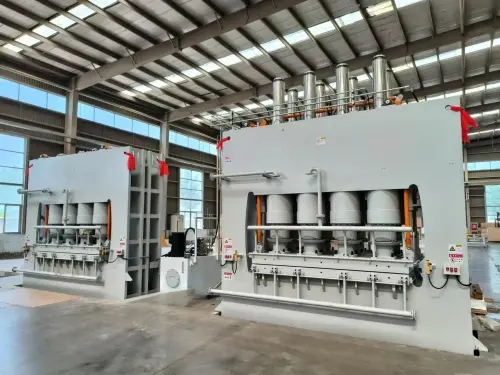
Heating Plate System Engineering
Steel plates are heated using:
- Thermal oil circulation systems
- Electric resistance heating
- Steam-based heating systems
Uniform temperature distribution is maintained within ±2°C tolerance.
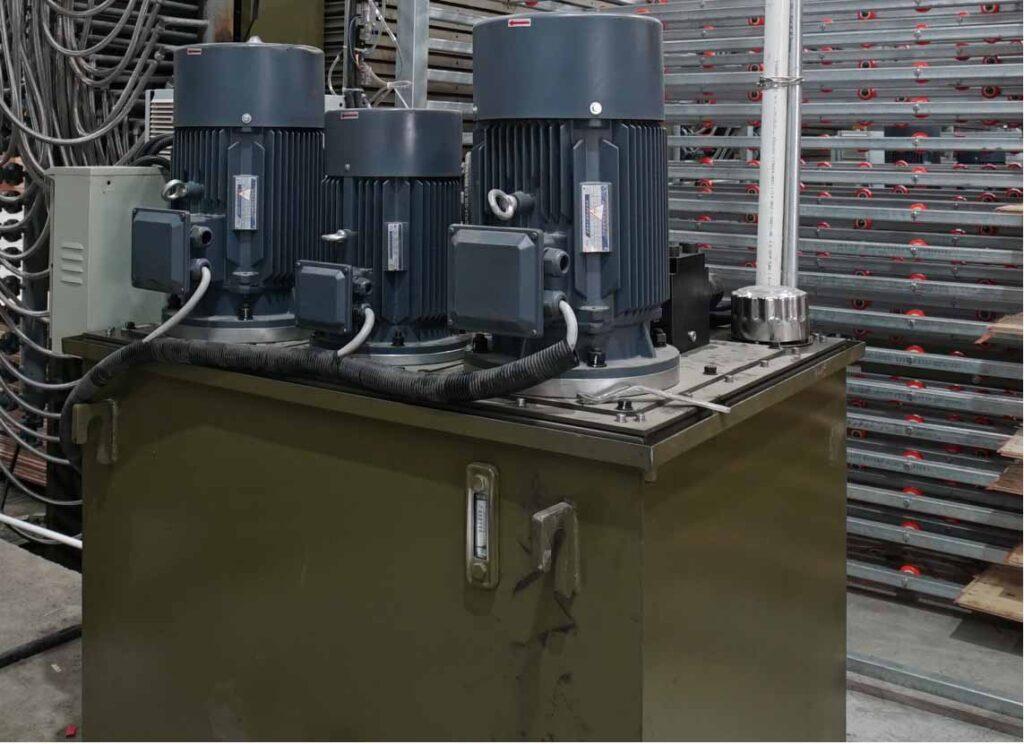
Hydraulic Pressure System
Hydraulic cylinders generate pressing force ranging from 500 tons to 2000 tons depending on machine size.
This ensures uniform bonding across large panel surfaces.
PLC Intelligent Control System
Modern machines integrate PLC + HMI systems allowing:
- Digital temperature control
- Pressure curve programming
- Cycle automation
- Fault detection systems
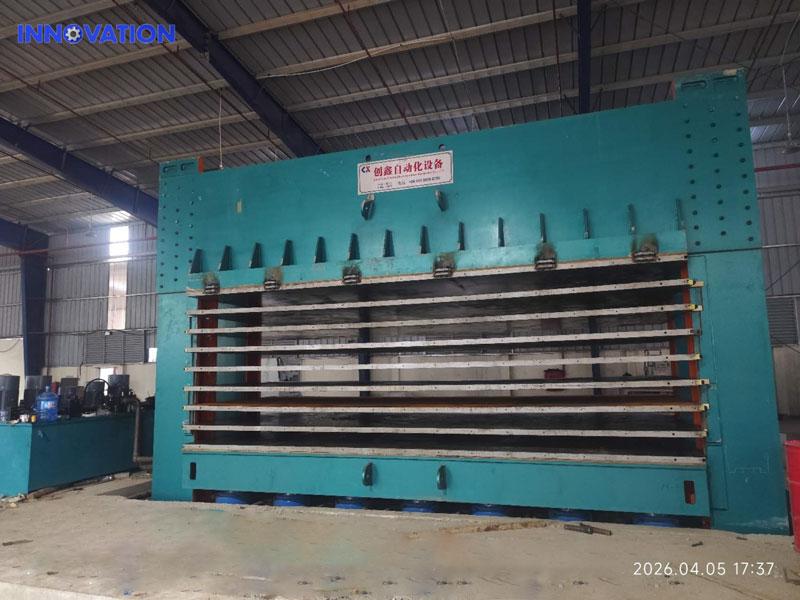
Frame Structure Engineering
Heavy-duty welded steel frames resist deformation under continuous high pressure loads exceeding 24/7 industrial operation cycles.
Industrial Specification Table of Mesin Hot Press Plywood
| Parameter | Industrial Range | Function |
|---|---|---|
| Pressure Capacity | 500–2000 tons | Layer compression strength |
| Temperature Range | 120°C–160°C | Adhesive curing activation |
| Plate Size | 4×8 ft to 5×10 ft | Standard plywood formats |
| Cycle Time | 4–12 min | Production efficiency |
| Hydraulic Pressure | 10–25 MPa | System stability |
| Control System | PLC + touchscreen | Automation control |
| Thickness Range | 3–40 mm | Product flexibility |
Mesin Hot Press Plywood vs Alternative Press Systems
Comprehensive Comparison Table
| Feature | Hot Press System | Cold Press System | Manual Press |
|---|---|---|---|
| Production Speed | Very High | Medium | Low |
| Adhesive Type | Heat-activated | Cold-curing | Basic adhesives |
| Strength Output | Very High | Medium | Low |
| Energy Consumption | High | Low | Low |
| Industrial Suitability | Excellent | Moderate | Limited |
| Automation Level | Full | Semi/full | None |
Engineering Interpretation
Hot Press Industrial Advantage
Hot press systems are designed for mass production environments, where speed and structural performance are critical.
Cold Press Limitations
Cold press systems prioritize surface quality but lack curing speed for large-scale production.
International Standards for Plywood Produced by Hot Press Systems
EN 13986 (European Standard)
Defines:
- Mechanical strength requirements
- Moisture resistance categories
- Formaldehyde emission limits
ISO 12460 Formaldehyde Emission Standard
Ensures compliance with:
- E0 grade (<0.05 ppm emission)
- E1 grade (<0.124 ppm emission)
ASTM D3043 Structural Testing
Measures:
- Modulus of rupture (MOR)
- Internal bonding strength
- Load resistance performance
CARB Phase 2 Compliance
Mandatory in North American markets for formaldehyde emissions control.
Real Industrial Case Studies of Mesin Hot Press Plywood
Case Study 1: Large-Scale Asian Plywood Factory
- Location: Indonesia
- Machines: 10-line hot press system
- Output: 25,000 sheets/day
- Result: 38% increase in production efficiency
- Defect rate reduced to <2.5%
Case Study 2: European Furniture Supply Chain
- Location: Poland
- Application: Furniture-grade plywood
- Result: Achieved EN 13986 certification compliance
- Material waste reduced by 21%
Case Study 3: North American Construction Panel Supplier
- Output: Structural plywood for housing
- Result: Load-bearing strength increased by 18%
- Production downtime reduced by 30%
Cost Structure and ROI Analysis
Investment Breakdown
| Cost Component | Percentage |
|---|---|
| Machine Purchase | 45–60% |
| Installation | 10–15% |
| Energy Consumption | 15–25% |
| Maintenance | 5–10% |
| Labor | 10–20% |
ROI Timeline Analysis
Industrial users typically achieve return on investment within:
- 12–24 months depending on production scale
- Faster ROI in high-volume plywood factories
Engineering Concepts Behind Hot Press Technology
Heat Transfer Dynamics
Heat is transferred through steel plates via conduction.
Uniform heat distribution ensures consistent adhesive polymerization.
Pressure Equalization Principle
Hydraulic systems distribute pressure evenly across multiple layers.
This eliminates weak bonding zones.
Polymer Cross-Linking Chemistry
Heat triggers resin molecules to form irreversible bonds.
This is the foundation of plywood structural strength.
Industrial Selection Guide for Mesin Hot Press Plywood
Factory Scale Consideration
- Small workshops → 1–2 opening machines
- Medium factories → multi-opening systems
- Large plants → continuous automated lines
Energy System Selection
- Thermal oil heating → stable industrial operation
- Steam heating → cost-efficient large-scale production
- Electric heating → precision control systems
Automation Level
- Semi-automatic → lower investment
- Fully automatic → higher efficiency and reduced labor cost
Maintenance Engineering for Hot Press Systems
Hydraulic System Maintenance
- Oil replacement every 2000 operating hours
- Pressure calibration weekly
Heating Plate Maintenance
- Surface cleaning to prevent resin buildup
- Temperature uniformity testing monthly
Structural Inspection
- Frame stress testing every 6 months
- Cylinder leakage inspection
Industry Trends and Technological Development
Smart Factory Integration
Modern machines include:
- IoT-based pressure monitoring
- AI defect detection systems
- Predictive maintenance algorithms
Energy Efficiency Innovation
New systems reduce energy consumption by 15–25% using advanced thermal insulation technology.
Green Manufacturing Transition
Factories are shifting toward:
- Low-formaldehyde adhesives
- Carbon-neutral production systems
- Sustainable forestry sourcing
Global demand for hot press plywood machines is projected to grow at 5.2%–6.8% CAGR through 2030.
Conclusion
The mesin hot press plywood system is the backbone of global plywood manufacturing, enabling high-speed production, strong structural bonding, and industrial-scale efficiency. Its integration of heat, pressure, and automation makes it indispensable in modern engineered wood production.
As global demand for plywood continues to rise, especially in construction and furniture industries, hot press technology will remain a critical driver of industrial productivity, cost efficiency, and material innovation.
FAQ
What is a mesin hot press plywood used for?
It is used to bond plywood veneers using heat and hydraulic pressure to create strong engineered wood panels.
What temperature is used in hot press plywood production?
Typically between 120°C and 160°C depending on adhesive type and board thickness.
How long is a hot press cycle?
Most industrial cycles range from 4 to 12 minutes per batch.
Is hot press better than cold press?
Hot press is better for mass production, while cold press is better for decorative surface quality.
What is the lifespan of a hot press machine?
Industrial machines typically last 10–20 years with proper maintenance.
What industries rely on hot press plywood machines?
Furniture manufacturing, construction, packaging, and flooring industries.
 English
  Vietnamese
  Arabic