
News
Top Hydraulic Press Models You Can Buy Today
Introduction
If you’ve been researching hydraulic presses, you already know how diverse the market is. From compact bench-top presses to massive four-column systems used in automotive or woodworking plants, choosing the right model can be overwhelming.
This article cuts through the noise. Drawing on industrial research, real-world applications, and engineering insights, we’ll explore today’s top hydraulic press models, their structures, functions, and what truly matters when buying one. Whether you run a manufacturing plant, a woodworking line, or an R&D workshop, this guide will help you make an informed investment.
Welcome to My Blog!
Before we dive into the content, if you’re interested in our products or have any questions, please feel free to visit our Contact Us page on the website. Our team is ready to assist you with inquiries, orders, or any support you may need.
Now, let’s get started on our journey together. I hope you find the content here insightful, engaging, and valuable.
1. Understanding the Main Types of Hydraulic Presses
Before you buy, it’s essential to know what’s out there. The type of press defines how it performs, how much space it needs, and what materials it’s best suited for.
| Type | Typical Tonnage | Best For | Main Advantages | Possible Limitations |
|---|---|---|---|---|
| C-Frame Press | 10–300 tons | Small parts, maintenance jobs | Compact, affordable, easy access | Limited rigidity, less suitable for large parts |
| H-Frame Press | 100–2000 tons | Heavy manufacturing, forming, laminating | Strong frame, balanced load | Larger footprint |
| Four-Column Press | 300–3000 tons | Wood panels, composites, large plates | High precision, uniform pressure | Higher cost, requires vertical clearance |
| Double-Acting Press | 200–2000 tons | Deep forming, dual-direction pressing | Faster cycles, multi-function | More complex hydraulic system |
| Bench / Table-Top Press | 1–50 tons | Lab testing, small batch work | Portable, low maintenance | Limited power and stroke length |
These are the structural backbones of nearly all hydraulic presses you’ll find on the market today.
2. High-Tonnage vs Low-Tonnage Presses: Which Do You Need?
Tonnage is often the first number buyers focus on—but bigger isn’t always better.
- Low-tonnage presses (10–200 tons) are perfect for precision jobs or smaller materials such as veneer boards or laminates.
- High-tonnage presses (500–3000+ tons) are used for heavy steel forming, automotive panels, and large composite sheets.
💡 Pro tip: Calculate your required pressing force based on the area and material strength—then add 20–30% for safety margin.
3. C-Frame vs H-Frame vs Four-Column: Key Comparisons
C-frames are popular for their accessibility and compactness. However, for wood or composite board pressing, the H-frame or four-column design gives better rigidity and even pressure distribution.
- C-Frame: Ideal for smaller workshops.
- H-Frame: A balanced solution for medium to large factories.
- Four-Column: The go-to design for large panel pressing—perfect for wood and board manufacturing (a sector Chuangxin specializes in).
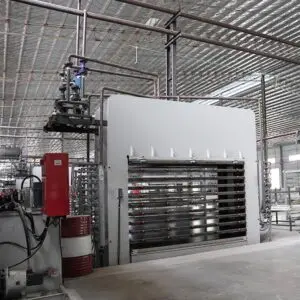
4. Hydraulic Presses for Wood and Board Pressing
In wood-based industries, pressure uniformity and temperature control are everything. A high-quality hydraulic hot press ensures even bonding, smooth surface finishing, and consistent density.
Modern models come with:
- Temperature-controlled platens for uniform heating
- Programmable pressure cycles
- Quick-release cooling systems
If your business produces laminated boards, plywood, or MDF panels, an industrial four-column press with heating capabilities will deliver the precision and durability you need.
5. Double-Acting Hydraulic Presses: Efficiency at Both Ends
A double-acting press can apply force in both upward and downward strokes, enabling faster cycles and cleaner forming results. These are ideal for high-volume production lines where speed and accuracy directly impact cost.
Manufacturers using bi-directional systems report up to 25% shorter cycle times and improved dimensional consistency, according to a 2024 industry report from Global Manufacturing Insights.

6. Smart and Automated Features
Modern hydraulic presses are smarter than ever. Features like IoT sensors, PLC controls, and force feedback systems allow you to monitor real-time performance, detect failures early, and optimize cycles for efficiency.
For example, the Chuangxin Intelligent Series integrates temperature, pressure, and cycle data into a single control dashboard—reducing downtime by up to 15% through predictive maintenance alerts.
Automation doesn’t just add convenience—it enhances productivity and consistency.
7. Energy Efficiency and Eco-Friendly Designs
Energy efficiency is becoming a decisive factor in heavy equipment selection. Many new hydraulic press models now feature:
- Variable-displacement pumps
- Servo-hydraulic drives
- Closed-loop oil systems
These innovations can reduce power consumption by 20–40% compared with conventional constant-flow systems. Investing in a green model not only lowers operational costs but also strengthens your ESG profile—a growing priority for global manufacturers.
8. Maintenance and Longevity Considerations
A hydraulic press is a long-term asset. Look for these design aspects to minimize maintenance and extend service life:
- Hardened and polished cylinders
- High-grade sealing systems
- Standardized components (easy replacement)
- Accessible lubrication and filter points
- Remote diagnostics
Routine maintenance—especially fluid checks and alignment calibration—can add 5–10 years of reliable service.
9. Real-World Applications Across Industries
Hydraulic presses are incredibly versatile. Common use cases include:
- Wood processing: Laminating, veneering, and hot pressing boards
- Automotive: Forming structural panels, bushings, and brake pads
- Metal fabrication: Stamping, drawing, and forming sheets
- Aerospace & composites: Molding lightweight structural parts
Each industry values different specs: woodworkers prioritize platen temperature stability, while metalworkers focus on stroke speed and force repeatability.
10. How to Choose the Right Model for You
Choosing the best hydraulic press comes down to matching capability with your workflow. Consider these steps:
- Define your material and application.
- Calculate required tonnage.
- Select structure type (C-frame, H-frame, or 4-column).
- Check platen size, stroke, and daylight.
- Compare automation and energy options.
- Evaluate supplier reputation and service.
If you need pressing for boards, laminates, or wood panels, focus on large four-column or H-frame hot press systems with stable temperature and pressure control—just like those offered by Chuangxin’s industrial series.
Conclusion
A hydraulic press is more than just a powerful machine—it’s a productivity multiplier. When chosen wisely, it can drastically improve product quality, reduce cycle times, and cut energy costs.
The right model depends on your application, space, and budget, but the principles remain the same: prioritize structure, efficiency, and after-sales support.
Whether you’re upgrading an existing line or launching a new production setup, now is the perfect time to invest in a smarter, more efficient press.
Explore modern hydraulic press solutions and discover how Chuangxin’s advanced models can help you build a more productive and sustainable operation.
FAQ
Q1. What is the main difference between hydraulic and mechanical presses?
Hydraulic presses use fluid power to generate pressure, offering smoother and more controllable force. Mechanical presses rely on flywheels—better for high-speed stamping but less flexible for variable materials.
Q2. How much maintenance does a hydraulic press require?
Basic maintenance includes checking oil levels, seals, and filters every few months. With proper care, most industrial presses operate for 15–20 years.
Q3. Can one press handle multiple materials (wood, metal, composites)?
Yes, but the setup must be adjusted for temperature, pressure, and cycle duration. Multi-purpose presses are common, but material-specific platens deliver better results.
Q4. How do I calculate required press tonnage?
Multiply your material’s yield strength by the surface area being pressed, then divide by two for safety margin. If unsure, consult your supplier’s engineering team for precise recommendations.
Q5. What certifications or standards should I look for?
Look for CE, ISO, and ANSI compliance, plus factory pressure testing certificates to ensure long-term safety and reliability.
 English
  Vietnamese
  Arabic