
Tin tức
Máy ép lạnh là gì?
Chào mừng đến với Blog của tôi!
Tôi rất vui vì bạn đã ghé thăm. Trước khi chúng ta đi sâu vào nội dung, tôi rất muốn được kết nối với bạn ngoài trang này. Trên mạng xã hội, tôi thường xuyên chia sẻ những hiểu biết sâu sắc về ngành, cập nhật sản phẩm và những khoảnh khắc hậu trường — hơn nữa, đây còn là một nơi tuyệt vời để chúng ta tương tác!
Theo dõi chúng tôi trên Facebook: Công ty TNHH Thiết bị tự động hóa Shandong Chuangxin
Hãy cùng nhau phát triển và giữ kết nối. Giờ thì, hãy cùng khám phá blog nhé — tôi hy vọng bạn thấy nội dung này bổ ích, hấp dẫn và thực sự giá trị.
Mục lục
Giới thiệu
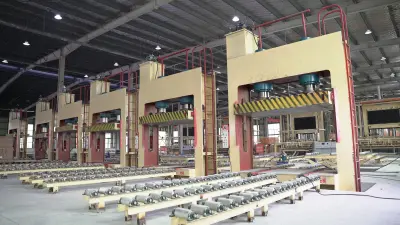
In the plywood and wood panel industry, the quality and efficiency of production largely depend on the pre-pressing stage. A máy ép lạnh is a pivotal piece of equipment in this process, designed to bond veneers, laminates, and wood panels without heat. By applying uniform hydraulic pressure, cold press machines ensure strong adhesion, flat surfaces, and improved panel stability, making them indispensable for furniture, door, and panel production lines.
Whether you are a factory owner, engineer, or equipment buyer, understanding the structure, operation, and advantages of cold press machines is crucial for optimizing plywood manufacturing and minimizing defects.
Key Takeaways from This Article
- Overview of what a cold press machine is and its role in plywood production
- Detailed workflow and specifications of a plywood cold press machine
- Comparison between top-mounted and bottom-mounted cold press machines
- Advantages, maintenance tips, and operational considerations
- Real-world applications, case studies, and industry standards
- FAQ addressing common questions from buyers and engineers
Understanding What a Cold Press Machine Is
MỘT máy ép lạnh is an industrial device that applies uniform pressure to glued veneer layers or wood panels without using heat. Unlike hot presses, which rely on temperature to activate adhesives, cold presses stabilize the veneers through mechanical and hydraulic pressure.
Core Functions of Cold Press Machines
- Veneer Layer Stabilization: Ensures that glued veneers remain aligned before hot pressing.
- Air Bubble Removal: Pressing expels trapped air, improving adhesion.
- Preparation for Hot Pressing: Reduces deformation and ensures a flat, strong plywood panel.
Ideal Applications
- Multi-layer plywood production
- Laminated furniture panels
- Door skins and large panels requiring precise thickness
- Any workflow requiring pre-pressing before hot curing
How a Cold Press Machine Works
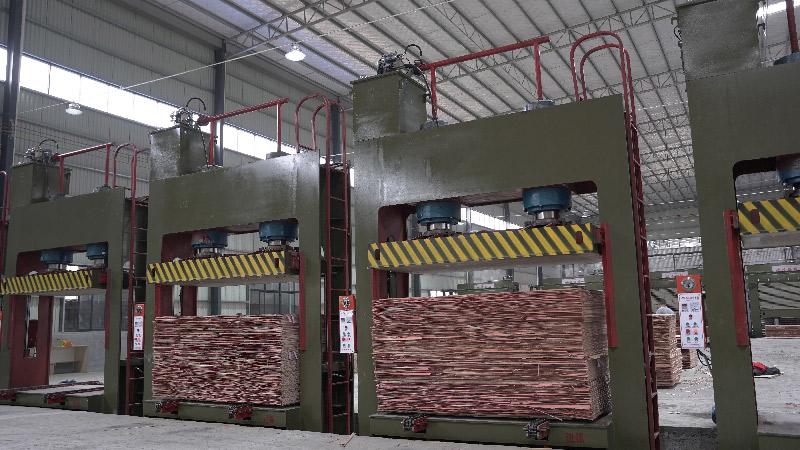
The workflow of a máy ép lạnh ván ép is a structured and precise process designed to ensure high-quality panel bonding, uniform thickness, and minimized defects. Each step in the workflow plays a critical role in achieving a stable pre-pressing result, which ultimately affects the final product quality after hot pressing.
Bước 1: Keo Ứng dụng
The process begins with the application of adhesive on veneer sheets.
- Glue Coating Method: Veneer sheets are evenly coated using a mechanical or automated glue spreader, ensuring consistent coverage across the surface.
- Glue Thickness Control: The adhesive thickness is carefully calibrated to avoid excessive glue that could seep during pressing, or insufficient glue that could lead to weak bonding.
- Quality Checks: Operators inspect each sheet for uneven coating, air bubbles, or gaps to ensure that every layer is ready for assembly.
Why it matters: Proper glue application prevents layer misalignment, weak adhesion, and future panel delamination, all of which can cause product rejection and increased production costs.
Step 2: Veneer Assembly
After applying glue, the veneers are carefully assembled into a panel.
- Layer-by-Layer Stacking: Veneers are stacked manually or via automated systems. Each layer is aligned to prevent offsets that could reduce panel strength.
- Thickness Adjustment: Desired plywood thickness is controlled by the number of veneer layers and the uniformity of glue distribution.
- Alignment Tools: Some factories use alignment frames or guides to ensure precise veneer positioning before pressing.
Practical Tip: In high-volume operations, automated stacking systems improve efficiency while reducing human error, ensuring that large panels maintain uniform quality across multiple production runs.
Bước 3: Tải bảng điều khiển
Once assembled, the veneer panel must be transferred to the cold press machine for pre-pressing.
- Lifting Mechanisms: Hydraulic or mechanical lifting systems are commonly used to safely handle large or heavy panels, reducing labor and preventing damage.
- Panel Positioning: The panel is centered on the press platform to ensure uniform pressure application across the entire surface.
- Operator Safety: Modern systems include sensors and safety stops to prevent accidents during loading.
Best Practice: Use forklifts or hydraulic lifts compatible with the cold press’s daylight opening and platform dimensions to maintain efficiency and safety.
Step 4: Pressing Operation
This is the core step where the veneers are bonded under uniform pressure.
- Hydraulic Cylinder Activation: Cylinders lower the upper platen onto the veneer stack.
- Pressure Settings: Typical pressing pressure ranges from 1 to 5 MPa, adjusted according to panel size, veneer type, and glue characteristics.
- Thời gian giữ: Panels are pressed for 3–10 phút, allowing the glue to partially set and the layers to stabilize.
- Monitoring: Advanced systems use digital pressure sensors to ensure even pressure distribution, while manual setups may rely on mechanical gauges.
Why it’s important: Uniform pressure prevents air pockets, uneven adhesion, and warping, which are common issues if pressing is uneven. Proper holding time ensures the veneers remain in place for the hot press stage.
Bước 5: Phát hành Platen và dỡ bảng điều khiển
After pressing is complete, the panel is released:
- Automatic Platen Rise: The hydraulic system lifts the upper platen automatically.
- Panel Removal: Pre-pressed panels are carefully removed using lifting tools, forklifts, or conveyors.
- Preparation for Hot Pressing: Panels are transferred to the máy ép nóng for final curing, ensuring strong, durable plywood.
Mẹo: Avoid immediate handling with bare hands for heavy panels. Using lifting aids reduces the risk of damage and improves workflow efficiency.
Step 6: Continuous Operation
A key advantage of cold press machines is the ability to support continuous production cycles:
- Next Batch Loading: Once one panel is removed, the next set of glued veneers is loaded immediately.
- Cycle Repetition: The pressing cycle repeats, allowing factories to maintain high throughput without downtime.
- Automation Integration: Some factories integrate conveyors and robotic loaders to automate panel transfer, increasing productivity and reducing manual labor.
Efficiency Note: Properly timed operations ensure that pressing pressure, holding time, and unloading are synchronized with panel assembly, optimizing throughput without compromising panel quality.
Extended Considerations for Large-Scale Production
- Panel Size and Weight: Large panels may require multiple hydraulic cylinders to maintain uniform pressure.
- Environmental Conditions: Temperature and humidity can affect glue curing and press performance. Maintaining stable conditions ensures consistent quality.
- Cycle Optimization: Pressing time and pressure can be adjusted depending on the type of adhesive, veneer thickness, and production speed.
- Energy Efficiency: Cold presses operate without heat, consuming significantly less energy than hot presses, reducing operational costs.
Ví dụ thực tế
A plywood factory using a 400T bottom-mounted cold press machine with 1800 mm daylight opening achieved the following:
- Production Rate: 120 panels per hour with continuous operation.
- Glue Efficiency: 10% reduction in adhesive waste due to uniform pressure.
- Panel Flatness: 95% of panels met strict flatness and thickness tolerances on the first pre-press pass.
- Labor Savings: Automated panel loading and unloading reduced manual labor by 40%.
Specifications of a Standard Plywood Cold Press Machine
| Đặc điểm kỹ thuật | Máy ép lạnh đáy 400T |
|---|---|
| Tổng áp suất | 400T |
| Cấu trúc khung | Welded frame with precision-machined upper/middle/lower beams |
| Beam Dimensions | Upper & Lower Beam: 900 mm, Middle Beam: 400 mm |
| Độ dày tấm thép khung | 30 mm |
| Upright Leg Width | 380 mm × 4 pcs |
| Mở cửa ban ngày | 1800 mm |
| Top Platen Loading | Forklift slots for panel placement |
| Xi lanh thủy lực chính | 320 × 900 mm, Cast steel body, alloy plunger, 26 MPa rated pressure, 2 units |
| Hệ thống thủy lực | Pollution-free standard station, Taiwan Jiugang valves, 10MC plunger pump |
| Động cơ | Fast Pump Motor: 7.5 KW-4, High-Pressure Pump Motor: 5.5 KW-4 |
| Hệ thống điều khiển | Fully automatic operation, Schneider electrical components |
Các tính năng chính:
- Tiết kiệm năng lượng: Operates without heat, reducing power consumption.
- Strong Bonding: Provides uniform, stable pressure for reliable adhesion.
- Vận hành dễ dàng: Simple controls and low maintenance requirements.
Types of Cold Press Machines
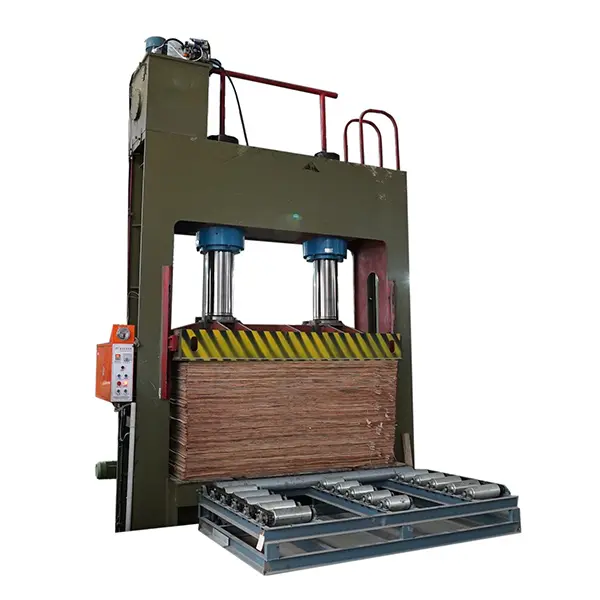
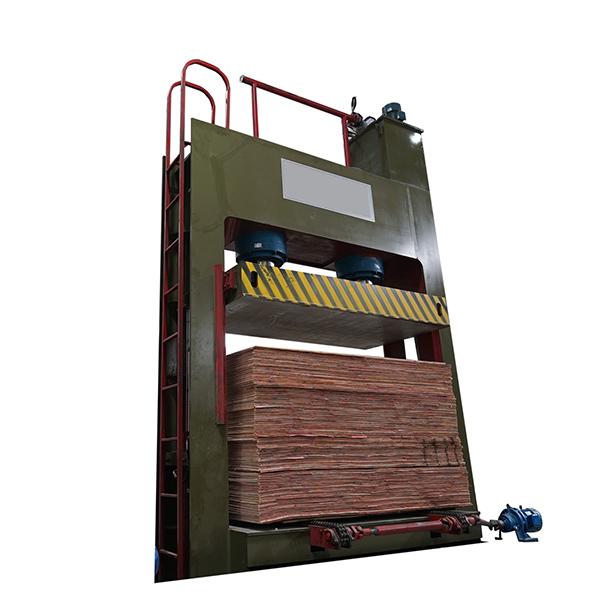
Máy ép lạnh can be categorized mainly by hydraulic cylinder placement.
Top-Mounted Cold Press Machines
- Cylinders are installed above the upper platen.
- Upper plate moves downward to compress plywood on the stationary lower platen.
Thuận lợi:
- Uniform pressure and strong bonding
- Easier maintenance and inspection
- Traditional, widely used in conventional plywood factories
Bottom-Mounted Cold Press Machines
- Cylinders are installed beneath the lower platen.
- Bottom plate rises to press against a fixed upper plate.
Thuận lợi:
- Saves overhead space for low-ceiling factories
- Allows open upper workspace for automation and conveyors
- Suitable for modern automated plywood production lines
Comparison: Top-Mounted vs Bottom-Mounted Cold Press Machines
| Tính năng | Top-Mounted | Bottom-Mounted |
|---|---|---|
| Hydraulic Cylinder Location | Above upper platen | Below lower platen |
| Pressing Direction | Downward | Upward |
| BẢO TRÌ | Easy | Moderate to complex |
| Space Requirement | Cao | Compact / Low-ceiling |
| Automation Compatibility | Vừa phải | Cao |
| Stability & Pressure | Xuất sắc | Requires precise alignment |
| Common Usage | Traditional plywood lines | Low-ceiling / automated lines |
Advantages of Máy ép lạnh
- Improved Panel Quality: Flat surfaces, strong bonding, reduced defects
- Enhanced Production Efficiency: Continuous operation and faster cycle times
- Cost Reduction: Minimizes waste and rework due to misalignment
- Tiết kiệm năng lượng: Operates without heat, lowering energy consumption
- Automation Integration: Compatible with conveyors, loaders, and modern factory layouts
Case Study: Furniture Panel Production
A mid-sized furniture panel factory integrated a 400T bottom-mounted cold press machine:
- Production capacity increased by 25% due to continuous pre-pressing cycles
- Glue usage reduced by 10% through uniform pressure application
- Panel flatness improved, resulting in lower rejection rates during hot pressing
Maintenance Tips for Cold Press Machines
- Daily Checks: Hydraulic oil level, cylinder alignment, platen surface cleanliness
- Weekly Inspections: Hoses, pump performance, and valve conditions
- Monthly Maintenance: Hydraulic fluid replacement, safety system verification, and control system calibration
- Safety First: Ensure operators are trained and emergency stop functions are operational
Phần kết luận
Hiểu biết what a máy ép lạnh is is vital for modern plywood production. From top-mounted to bottom-mounted designs, these machines improve panel flatness, bonding strength, and production efficiency. By selecting the right type, following proper workflow, and maintaining the machine effectively, factories can achieve high-quality plywood, reduced waste, and optimized operational efficiency.
MỘT máy ép lạnh is not just a pre-pressing tool—it is an essential investment for any plywood or wood panel manufacturing line seeking quality, efficiency, and automation readiness.
Câu hỏi thường gặp
Q1: What is a máy ép lạnh dùng để làm gì?
A: It stabilizes glued veneers before hot pressing, ensuring uniform adhesion and flat surfaces.
Q2: Which type is better for automated production lines?
A: Bottom-mounted cold press machines provide open upper space for conveyors and robotic loaders.
Q3: How does a cold press machine improve panel quality?
A: By applying uniform pressure, removing air bubbles, and stabilizing layers, reducing defects in hot pressing.
Q4: What maintenance is required?
A: Regular inspections of hydraulic cylinders, alignment guides, oil levels, and cleaning platen surfaces.
Q5: Can cold press machines handle large plywood panels?
A: Yes, with specifications like 400T pressing capacity and 1800 mm daylight opening, they accommodate large panels efficiently.
 Vietnamese
  English
  Arabic