
News
What Is Core Board? A Practical Guide for Plywood Production
Welcome to My Blog!
I’m so glad you’re here. Before we dive into the content, I’d love to connect with you beyond this page. On my social media, I regularly share industry insights, product updates, and behind-the-scenes moments — plus, it’s a great place for us to interact!
👉 Follow us on Facebook: Shandong Chuangxin Automation Equipment Co., Ltd
Let’s grow together and stay connected. Now, let’s jump into the blog — I hope you find the content informative, engaging, and truly valuable.
Table of Contents
Introduction

Core board plays one of the most fundamental roles in plywood and panel manufacturing. As the internal layer that provides strength, stability, and structure, it directly determines the performance of the final wood panel product. In modern production, the process of assembling high-quality core board increasingly depends on advanced equipment such as core veneer composers, which help factories achieve consistent quality, reduced waste, and higher efficiency.
This guide takes you from concept → process → technology → comparison → real examples, providing a full understanding of how core board is made and why it matters.
What Is Core Board? Understanding the Essential Middle Layer
Core Board Definition and Concept
Core board refers to the middle structural layer of plywood, blockboard, and various engineered panels.
It is typically produced by joining smaller veneer strips into full-size sheets.
This layer ensures overall panel strength and minimizes warping over time.
Why Core Board Matters
The core layer acts as the backbone of plywood.
Without a stable core, the outer veneer surfaces lose durability and dimensional stability.
This is why manufacturers focus heavily on the quality of the core during production.
Core Veneer vs. Face Veneer
Core veneer prioritizes strength, uniformity, and bonding quality, while face veneer focuses on appearance and texture.
Both layers exist for different purposes but must work together to achieve a high-quality panel.
Key Functions of Core Board in Wood Panel Manufacturing
Structural Support
The core layer takes on most of the load-bearing responsibility in plywood.
Its strength directly influences the bending resistance and overall lifespan of the panel.
Enhancing Dimensional Stability
A well-composed core board reduces gaps and internal stress.
This helps prevent panel deformation due to humidity, pressure, or temperature changes.
Optimizing Raw Material Use
Manufacturers often utilize small or narrow veneer pieces that would otherwise be waste.
Through proper composing, these scrap pieces become valuable full-size core sheets.
Types of Core Boards and Their Characteristics
Veneer Core
Made from multiple veneer layers for excellent mechanical strength.
Commonly used in high-quality plywood production.
Lumber Core
Constructed from small wooden strips, ideal for thicker panels requiring rigidity.
Offers enhanced screw-holding strength.
Composite Core
A combination of veneer and particle materials.
Used in cost-sensitive furniture and general-purpose panels.
How Core Board Is Made: Step-by-Step Production Process
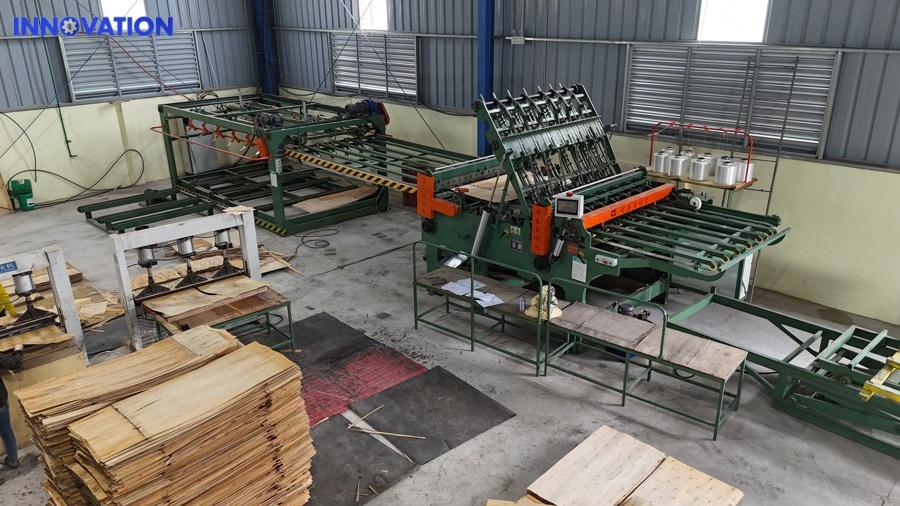
Producing core board involves multiple integrated steps, from veneer preparation to final sheet stacking. Below is the typical workflow used in modern factories.
Step 1 – Veneer Preparation
Veneers are sorted by width, thickness, and moisture content.
Defected edges are removed manually or with automated systems.
Step 2 – Edge Cutting and Sizing
Damaged or uneven edges are trimmed for a clean, bond-ready surface.
Precision cutters ensure consistent alignment later in the process.
Step 3 – Veneer Jointing / Composing (Core Veneer Composer Stage)
This is the most critical phase for core board.
Small veneer strips are aligned and joined into large sheets using finger-joint or butt-joint technology.
Finger-Joint Technology
Creates strong, interlocking joints that maximize bonding strength.
Ideal for factories aiming for long-term panel durability.
Butt-Joint System
Faster joining method suitable for general-purpose panels.
Useful for factories processing large volumes of veneer daily.
Step 4 – Adhesive Application
A thin, evenly distributed layer of glue is applied with rollers or spray nozzles.
Uniform gluing prevents weak spots and delamination.
Step 5 – Pressing and Cooling
Hydraulic or pneumatic pressure ensures the veneer strips form a stable, flat core sheet.
Short cooling time protects bonding quality.
Step 6 – Output and Automatic Stacking
Finished core boards are neatly stacked for transport to the next manufacturing step.
Automation reduces labor and prevents sheet damage.
Technical Factors That Influence Core Board Quality
Moisture Content Control
Optimal moisture is between 8–12%.
Too much moisture leads to warping; too little causes brittle edges.
Thickness Consistency
Even thickness ensures smooth lamination and stable hot-press performance.
Joint Strength and Accuracy
High-quality joints prevent cracks and delamination in finished products.
Precision joining directly contributes to long-term panel durability.
Glue Uniformity
Proper adhesive distribution affects bonding strength, surface flatness, and resistance to internal stress.
Manual Core Board Joining vs. Automated Core Veneer Composer
Efficiency Comparison
Manual joining: 5–8 m/min
Automated composer: 30–60 m/min
Automation significantly shortens production cycles.
Material Utilization
Manual waste: 15–20%
Machine waste: below 5%
Better alignment and trimming systems reduce scrap.
Labor Requirements
Manual joining requires 6–8 workers.
Automated systems need only 1–2 operators.
Quality Consistency
Manual work depends heavily on operator skill.
A composer machine uses PLC-controlled accuracy, ensuring consistent sheet quality.
Technical Comparison Table: Core Board Requirements vs. Composer Features
| Core Board Requirement | Composer Machine Feature |
|---|---|
| Consistent thickness | Adjustable feeding + trimming |
| Strong joints | Finger-joint / butt-joint system |
| Smooth, straight edges | High-precision saw or rotary cutters |
| Even glue distribution | Roll coater / spray glue system |
| High productivity | 30–60 m/min speed |
| Automated stability | PLC touchscreen control |
Real Case Study: Improving Production with a Core Veneer Composer
Background
A plywood plant in Southeast Asia struggled with inconsistent core veneer quality and high labor costs.
Challenges
- Uneven veneer width
- Weak joints
- 18% material waste
- Slow manual production
Solution
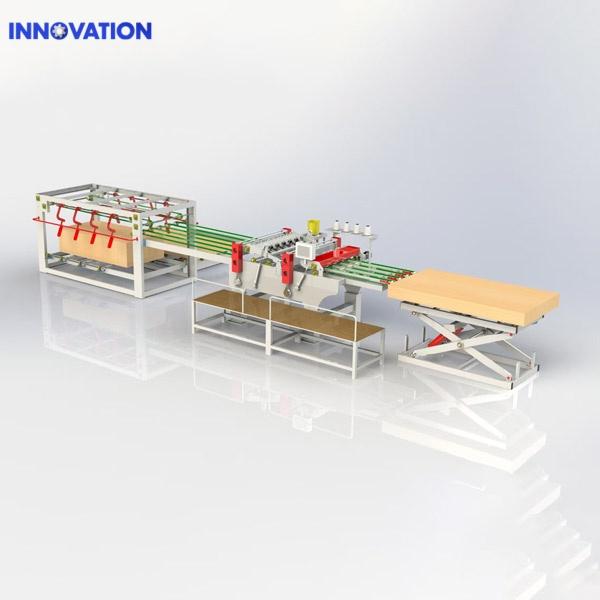
The factory upgraded to a fully automated Core Veneer Composer with finger-joint technology.
Results
- Production increased by 40%
- Material waste dropped to 4%
- Labor reduced from 8 workers to 2
- Core sheet stability significantly improved
This case represents how modern machinery directly elevates overall plywood quality.
Introducing the Core Veneer Composer: Essential Machine for Core Board Production
Core Functions
The composer joins small veneer strips into full-size core sheets with high precision.
This ensures consistent quality across the entire panel production line.
Machine Features
- Veneer thickness: 1.2–4.0 mm
- Veneer width: 50–300 mm
- Output size: 4×8 ft or customized
- Speed: 30–60 m/min
- Finger-joint or butt-joint system
- PLC touchscreen control
- Automatic fault detection
- Precision glue application system
Why It’s Essential
It improves efficiency, reduces waste, enhances quality, and enables stable large-scale production.
Conclusion
High-quality core board is the foundation of strong, stable plywood and engineered panels.
From veneer preparation to advanced finger-joint systems, every step influences the final product.
For factories aiming for higher efficiency, stronger bonding, and lower waste, a Core Veneer Composer has become an indispensable part of modern production.
FAQ
What exactly does core board do in plywood?
It acts as the central support layer that gives plywood strength, thickness, and stability.
Is core board made from scraps or waste veneer?
Often yes — small veneer strips can be joined into full sheets using a composer machine.
How important is moisture content when producing core board?
Very important. Moisture that’s too high can cause warping; too low leads to brittle veneer.
Do finger-joint and butt-joint systems produce different quality?
Finger joints generally offer stronger bonding. Butt joints are faster and suitable for basic applications.
Can a core veneer composer really save labor?
Yes. Most factories reduce staffing by more than 60% after upgrading to automated composing.
What size of veneer can the composer handle?
Common widths range from 50–300 mm, but machines can be customized.
Is it suitable for all plywood factories?
If a factory produces medium to high volumes, upgrading to a composer usually pays back quickly.
How do I maintain a core veneer composer?
Regular cleaning, lubrication, and checking cutter alignment ensures long-term performance.
 English
  Vietnamese
  Arabic