
News
Plywood Hot Press Machine Guide: Complete Industrial Handbook for Modern Plywood Manufacturing
Welcome to My Blog!
I’m so glad you’re here. Before we dive into the content, I’d love to connect with you beyond this page. On my social media, I regularly share industry insights, product updates, and behind-the-scenes moments — plus, it’s a great place for us to interact!
Follow us on Facebook: Shandong Chuangxin Automation Equipment Co., Ltd
Let’s grow together and stay connected. Now, let’s jump into the blog — I hope you find the content informative, engaging, and truly valuable.
Table of Contents
Key Takeaways of This Article
- Understand how a plywood hot press machine works in industrial plywood production
- Learn core structure, hydraulic system, and heating technologies
- Compare single-layer and multi-layer hot press systems
- Review technical specifications and industrial standards
- Evaluate production efficiency, cost structure, and ROI logic
- Understand real-world applications in furniture and construction industries
- Explore buyer-oriented FAQs based on real search intent
What is a Plywood Hot Press Machine?
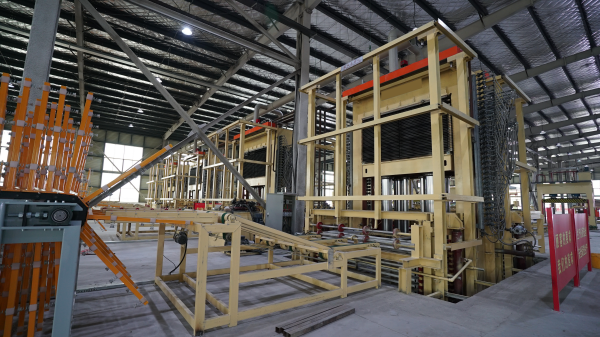
Industrial Definition
A plywood hot press machine is a core equipment in plywood manufacturing that bonds multiple veneer layers under controlled heat and pressure. It activates adhesive resin and transforms loose veneer stacks into solid engineered boards used across furniture, construction, and flooring industries.
This equipment is essential because it directly determines:
- Bonding strength
- Surface flatness
- Structural density
- Long-term durability
Core Functional Concept
Heat Activation System
Heat is applied through steel platens to activate adhesive curing, typically within 120°C–160°C depending on resin type.
Hydraulic Compression System
Hydraulic pressure compresses veneer stacks into a dense and stable board structure, ensuring uniform bonding across the entire surface.
Structural Stabilization Process
After pressing, cooling stabilizes internal stress and prevents warping or deformation during storage and use.
Plywood Hot Press Machine Working Principle
How a Plywood Hot Press Machine Works
The plywood hot press machine applies synchronized heat and pressure to stacked veneer layers, converting them into a rigid plywood panel through adhesive curing and compression.
Main Process Flow
- Veneer preparation and drying
- Glue coating and resin application
- Layer stacking and alignment
- Hot pressing under hydraulic pressure
- Heat curing and bonding
- Cooling and stabilization
- Cutting and finishing
Technical Working Concepts
Thermal Transfer Mechanism
Heat is transferred through thick steel platens using thermal oil or steam systems, ensuring uniform temperature distribution across all layers.
Hydraulic Pressure Control
Multiple hydraulic cylinders maintain consistent force to avoid uneven thickness or delamination issues.
Plywood Hot Press Machine Structure Overview
Main System Components
| Component | Function | Importance |
|---|---|---|
| Steel Frame | Structural support | Critical |
| Hydraulic Cylinders | Pressing force generation | Critical |
| Hot Platens | Heat transfer surface | Critical |
| PLC Control System | Automation control | High |
| Heating System | Thermal energy supply | High |
| Feeding System | Material handling | Medium |
Engineering Design Concept
Heavy-Duty Frame Structure
The frame is built using high-thickness steel plates (commonly 40 mm) to withstand long-term pressure loads without deformation.
Precision Machining Standard
Critical surfaces are machined with high precision to maintain platen flatness within ±0.1 mm tolerance.
Plywood Hot Press Machine Technical Specifications (Industrial Example)
Standard 600T Multi-Platen Model
| Parameter | Specification |
|---|---|
| Total Pressure | 600T |
| Platen Size | 1370 × 2700 mm |
| Number of Platens | 11 layers |
| Platen Thickness | 42 mm |
| Heating Method | Thermal oil |
| Hydraulic Pressure | 26 MPa |
| Control System | PLC automatic control |
| Flatness Accuracy | ≤ 0.1 mm |
| Total Power | 29.5 kW |
Technical Interpretation
Pressure Capacity Design
600T pressure capacity ensures stable compression for medium to large plywood panels in industrial production.
Thermal Oil Heating System
Thermal oil provides stable and uniform heat distribution, reducing temperature fluctuation during long production cycles.
Types of Plywood Hot Press Machine Systems
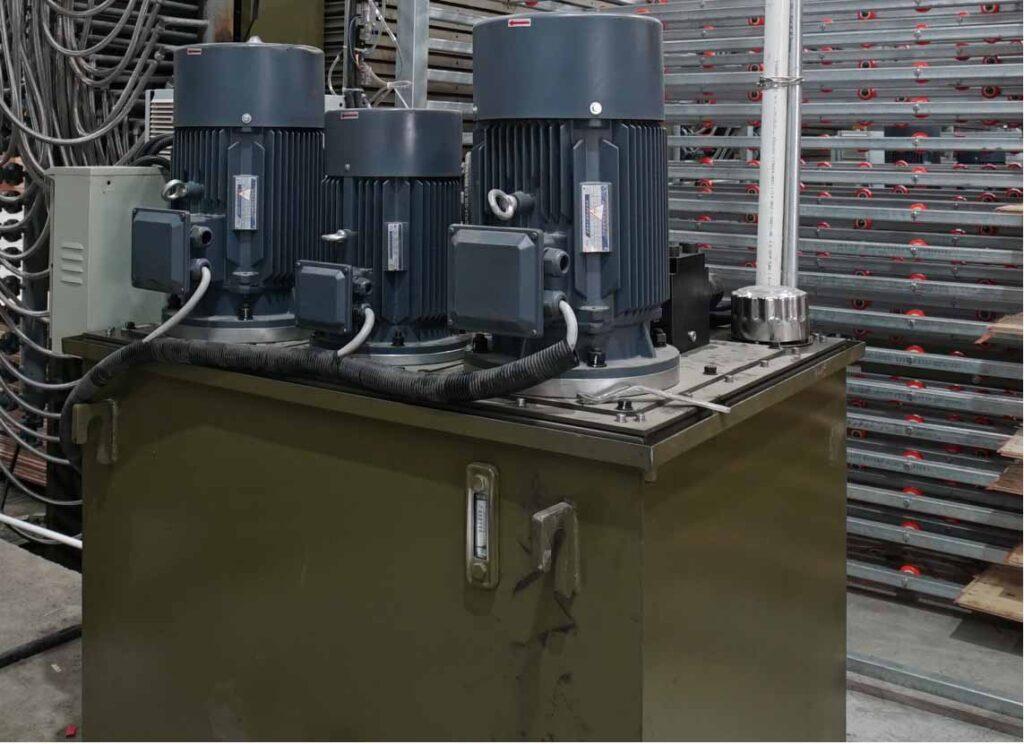
Single-Layer Hot Press Machine
Concept Explanation
A single-layer system presses one plywood board per cycle, suitable for small-scale production environments.
Key Features
- Lower investment cost
- Simple structure
- Easier maintenance
Multi-Layer Hot Press Machine
Concept Explanation
A multi-layer system presses multiple plywood boards simultaneously, significantly increasing production output.
Key Features
- High production efficiency
- Reduced cycle time
- Suitable for mass manufacturing
Comparison Table
| Feature | Single-Layer | Multi-Layer |
|---|---|---|
| Output Efficiency | Medium | Very High |
| Investment Cost | Low | High |
| Automation Level | Medium | High |
| Labor Requirement | Higher | Lower |
| Best Use Case | Small factories | Industrial production |
High-Layer Plywood Hot Press Machine Concept
Multi-Layer Pressing Technology
System Definition
A high-layer hot press machine is designed to press 10–20 veneer stacks simultaneously under synchronized hydraulic control.
Operational Advantage
This design significantly improves production efficiency while maintaining uniform bonding quality across all layers.
Structural Stability Concept
Pressure Balance System
Hydraulic systems distribute pressure evenly across all platens to avoid thickness variation.
Layer Synchronization Mechanism
Each layer receives identical heat and pressure conditions to ensure consistent product quality.
Production Line Integration System
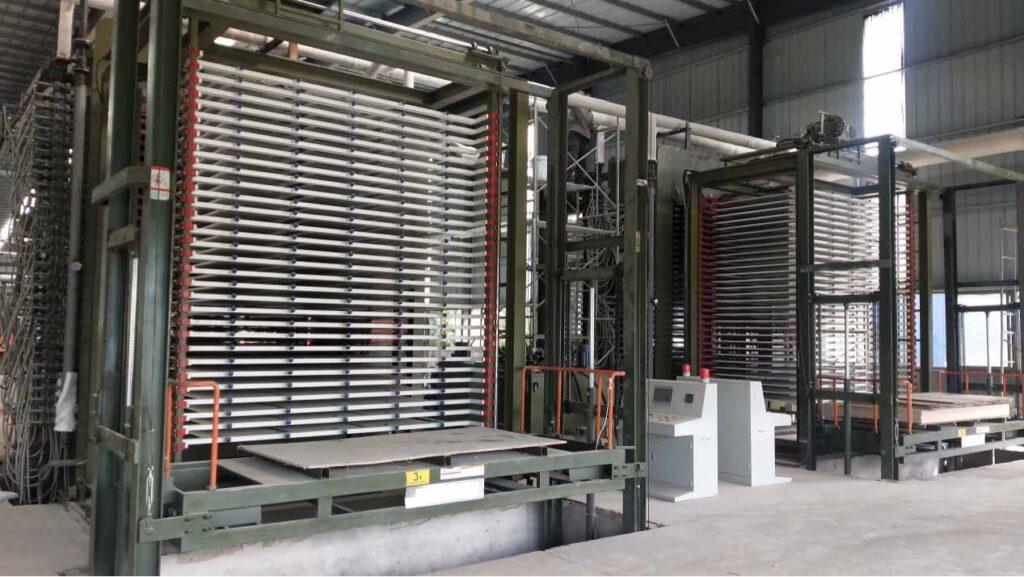
Full Plywood Manufacturing Workflow
Veneer Preparation
Logs are peeled into thin sheets and dried to achieve optimal moisture content (typically 8%–12%).
Glue Application
Adhesive resin is applied using roller coating systems for uniform distribution.
Hot Pressing Stage
This is the core stage where the plywood hot press machine bonds all layers into a single board.
Cooling Process
Boards are cooled to eliminate internal stress and stabilize structure.
Cutting and Finishing
Final boards are trimmed into standard industrial sizes such as 1220 × 2440 mm.
Performance Advantages of Plywood Hot Press Machine
Production Efficiency
Multi-layer systems significantly increase output by processing multiple boards in one cycle, reducing total production time.
Quality Consistency
Uniform heat and pressure ensure strong bonding and minimize defects such as blistering or delamination.
Cost Optimization
Automation reduces labor dependency and material waste, improving overall factory profitability.
Plywood Hot Press Machine vs Cold Press Machine
Functional Comparison
| Feature | Hot Press Machine | Cold Press Machine |
|---|---|---|
| Heat Application | Yes | No |
| Bond Strength | High | Medium |
| Production Speed | Fast | Slow |
| Industrial Use | Mass production | Pre-pressing |
Concept Difference
Hot Press Technology
Uses heat and pressure to accelerate adhesive curing and create permanent bonding.
Cold Press Technology
Applies pressure only, mainly used for pre-shaping before hot pressing.
Energy Consumption Analysis
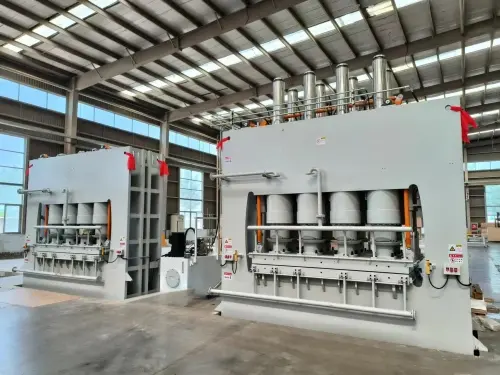
Energy Distribution
- Heating system: 50–60%
- Hydraulic system: 25–30%
- Auxiliary systems: 10–15%
Optimization Methods
- Thermal oil circulation recovery
- PLC intelligent cycle control
- Pressure-based energy adjustment systems
Buyer-Oriented Selection Guide
Key Decision Factors
- Required daily production capacity
- Factory space availability
- Energy infrastructure capability
- Target product thickness range
Common Buyer Questions
“What capacity should I choose?”
Small factories typically choose 5–10 m³/day, while industrial plants exceed 50 m³/day.
“What is the standard plywood thickness range?”
Most machines support 3 mm to 40 mm plywood production.
“Is automation necessary?”
Automation is strongly recommended for large-scale production due to labor cost reduction and stability improvement.
FAQ
What is a plywood hot press machine used for?
It bonds veneer layers into plywood panels using heat and hydraulic pressure in industrial production lines.
What temperature is required in hot pressing?
Typical operating range is 120°C–160°C depending on adhesive type and production requirements.
How long is one pressing cycle?
Usually 3 to 8 minutes depending on board thickness and resin formulation.
What is the lifespan of the machine?
With proper maintenance, industrial systems can operate for 10–20 years.
What is the main difference between multi-layer and single-layer machines?
Multi-layer machines increase output by pressing multiple boards simultaneously, improving efficiency significantly.
Conclusion
A plywood hot press machine is a core industrial system in modern plywood manufacturing, directly influencing production efficiency, product quality, and overall profitability.
With increasing global demand for engineered wood products, manufacturers are shifting toward automated multi-layer systems to achieve higher output, lower operational cost, and stable product quality. Investing in the right system is a strategic decision that determines long-term competitiveness in the wood-based panel industry.
 English
  Vietnamese
  Arabic