
News
Plywood Manufacturing: A Complete Guide from Veneer to Finished Panel
Welcome to My Blog!
I’m so glad you’re here. Before we dive into the content, I’d love to connect with you beyond this page. On my social media, I regularly share industry insights, product updates, and behind-the-scenes moments — plus, it’s a great place for us to interact!
Follow us on Facebook: Shandong Chuangxin Automation Equipment Co., Ltd
Let’s grow together and stay connected. Now, let’s jump into the blog — I hope you find the content informative, engaging, and truly valuable.
Table of Contents
Introduction
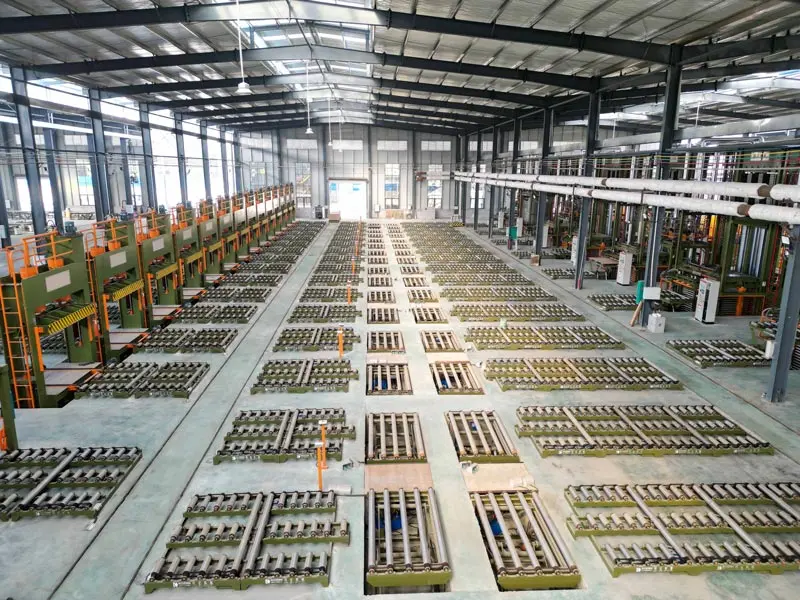
Plywood manufacturing is a highly engineered wood processing method that transforms thin veneer layers into strong, stable, and versatile panels. By cross-laminating veneers with adhesive and applying controlled pressure and heat, plywood achieves superior dimensional stability, strength, and durability compared to solid wood.
From construction and furniture to decorative panels and packaging, plywood plays a vital role across industries. In this guide, we explore the complete plywood manufacturing process—from raw veneer preparation to pressing, trimming, sanding, and surface finishing—while highlighting the key machines, technologies, and quality control elements that ensure consistent panel performance.
The Importance of Plywood in Modern Wood Processing
Plywood has become one of the most widely used engineered wood products in modern wood processing due to its structural stability, efficient resource utilization, and adaptability across industries.
Unlike solid wood panels, plywood is designed through controlled layering and bonding, making it highly suitable for large-scale manufacturing and long-term performance.
Why Plywood Matters
Structural Stability Through Layered Design
Plywood manufacturing relies on cross-laminated veneer layers, where the grain direction alternates between layers.
This structure significantly reduces internal stress caused by moisture changes, helping panels stay flat over time.
Efficient Use of Wood Resources
By peeling logs into thin veneers, plywood manufacturing maximizes usable wood volume.
Even smaller-diameter logs or fast-growing species can be transformed into high-performance panels.
Consistency for Mass Production
Plywood panels are manufactured under controlled conditions, resulting in consistent thickness, strength, and bonding quality—essential for furniture and construction industries.
Have you ever wondered why plywood floors or cabinet panels remain stable for years while solid wood boards may warp or split?
The answer lies in veneer orientation, adhesive bonding, and precise hot-pressing technology used in plywood manufacturing.
Applications Across Industries
Plywood is used extensively in:
- Construction: Flooring, wall sheathing, roofing
- Furniture Manufacturing: Cabinets, shelves, tables
- Interior Decoration: Laminated and veneered panels
- Packaging & Transport: Crates, pallets
- Industrial Uses: Vehicle floors, formwork panels
Each application requires specific plywood grades, thicknesses, and surface qualities—making manufacturing precision essential.
Raw Materials in Plywood Production
Veneer as the Core Material
Veneer is the fundamental raw material in plywood manufacturing.
It is typically produced by rotary peeling logs into continuous thin sheets, allowing efficient material use and uniform thickness control.
Veneer quality directly affects:
- Panel strength
- Surface appearance
- Bonding reliability
Types of Veneers Used in Plywood
Face Veneer
Face veneer determines surface appearance and visual quality.
It is usually selected from higher-grade wood species with fewer defects.
Core Veneer
Core veneer provides structural strength and thickness.
It may contain repaired or composed sections without compromising overall panel performance.
Back Veneer
Back veneer balances internal stress and ensures panel stability.
Its primary role is structural balance rather than appearance.
Would using narrow or defective veneer strips reduce plywood quality?
Not necessarily—modern plywood manufacturing uses specialized equipment to recombine veneers efficiently.
Not necessarily—with the right equipment, even small veneer pieces can be efficiently reused.
Core Veneer Composition: Maximizing Material Efficiency
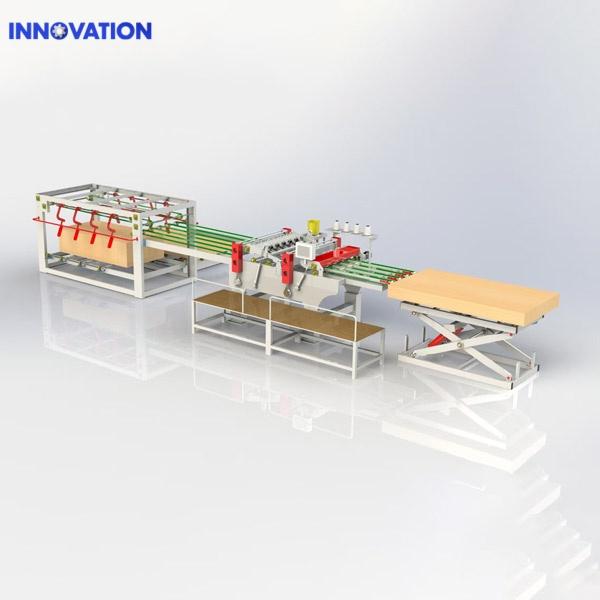
What Is a Core Veneer Composer?
A core veneer composer is a machine designed to join narrow, short, or defect-cut veneer strips into full-size core sheets.
This process plays a vital role in sustainable plywood manufacturing.
How Core Veneer Composition Works
The process generally includes veneer alignment, edge trimming, glue application, and pressing to form uniform sheets.
Advanced systems ensure accurate thickness and stable bonding across the entire panel.
Benefits of Core Veneer Composition
- Maximizes wood utilization
- Reduces raw material waste
- Lowers overall production costs
- Maintains consistent panel thickness
By using veneer composition technology, plywood manufacturers can increase yield without sacrificing structural integrity.
Glue Application: The Foundation of Strong Bonding
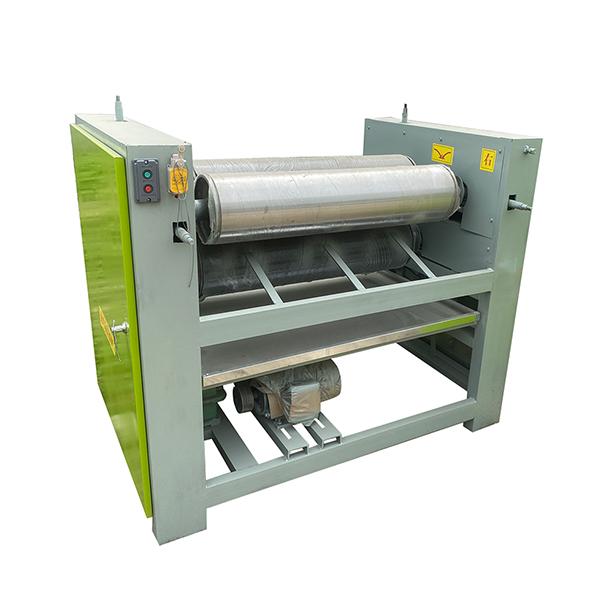
Glue Spreader in Plywood Manufacturing
The glue spreader applies a controlled and uniform adhesive layer onto veneer surfaces before assembly.
Why glue spreading matters:
- Ensures consistent bonding strength
- Prevents delamination
- Reduces adhesive waste
- Improves pressing efficiency
Modern glue spreaders feature adjustable roller systems, precise glue thickness control, and high-speed operation—making them essential for stable plywood quality.
Veneer Assembly and Paving Process
Automatic Plywood Paving Machine

An automatic plywood paving machine stacks glued veneers in the correct sequence and orientation before pressing.
It replaces manual stacking with precise, repeatable automation—essential for modern plywood manufacturing lines.
Core Functions of a Plywood Paving Machine
- Automated veneer feeding to reduce labor dependency
- Precise layer positioning controlled by PLC systems
- Optional cutting and trimming integration
- Continuous conveyor transport for stable output
Why Automated Paving Matters
Manual stacking may work for small workshops, but it cannot meet the speed and accuracy requirements of high-volume plywood manufacturing.
Automated paving machines significantly reduce human error while improving layer consistency across every panel.
Manual vs Automatic Veneer Paving: A Practical Comparison
| Aspect | Manual Stacking | Automatic Paving Machine |
|---|---|---|
| Production Speed | Low | High |
| Layer Alignment Accuracy | Operator-dependent | PLC-controlled |
| Labor Requirement | High | Low |
| Panel Consistency | Inconsistent | Highly consistent |
| Suitability for Mass Production | Limited | Ideal |
This comparison explains why automated paving systems are now standard in medium and large plywood factories.
Cold Pressing: Stabilizing Veneers Before Hot Pressing
Plywood Cold Press Machine Overview
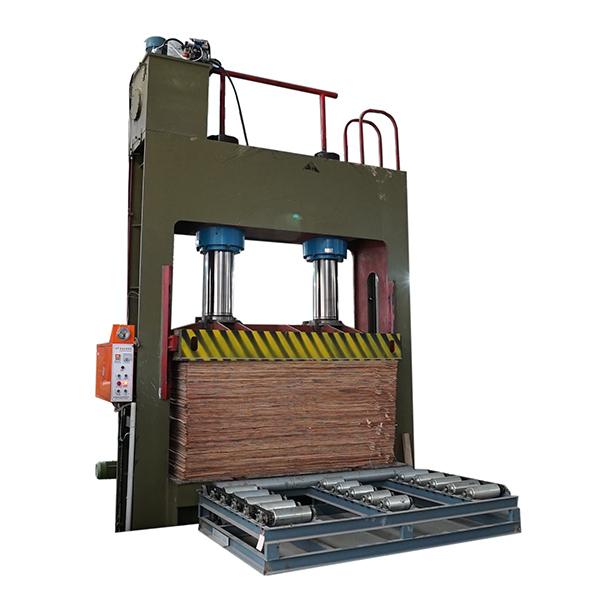
Cold pressing is the preliminary pressing stage in plywood production. It stabilizes glued veneers before they enter the hot press.
Cold Press Workflow
- Glued veneer panel loading
- Uniform hydraulic pressure application
- Holding time for initial bonding
- Panel release and unloading
Why Cold Pressing Is Essential
- Removes air bubbles
- Prevents veneer misalignment
- Improves panel flatness
- Reduces defects during hot pressing
Cold pressing enhances both quality and production efficiency, especially in multi-layer plywood manufacturing.
Hot Pressing: Final Bonding and Curing
Plywood Hot Press Machine
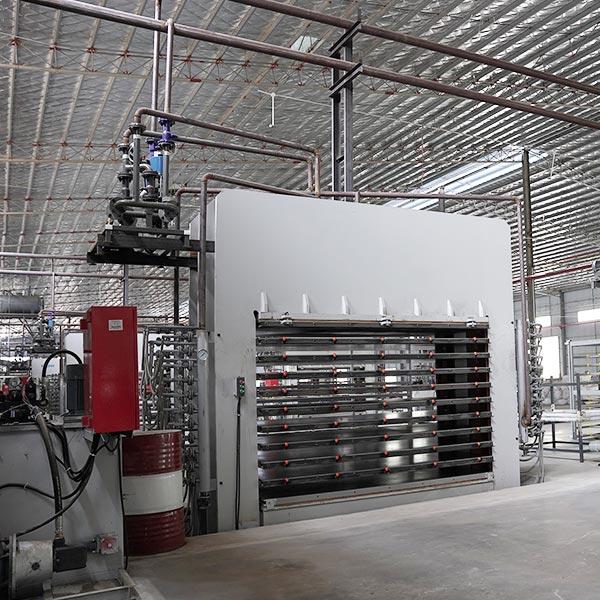
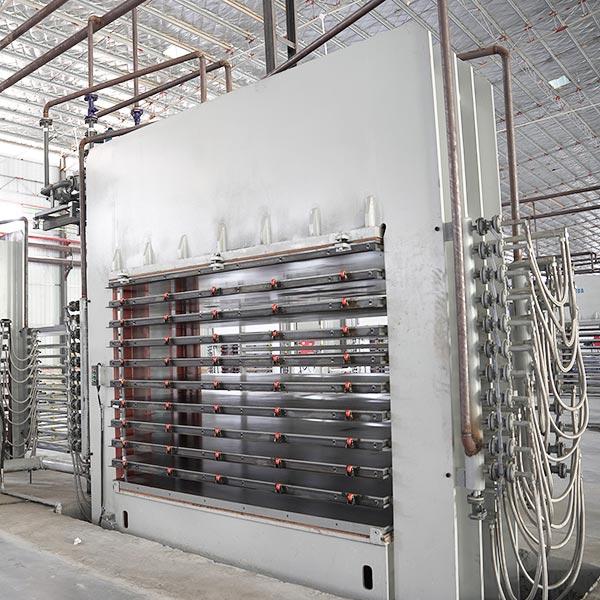
Hot pressing is the most critical stage in plywood manufacturing, where heat and pressure permanently cure adhesives and define panel structure.
This step determines final strength, density, and surface quality.
Key Hot Press Features Explained
Temperature and Pressure Control
Accurate control ensures adhesives cure evenly without overheating veneers.
Multi-stage pressure profiles help prevent surface defects.
Multi-Platen Structure
Multiple press openings allow simultaneous panel processing, dramatically increasing output.
This design is ideal for continuous plywood manufacturing lines.
Heating Systems
Thermal oil or steam heating provides uniform temperature distribution across platens, ensuring consistent bonding.
Benefits of Hot Pressing in Industrial Production
- Strong and durable adhesive curing
- Smooth and uniform panel surfaces
- Stable thickness and density control
- High production efficiency per shift
Would investing in a multi-platen hot press double production capacity?
For medium to large plywood manufacturing plants, hot presses significantly reduce unit costs while improving consistency.
Edge Trimming: Achieving Dimensional Accuracy
Edge Trimming Machine

After pressing, plywood panels are trimmed to exact dimensions.
Advantages
- High-precision cutting
- Smooth, clean edges
- Automated feeding and control
- Improved panel consistency
Edge trimming ensures panels meet international size standards and improves their appearance for downstream processing.
Sanding and Surface Finishing
Plywood Sanding Machine
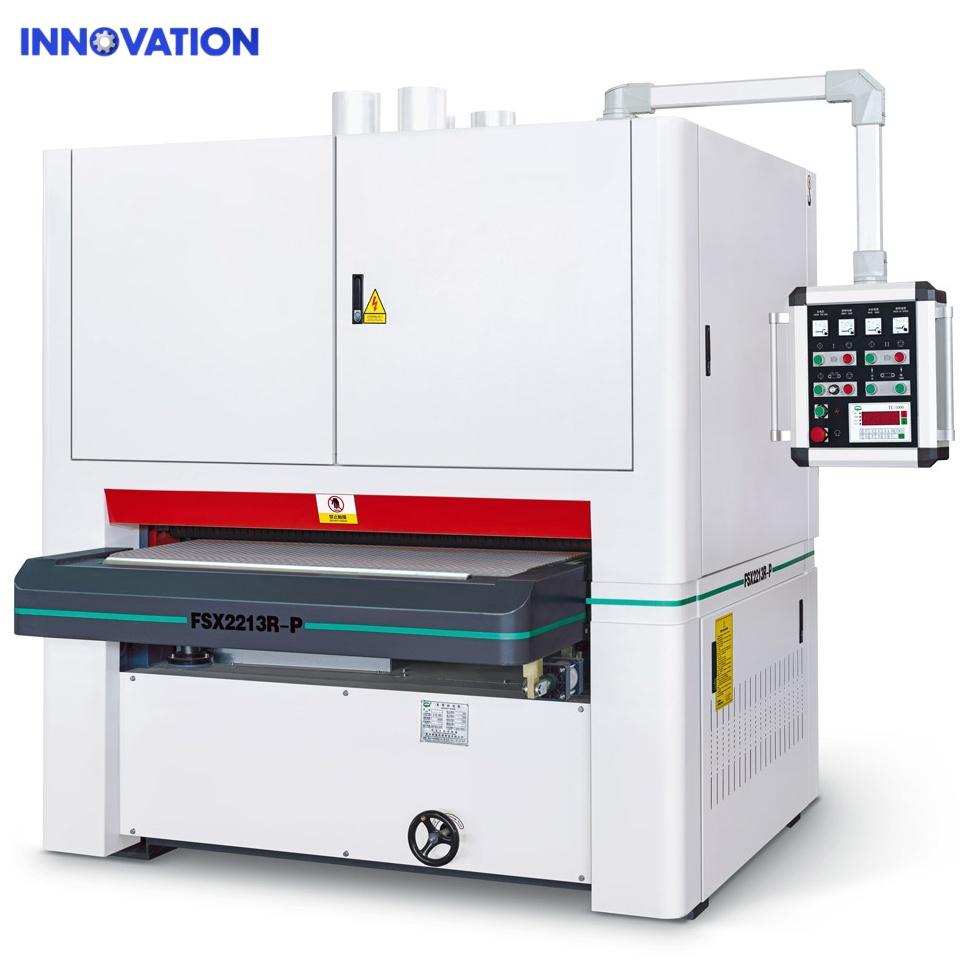
Sanding refines surface smoothness and thickness uniformity.
Key Characteristics
Rigid Machine Structure
A heavy-duty frame minimizes vibration and ensures stable sanding accuracy over long operating hours.
Multi-Roller Sanding System
Multiple sanding rollers allow gradual material removal, reducing surface damage.
Controlled Feeding Speed
Frequency-controlled conveyors ensure consistent sanding quality for panels of varying thicknesses.
Digital Operation Interface
Touch-screen controls allow precise adjustment and real-time monitoring during plywood manufacturing.
Proper sanding reduces surface defects, enhances visual quality, and prepares panels for decorative or protective finishes.
Surface Repair and Putty Application
Plywood Putty Spreader Machine

Small cracks, holes, and surface imperfections are corrected using an automatic putty spreader.
Benefits
- Uniform putty application
- Reduced manual labor
- Improved surface flatness
- Better finishing results
Automated putty spreading ensures consistent quality and reduces sanding workload later.
Quality Control in Plywood Manufacturing
Key quality elements include:
- Veneer moisture control
- Bonding strength testing
- Thickness and flatness inspection
- Surface defect evaluation
Would you pay more for plywood with stricter quality control?
Higher-quality panels reduce installation issues, maintenance costs, and replacement risks.
Environmental and Sustainability Considerations
Modern plywood production emphasizes sustainability:
- Efficient use of veneer waste
- Reduced adhesive consumption
- Energy-efficient pressing systems
- Automated production to minimize errors
Engineered plywood products help maximize wood resources and support responsible forestry practices.
Future Trends in Plywood Manufacturing
Emerging Innovations
- AI-controlled pressing systems
- Smart monitoring and fault diagnosis
- Advanced engineered wood panels
- Higher automation and lower labor dependency
Would you choose engineered plywood over solid wood for long-term projects?
For stability, efficiency, and sustainability, plywood remains a preferred solution.
FAQ
What is plywood manufacturing and how is it different from solid wood production?
Plywood manufacturing involves bonding multiple wood veneers together with adhesives under heat and pressure.
Unlike solid wood, plywood uses cross-layer construction, which improves dimensional stability and reduces warping, cracking, and shrinkage.
Why does plywood stay flatter than solid wood over time?
Plywood remains flat because each veneer layer is placed with alternating grain directions.
This structure balances internal stresses caused by moisture changes, making plywood manufacturing ideal for flooring, furniture panels, and construction uses.
Is plywood manufacturing more sustainable than using solid wood?
Yes, plywood manufacturing makes more efficient use of wood resources.
Thin veneers can be peeled from logs with minimal waste, and smaller or lower-grade timber can still be converted into high-performance panels.
What role does pressing play in plywood manufacturing quality?
Pressing is critical in plywood manufacturing because it permanently bonds veneer layers.
Cold pressing stabilizes the panel structure, while hot pressing cures adhesives and defines final strength, thickness, and surface quality.
How do I choose the right plywood for my project?
The right plywood depends on application requirements such as load-bearing needs, moisture exposure, and surface finish.
Construction projects often require structural-grade plywood, while furniture manufacturing focuses more on surface quality and thickness consistency.
Conclusion
Plywood manufacturing is a sophisticated wood processing system that integrates material science, mechanical engineering, and automation. From veneer composition and glue spreading to cold pressing, hot pressing, trimming, sanding, and finishing, every stage plays a crucial role in final panel quality.
By investing in advanced plywood machinery and optimized production workflows, manufacturers can achieve higher efficiency, consistent quality, and sustainable growth. Understanding each element of plywood production allows professionals to make smarter decisions and build stronger, more reliable wood products.
 English
  Vietnamese
  Arabic